

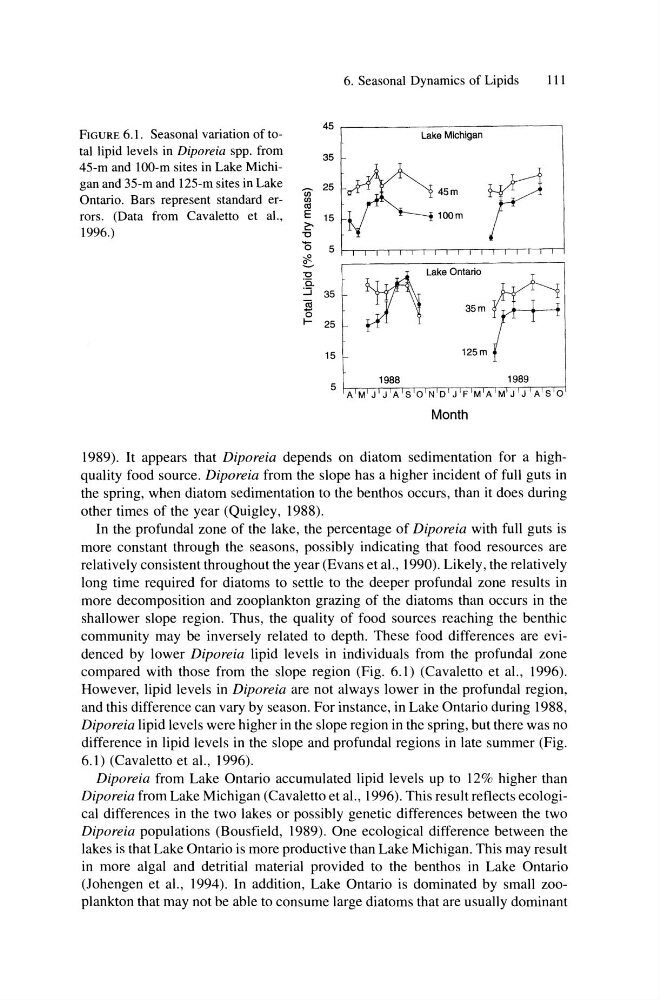
FIGURE 6.1. Seasonal variation of total lipid levels in Diporeia spp. from
45-m and lOO-m sites in Lake Michigan and 35-m and 125-m sites in Lake
Ontario. Bars represent standard errors. (Data from Cavaletto et aI.,
1996.)
Cil
l\l
E
~
"C
'0
~
"C
'0.
45
35
25
15
5
::::i 35
-I-~
25
15
6. Seasonal Dynamics of Lipids
111
Lake Michigan
~~m
100m
~
~T Lake Ontario f
r-f¥ 1
35m
125m
1988
1989
5 AMJJASONDJFMAMJJASO
Month
1989). It appears that Diporeia depends on diatom sedimentation for a highquality food source. Diporeia from the slope has a higher incident of full guts in
the spring, when diatom sedimentation to the benthos occurs, than it does during
other times of the year (Quigley, 1988).
In the profundal zone of the lake, the percentage of Diporeia with full guts is
more constant through the seasons, possibly indicating that food resources are
relatively consistent throughout the year (Evans et aI., 1990). Likely, the relatively
long time required for diatoms to settle to the deeper profundal zone results in
more decomposition and zooplankton grazing of the diatoms than occurs in the
shallower slope region. Thus, the quality of food sources reaching the benthic
community may be inversely related to depth. These food differences are evidenced by lower Diporeia lipid levels in individuals from the profunda! zone
compared with those from the slope region (Fig. 6.1) (Cavaletto et aI., 1996).
However, lipid levels in Diporeia are not always lower in the profundal region,
and this difference can vary by season. For instance, in Lake Ontario during 1988,
Diporeia lipid levels were higher in the slope region in the spring, but there was no
difference in lipid levels in the slope and profundal regions in late summer (Fig.
6.1) (Cavaletto et aI., 1996).
Diporeia from Lake Ontario accumulated lipid levels up to 12% higher than
Diporeia from Lake Michigan (Cavaletto et aI., 1996). This result reflects ecological differences in the two lakes or possibly genetic differences between the two
Diporeia popUlations (Bousfield, 1989). One ecological difference between the
lakes is that Lake Ontario is more productive than Lake Michigan. This may result
in more algal and detritial material provided to the benthos in Lake Ontario
(Johengen et aI., 1994). In addition, Lake Ontario is dominated by small zooplankton that may not be able to consume large diatoms that are usually dominant
45-m and lOO-m sites in Lake Michigan and 35-m and 125-m sites in Lake
Ontario. Bars represent standard errors. (Data from Cavaletto et aI.,
1996.)
Cil
l\l
E
~
"C
'0
~
"C
'0.
45
35
25
15
5
::::i 35
-I-~
25
15
6. Seasonal Dynamics of Lipids
111
Lake Michigan
~~m
100m
~
~T Lake Ontario f
r-f¥ 1
35m
125m
1988
1989
5 AMJJASONDJFMAMJJASO
Month
1989). It appears that Diporeia depends on diatom sedimentation for a highquality food source. Diporeia from the slope has a higher incident of full guts in
the spring, when diatom sedimentation to the benthos occurs, than it does during
other times of the year (Quigley, 1988).
In the profundal zone of the lake, the percentage of Diporeia with full guts is
more constant through the seasons, possibly indicating that food resources are
relatively consistent throughout the year (Evans et aI., 1990). Likely, the relatively
long time required for diatoms to settle to the deeper profundal zone results in
more decomposition and zooplankton grazing of the diatoms than occurs in the
shallower slope region. Thus, the quality of food sources reaching the benthic
community may be inversely related to depth. These food differences are evidenced by lower Diporeia lipid levels in individuals from the profunda! zone
compared with those from the slope region (Fig. 6.1) (Cavaletto et aI., 1996).
However, lipid levels in Diporeia are not always lower in the profundal region,
and this difference can vary by season. For instance, in Lake Ontario during 1988,
Diporeia lipid levels were higher in the slope region in the spring, but there was no
difference in lipid levels in the slope and profundal regions in late summer (Fig.
6.1) (Cavaletto et aI., 1996).
Diporeia from Lake Ontario accumulated lipid levels up to 12% higher than
Diporeia from Lake Michigan (Cavaletto et aI., 1996). This result reflects ecological differences in the two lakes or possibly genetic differences between the two
Diporeia popUlations (Bousfield, 1989). One ecological difference between the
lakes is that Lake Ontario is more productive than Lake Michigan. This may result
in more algal and detritial material provided to the benthos in Lake Ontario
(Johengen et aI., 1994). In addition, Lake Ontario is dominated by small zooplankton that may not be able to consume large diatoms that are usually dominant