

79
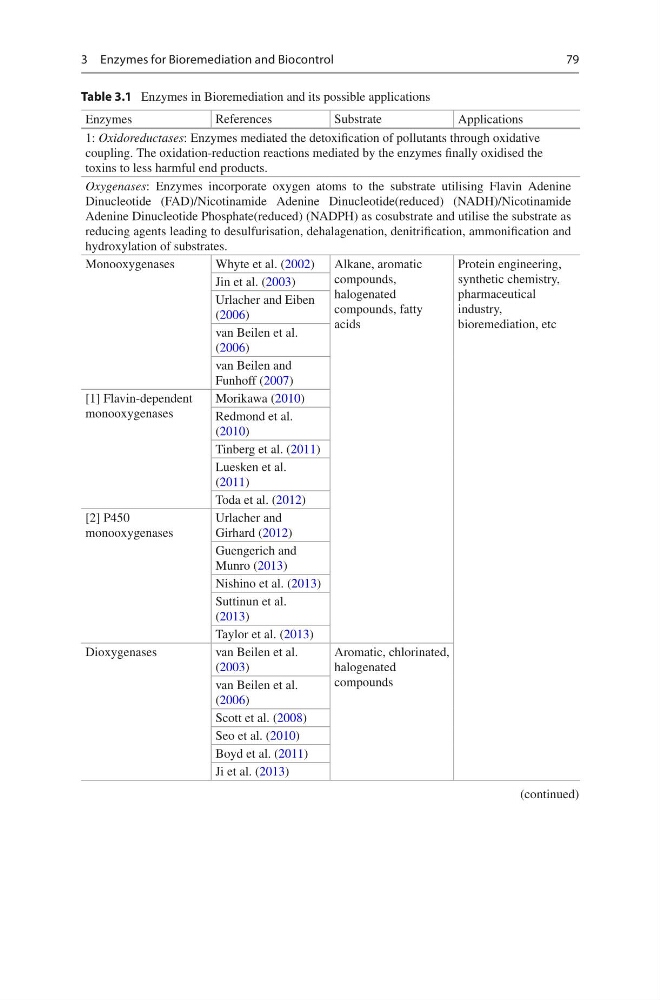
Table 3.1 Enzymes in Bioremediation and its possible applications
Enzymes
References
Substrate
Applications
1: Oxidoreductases: Enzymes mediated the detoxification of pollutants through oxidative
coupling. The oxidation-reduction reactions mediated by the enzymes finally oxidised the
toxins to less harmful end products.
Oxygenases: Enzymes incorporate oxygen atoms to the substrate utilising Flavin Adenine
Dinucleotide (FAD)/Nicotinamide Adenine Dinucleotide(reduced) (NADH)/Nicotinamide
Adenine Dinucleotide Phosphate(reduced) (NADPH) as cosubstrate and utilise the substrate as
reducing agents leading to desulfurisation, dehalagenation, denitrification, ammonification and
hydroxylation of substrates.
Monooxygenases
Whyte et al. (2002)
Alkane, aromatic
compounds,
halogenated
compounds, fatty
acids
Protein engineering,
synthetic chemistry,
pharmaceutical
industry,
bioremediation, etc
Jin et al. (2003)
Urlacher and Eiben
(2006)
van Beilen et al.
(2006)
van Beilen and
Funhoff (2007)
[1] Flavin-dependent
monooxygenases
Morikawa (2010)
Redmond et al.
(2010)
Tinberg et al. (2011)
Luesken et al.
(2011)
Toda et al. (2012)
[2] P450
monooxygenases
Urlacher and
Girhard (2012)
Guengerich and
Munro (2013)
Nishino et al. (2013)
Suttinun et al.
(2013)
Taylor et al. (2013)
Dioxygenases
van Beilen et al.
(2003)
Aromatic, chlorinated,
halogenated
compounds
van Beilen et al.
(2006)
Scott et al. (2008)
Seo et al. (2010)
Boyd et al. (2011)
Ji et al. (2013)
(continued)
3 Enzymes for Bioremediation and Biocontrol
Table 3.1 Enzymes in Bioremediation and its possible applications
Enzymes
References
Substrate
Applications
1: Oxidoreductases: Enzymes mediated the detoxification of pollutants through oxidative
coupling. The oxidation-reduction reactions mediated by the enzymes finally oxidised the
toxins to less harmful end products.
Oxygenases: Enzymes incorporate oxygen atoms to the substrate utilising Flavin Adenine
Dinucleotide (FAD)/Nicotinamide Adenine Dinucleotide(reduced) (NADH)/Nicotinamide
Adenine Dinucleotide Phosphate(reduced) (NADPH) as cosubstrate and utilise the substrate as
reducing agents leading to desulfurisation, dehalagenation, denitrification, ammonification and
hydroxylation of substrates.
Monooxygenases
Whyte et al. (2002)
Alkane, aromatic
compounds,
halogenated
compounds, fatty
acids
Protein engineering,
synthetic chemistry,
pharmaceutical
industry,
bioremediation, etc
Jin et al. (2003)
Urlacher and Eiben
(2006)
van Beilen et al.
(2006)
van Beilen and
Funhoff (2007)
[1] Flavin-dependent
monooxygenases
Morikawa (2010)
Redmond et al.
(2010)
Tinberg et al. (2011)
Luesken et al.
(2011)
Toda et al. (2012)
[2] P450
monooxygenases
Urlacher and
Girhard (2012)
Guengerich and
Munro (2013)
Nishino et al. (2013)
Suttinun et al.
(2013)
Taylor et al. (2013)
Dioxygenases
van Beilen et al.
(2003)
Aromatic, chlorinated,
halogenated
compounds
van Beilen et al.
(2006)
Scott et al. (2008)
Seo et al. (2010)
Boyd et al. (2011)
Ji et al. (2013)
(continued)
3 Enzymes for Bioremediation and Biocontrol