

59
2.5
Enzymes for Wound Debridement
Cleansing and wound debridement are common practices in wound bed preparation
from ancient times. Debridement is removal of foreign material, non-viable tissue,
excess wound moisture and contaminants from the wound bed until healthy tissue
gets exposed. Debridement can be by means of mechanical, chemical (enzymatic),
autolytic and surgical methods. Removing necrotic tissue by debridement helps in
the healing process and enzymatic wound debridement has many advantages.
Enzymatic wound healing is a selective debridement process by which proteolytic
enzymes help to remove the necrotic tissue. Proteases from various sources were
used for debriding purposes. A few of the debriding agents are considered here such
as bacterial collagenase, papain/urea and trypsin.
2.5.1 Collagenase
Collagenase is a proteolytic enzyme that could degrade collagen. It is proteinase
specific to collagen which has a triple helical structure whereas none of the other
proteinases cleave collagen. Collagen binds to necrotic tissue at the wound surface
and dissolutes collagen and thus facilitates wound healing. It is obtained from
Clostridium histolyticum and is commercially available as Santyl
®
(McCallon et al.
2014) with an optimum pH between 6 and 8. Dupuytren’s contracture and Peyronie’s
disease are often associated with trauma and deposition of collagen plaques.
Collagenase is an FDA-approved drug for treating Dupuytren’s contracture and
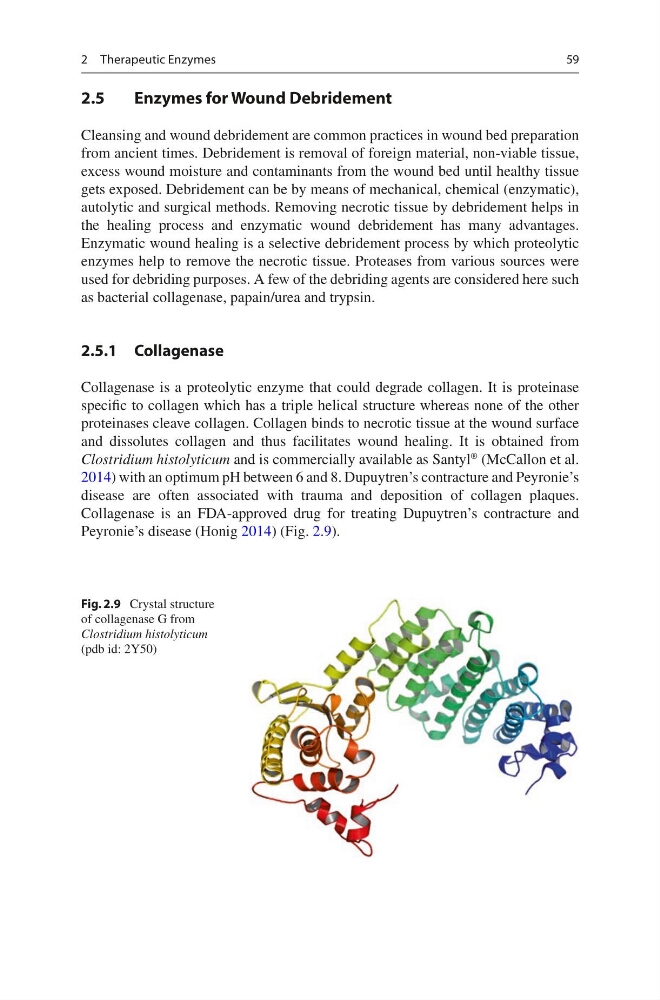
Peyronie’s disease (Honig 2014) (Fig. 2.9).
Fig. 2.9 Crystal structure
of collagenase G from
Clostridium histolyticum
(pdb id: 2Y50)
2 Therapeutic Enzymes
2.5
Enzymes for Wound Debridement
Cleansing and wound debridement are common practices in wound bed preparation
from ancient times. Debridement is removal of foreign material, non-viable tissue,
excess wound moisture and contaminants from the wound bed until healthy tissue
gets exposed. Debridement can be by means of mechanical, chemical (enzymatic),
autolytic and surgical methods. Removing necrotic tissue by debridement helps in
the healing process and enzymatic wound debridement has many advantages.
Enzymatic wound healing is a selective debridement process by which proteolytic
enzymes help to remove the necrotic tissue. Proteases from various sources were
used for debriding purposes. A few of the debriding agents are considered here such
as bacterial collagenase, papain/urea and trypsin.
2.5.1 Collagenase
Collagenase is a proteolytic enzyme that could degrade collagen. It is proteinase
specific to collagen which has a triple helical structure whereas none of the other
proteinases cleave collagen. Collagen binds to necrotic tissue at the wound surface
and dissolutes collagen and thus facilitates wound healing. It is obtained from
Clostridium histolyticum and is commercially available as Santyl
®
(McCallon et al.
2014) with an optimum pH between 6 and 8. Dupuytren’s contracture and Peyronie’s
disease are often associated with trauma and deposition of collagen plaques.
Collagenase is an FDA-approved drug for treating Dupuytren’s contracture and
Peyronie’s disease (Honig 2014) (Fig. 2.9).
Fig. 2.9 Crystal structure
of collagenase G from
Clostridium histolyticum
(pdb id: 2Y50)
2 Therapeutic Enzymes