

58
insufficiency. It is one of the most common gastrointestinal disorders. Elimination
of milk and dairy products is a common practice to overcome lactose intolerance.
But lactose is an excellent source of energy, and avoiding milk products leads to
malnutrition, especially calcium and mineral deficiency. Management of lactose
intolerance is achieved by enzyme supplementation therapy. β-galactosidase
enzymes obtained from various sources are used for this. The sources include yeasts
such as Kluyveromyces fragilis and K. lactis, fungi such as Aspergillus niger and
A. oryzae, and bacteria such as Bacillus coagulans. Another approach to overcome
lactose intolerance is supplementation of dairy along with probiotics. In probiotics
some of the microorganisms producing β-galactosidase are present such as
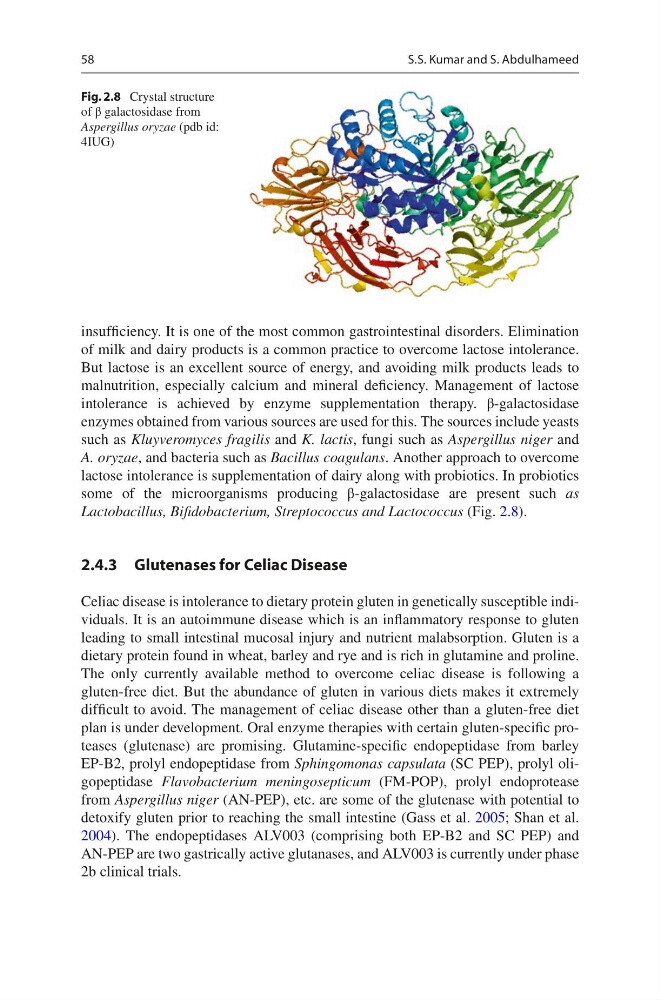
Lactobacillus, Bifidobacterium, Streptococcus and Lactococcus (Fig. 2.8).
2.4.3 Glutenases for Celiac Disease
Celiac disease is intolerance to dietary protein gluten in genetically susceptible individuals. It is an autoimmune disease which is an inflammatory response to gluten
leading to small intestinal mucosal injury and nutrient malabsorption. Gluten is a
dietary protein found in wheat, barley and rye and is rich in glutamine and proline.
The only currently available method to overcome celiac disease is following a
gluten- free diet. But the abundance of gluten in various diets makes it extremely
difficult to avoid. The management of celiac disease other than a gluten-free diet
plan is under development. Oral enzyme therapies with certain gluten-specific proteases (glutenase) are promising. Glutamine-specific endopeptidase from barley
EP-B2, prolyl endopeptidase from Sphingomonas capsulata (SC PEP), prolyl oligopeptidase Flavobacterium meningosepticum (FM-POP), prolyl endoprotease
from Aspergillus niger (AN-PEP), etc. are some of the glutenase with potential to
detoxify gluten prior to reaching the small intestine (Gass et al. 2005; Shan et al.
2004). The endopeptidases ALV003 (comprising both EP-B2 and SC PEP) and
AN-PEP are two gastrically active glutanases, and ALV003 is currently under phase
2b clinical trials.
Fig. 2.8 Crystal structure
of β galactosidase from
Aspergillus oryzae (pdb id:
4IUG)
S.S. Kumar and S. Abdulhameed
insufficiency. It is one of the most common gastrointestinal disorders. Elimination
of milk and dairy products is a common practice to overcome lactose intolerance.
But lactose is an excellent source of energy, and avoiding milk products leads to
malnutrition, especially calcium and mineral deficiency. Management of lactose
intolerance is achieved by enzyme supplementation therapy. β-galactosidase
enzymes obtained from various sources are used for this. The sources include yeasts
such as Kluyveromyces fragilis and K. lactis, fungi such as Aspergillus niger and
A. oryzae, and bacteria such as Bacillus coagulans. Another approach to overcome
lactose intolerance is supplementation of dairy along with probiotics. In probiotics
some of the microorganisms producing β-galactosidase are present such as
Lactobacillus, Bifidobacterium, Streptococcus and Lactococcus (Fig. 2.8).
2.4.3 Glutenases for Celiac Disease
Celiac disease is intolerance to dietary protein gluten in genetically susceptible individuals. It is an autoimmune disease which is an inflammatory response to gluten
leading to small intestinal mucosal injury and nutrient malabsorption. Gluten is a
dietary protein found in wheat, barley and rye and is rich in glutamine and proline.
The only currently available method to overcome celiac disease is following a
gluten- free diet. But the abundance of gluten in various diets makes it extremely
difficult to avoid. The management of celiac disease other than a gluten-free diet
plan is under development. Oral enzyme therapies with certain gluten-specific proteases (glutenase) are promising. Glutamine-specific endopeptidase from barley
EP-B2, prolyl endopeptidase from Sphingomonas capsulata (SC PEP), prolyl oligopeptidase Flavobacterium meningosepticum (FM-POP), prolyl endoprotease
from Aspergillus niger (AN-PEP), etc. are some of the glutenase with potential to
detoxify gluten prior to reaching the small intestine (Gass et al. 2005; Shan et al.
2004). The endopeptidases ALV003 (comprising both EP-B2 and SC PEP) and
AN-PEP are two gastrically active glutanases, and ALV003 is currently under phase
2b clinical trials.
Fig. 2.8 Crystal structure
of β galactosidase from
Aspergillus oryzae (pdb id:
4IUG)
S.S. Kumar and S. Abdulhameed