

389
carbohydrates and the risk of acne (Bowe and Logan 2010). Research also indicated
the connection between glucose tolerance and gut microflora (Kleerebezem and
Vaughan 2009a, b).
The capability of probiotic bacteria for delivering functional proteins and
enzymes was also recorded. People with lactose intolerance can be treated with
probiotic-mediated delivery of the enzyme that converts lactose into glucose and
galactose. Some such enzymes can help to digest food, thus creating beneficial end
products. Braat et al. (2006) reported successful use of genetically engineered
Lactococcus to treat Crohn’s patients by delivering the cytokine IL-10 to reduce
intestinal tract inflammation.
16.6 Diversity in Probiotic Organisms and Fermented
Products
Species of Lactobacillus have been commonly used for treating a large variety of
diseases; nearly 50 species of lactobacilli are found in fermented dietary supplements. These species include Lactobacillus acidophilus, L. bulgaricus, L. casei, L.
gasseri, L. johnsonii, L. plantarum, L. rhamnosus, L. reuteri, and L. salivarius in
food supplements (Vemuri et al. 2014). The types of probiotics most widely used
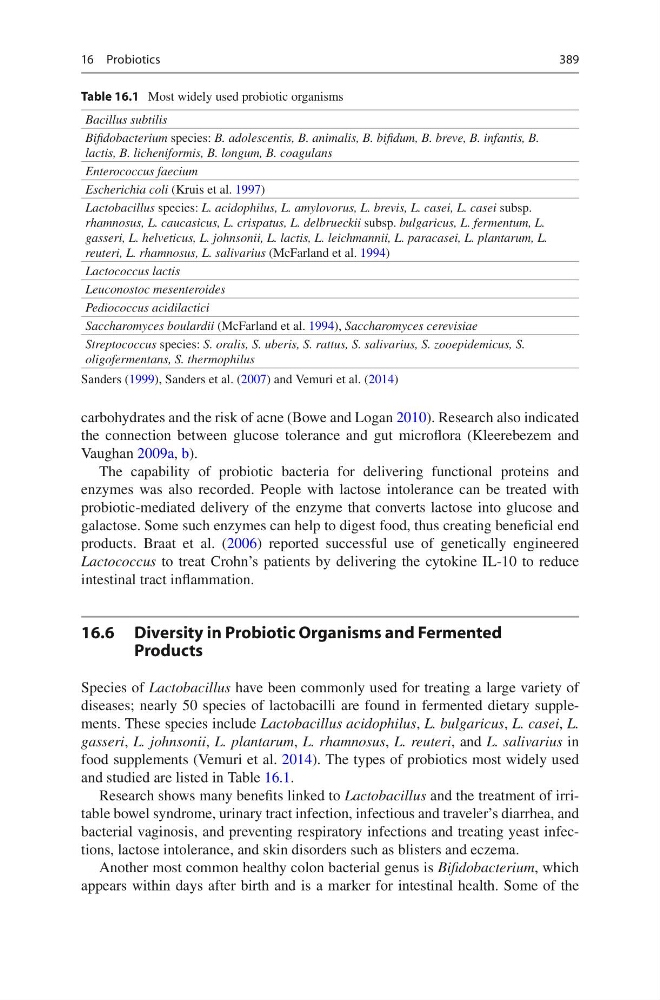
and studied are listed in Table 16.1.
Research shows many benefits linked to Lactobacillus and the treatment of irritable bowel syndrome, urinary tract infection, infectious and traveler’s diarrhea, and
bacterial vaginosis, and preventing respiratory infections and treating yeast infections, lactose intolerance, and skin disorders such as blisters and eczema.
Another most common healthy colon bacterial genus is Bifidobacterium, which
appears within days after birth and is a marker for intestinal health. Some of the
Table 16.1 Most widely used probiotic organisms
Bacillus subtilis
Bifidobacterium species: B. adolescentis, B. animalis, B. bifidum, B. breve, B. infantis, B.
lactis, B. licheniformis, B. longum, B. coagulans
Enterococcus faecium
Escherichia coli (Kruis et al. 1997)
Lactobacillus species: L. acidophilus, L. amylovorus, L. brevis, L. casei, L. casei subsp.
rhamnosus, L. caucasicus, L. crispatus, L. delbrueckii subsp. bulgaricus, L. fermentum, L.
gasseri, L. helveticus, L. johnsonii, L. lactis, L. leichmannii, L. paracasei, L. plantarum, L.
reuteri, L. rhamnosus, L. salivarius (McFarland et al. 1994)
Lactococcus lactis
Leuconostoc mesenteroides
Pediococcus acidilactici
Saccharomyces boulardii (McFarland et al. 1994), Saccharomyces cerevisiae
Streptococcus species: S. oralis, S. uberis, S. rattus, S. salivarius, S. zooepidemicus, S.
oligofermentans, S. thermophilus
Sanders (1999), Sanders et al. (2007) and Vemuri et al. (2014)
16 Probiotics
carbohydrates and the risk of acne (Bowe and Logan 2010). Research also indicated
the connection between glucose tolerance and gut microflora (Kleerebezem and
Vaughan 2009a, b).
The capability of probiotic bacteria for delivering functional proteins and
enzymes was also recorded. People with lactose intolerance can be treated with
probiotic-mediated delivery of the enzyme that converts lactose into glucose and
galactose. Some such enzymes can help to digest food, thus creating beneficial end
products. Braat et al. (2006) reported successful use of genetically engineered
Lactococcus to treat Crohn’s patients by delivering the cytokine IL-10 to reduce
intestinal tract inflammation.
16.6 Diversity in Probiotic Organisms and Fermented
Products
Species of Lactobacillus have been commonly used for treating a large variety of
diseases; nearly 50 species of lactobacilli are found in fermented dietary supplements. These species include Lactobacillus acidophilus, L. bulgaricus, L. casei, L.
gasseri, L. johnsonii, L. plantarum, L. rhamnosus, L. reuteri, and L. salivarius in
food supplements (Vemuri et al. 2014). The types of probiotics most widely used
and studied are listed in Table 16.1.
Research shows many benefits linked to Lactobacillus and the treatment of irritable bowel syndrome, urinary tract infection, infectious and traveler’s diarrhea, and
bacterial vaginosis, and preventing respiratory infections and treating yeast infections, lactose intolerance, and skin disorders such as blisters and eczema.
Another most common healthy colon bacterial genus is Bifidobacterium, which
appears within days after birth and is a marker for intestinal health. Some of the
Table 16.1 Most widely used probiotic organisms
Bacillus subtilis
Bifidobacterium species: B. adolescentis, B. animalis, B. bifidum, B. breve, B. infantis, B.
lactis, B. licheniformis, B. longum, B. coagulans
Enterococcus faecium
Escherichia coli (Kruis et al. 1997)
Lactobacillus species: L. acidophilus, L. amylovorus, L. brevis, L. casei, L. casei subsp.
rhamnosus, L. caucasicus, L. crispatus, L. delbrueckii subsp. bulgaricus, L. fermentum, L.
gasseri, L. helveticus, L. johnsonii, L. lactis, L. leichmannii, L. paracasei, L. plantarum, L.
reuteri, L. rhamnosus, L. salivarius (McFarland et al. 1994)
Lactococcus lactis
Leuconostoc mesenteroides
Pediococcus acidilactici
Saccharomyces boulardii (McFarland et al. 1994), Saccharomyces cerevisiae
Streptococcus species: S. oralis, S. uberis, S. rattus, S. salivarius, S. zooepidemicus, S.
oligofermentans, S. thermophilus
Sanders (1999), Sanders et al. (2007) and Vemuri et al. (2014)
16 Probiotics