

300
ble bonds. These drugs interact with ergo sterols of fungal cell membrane to produce
pores that make them leaky. The polyene class of mycotics includes Amphotericin
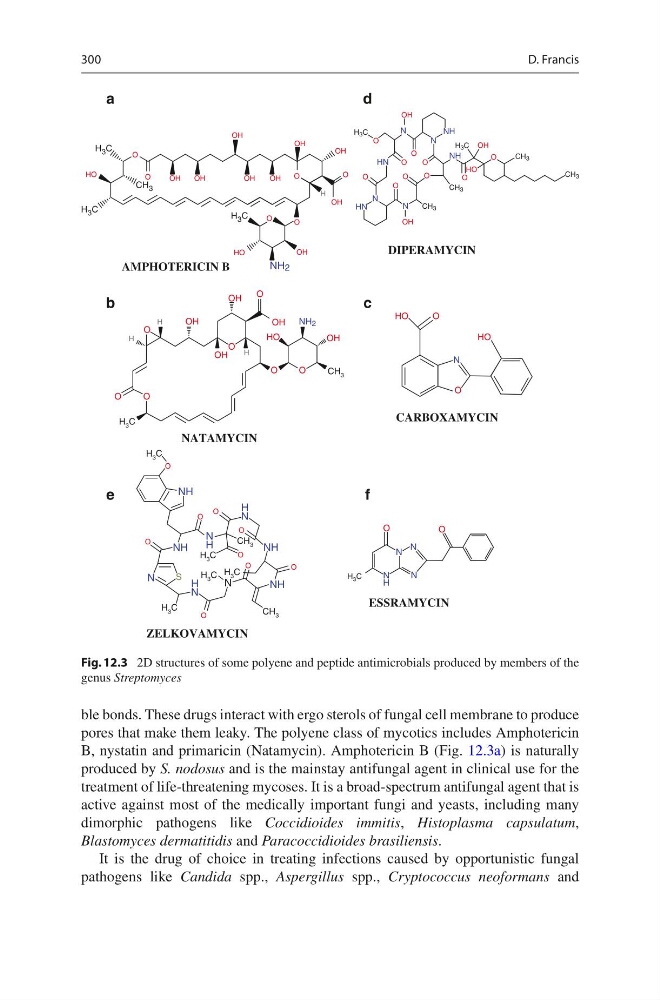
B, nystatin and primaricin (Natamycin). Amphotericin B (Fig. 12.3a) is naturally
produced by S. nodosus and is the mainstay antifungal agent in clinical use for the
treatment of life-threatening mycoses. It is a broad-spectrum antifungal agent that is
active against most of the medically important fungi and yeasts, including many
dimorphic pathogens like Coccidioides immitis, Histoplasma capsulatum,
Blastomyces dermatitidis and Paracoccidioides brasiliensis.
It is the drug of choice in treating infections caused by opportunistic fungal
pathogens like Candida spp., Aspergillus spp., Cryptococcus neoformans and
O
OH
OH
OH
OH
OH
NH2
CH 3
CH 3
CH 3
HO
H
H
H
H 3 C
H 3 C
H 3 C
H 3 C H 3 C
H 3 C
O
O
O
O
O
S
O
O
O
O
O
O
O
O
O
O
O
O
O
O
O
OH
O
O
O
O
N
N
N
N
NH
HN
HN
NH
O
O
O
O
O
O
H
HO
HO
O
O
O
N
N
N
N
N
NH
NH
NH
NH
N
H
H
H
N
N
N
H
H 3 C
N
HO
HO
O
OH
OH
OH
OH
OH
OH
OH
HO
OH
CH3
CH3
CH3
H3C
H3C
CH3
OH
OH
OH
H 3 C
CH 3
NH2
H 3 C
H 3 C
O
AMPHOTERICIN B
DIPERAMYCIN
CARBOXAMYCIN
ESSRAMYCIN
ZELKOVAMYCIN
NATAMYCIN
a
b
c
d
e
f
Fig. 12.3 2D structures of some polyene and peptide antimicrobials produced by members of the
genus Streptomyces
D. Francis
ble bonds. These drugs interact with ergo sterols of fungal cell membrane to produce
pores that make them leaky. The polyene class of mycotics includes Amphotericin
B, nystatin and primaricin (Natamycin). Amphotericin B (Fig. 12.3a) is naturally
produced by S. nodosus and is the mainstay antifungal agent in clinical use for the
treatment of life-threatening mycoses. It is a broad-spectrum antifungal agent that is
active against most of the medically important fungi and yeasts, including many
dimorphic pathogens like Coccidioides immitis, Histoplasma capsulatum,
Blastomyces dermatitidis and Paracoccidioides brasiliensis.
It is the drug of choice in treating infections caused by opportunistic fungal
pathogens like Candida spp., Aspergillus spp., Cryptococcus neoformans and
O
OH
OH
OH
OH
OH
NH2
CH 3
CH 3
CH 3
HO
H
H
H
H 3 C
H 3 C
H 3 C
H 3 C H 3 C
H 3 C
O
O
O
O
O
S
O
O
O
O
O
O
O
O
O
O
O
O
O
O
O
OH
O
O
O
O
N
N
N
N
NH
HN
HN
NH
O
O
O
O
O
O
H
HO
HO
O
O
O
N
N
N
N
N
NH
NH
NH
NH
N
H
H
H
N
N
N
H
H 3 C
N
HO
HO
O
OH
OH
OH
OH
OH
OH
OH
HO
OH
CH3
CH3
CH3
H3C
H3C
CH3
OH
OH
OH
H 3 C
CH 3
NH2
H 3 C
H 3 C
O
AMPHOTERICIN B
DIPERAMYCIN
CARBOXAMYCIN
ESSRAMYCIN
ZELKOVAMYCIN
NATAMYCIN
a
b
c
d
e
f
Fig. 12.3 2D structures of some polyene and peptide antimicrobials produced by members of the
genus Streptomyces
D. Francis