

225
carboxyl group of a conserved isoleucine at the C terminus of the protein and conserved histidines. The active site non-heme iron of catalytic domain serves as both
oxidizing and reducing agents. During catalysis the inactive ferrous form of enzyme
is converted to active ferric form. This is favoured by lipid hydroperoxides. The
octahedral arrangement shown by the amino acids close to iron is at the corners of
a tiltedbipyramid (Brash 1999).
Soybean lipoxygenase-1 is a 95 kDa polypeptide. The 839 residues of this
enzyme were organized in N-terminal domain (domain I, 146 residue) and
C-terminal domain (domain II, 693 residues). The structure of lipoxygenase-3,
another soybean lipoxygenase isozyme, is very similar with a huge difference in
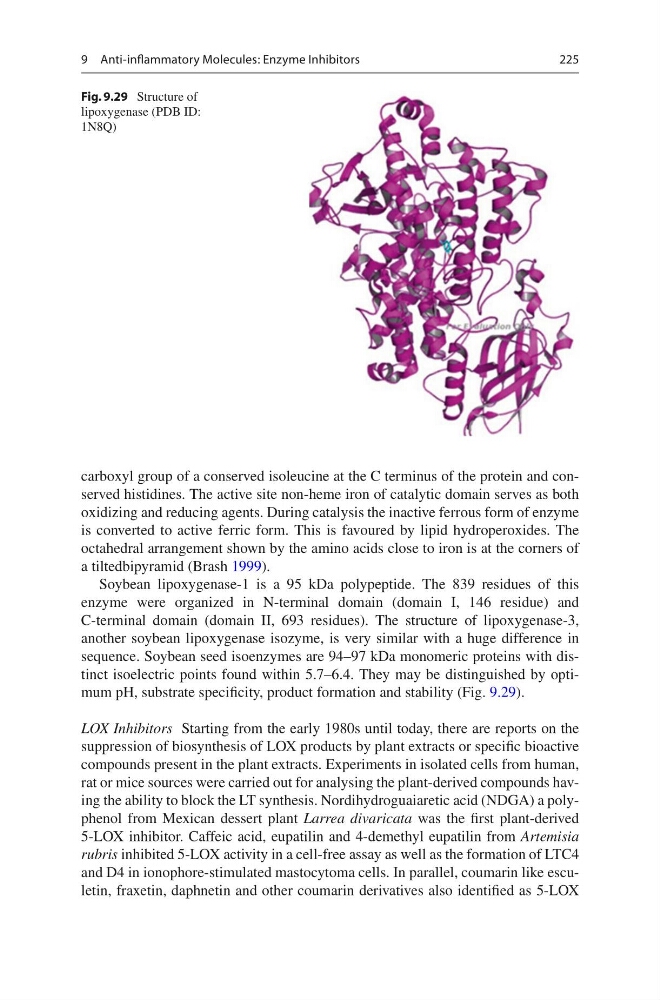
sequence. Soybean seed isoenzymes are 94–97 kDa monomeric proteins with distinct isoelectric points found within 5.7–6.4. They may be distinguished by optimum pH, substrate specificity, product formation and stability (Fig. 9.29).
LOX Inhibitors Starting from the early 1980s until today, there are reports on the
suppression of biosynthesis of LOX products by plant extracts or specific bioactive
compounds present in the plant extracts. Experiments in isolated cells from human,
rat or mice sources were carried out for analysing the plant-derived compounds having the ability to block the LT synthesis. Nordihydroguaiaretic acid (NDGA) a polyphenol from Mexican dessert plant Larrea divaricata was the first plant-derived
5-LOX inhibitor. Caffeic acid, eupatilin and 4-demethyl eupatilin from Artemisia
rubris inhibited 5-LOX activity in a cell-free assay as well as the formation of LTC4
and D4 in ionophore-stimulated mastocytoma cells. In parallel, coumarin like esculetin, fraxetin, daphnetin and other coumarin derivatives also identified as 5-LOX
Fig. 9.29 Structure of
lipoxygenase (PDB ID:
1N8Q)
9 Anti-inflammatory Molecules: Enzyme Inhibitors
carboxyl group of a conserved isoleucine at the C terminus of the protein and conserved histidines. The active site non-heme iron of catalytic domain serves as both
oxidizing and reducing agents. During catalysis the inactive ferrous form of enzyme
is converted to active ferric form. This is favoured by lipid hydroperoxides. The
octahedral arrangement shown by the amino acids close to iron is at the corners of
a tiltedbipyramid (Brash 1999).
Soybean lipoxygenase-1 is a 95 kDa polypeptide. The 839 residues of this
enzyme were organized in N-terminal domain (domain I, 146 residue) and
C-terminal domain (domain II, 693 residues). The structure of lipoxygenase-3,
another soybean lipoxygenase isozyme, is very similar with a huge difference in
sequence. Soybean seed isoenzymes are 94–97 kDa monomeric proteins with distinct isoelectric points found within 5.7–6.4. They may be distinguished by optimum pH, substrate specificity, product formation and stability (Fig. 9.29).
LOX Inhibitors Starting from the early 1980s until today, there are reports on the
suppression of biosynthesis of LOX products by plant extracts or specific bioactive
compounds present in the plant extracts. Experiments in isolated cells from human,
rat or mice sources were carried out for analysing the plant-derived compounds having the ability to block the LT synthesis. Nordihydroguaiaretic acid (NDGA) a polyphenol from Mexican dessert plant Larrea divaricata was the first plant-derived
5-LOX inhibitor. Caffeic acid, eupatilin and 4-demethyl eupatilin from Artemisia
rubris inhibited 5-LOX activity in a cell-free assay as well as the formation of LTC4
and D4 in ionophore-stimulated mastocytoma cells. In parallel, coumarin like esculetin, fraxetin, daphnetin and other coumarin derivatives also identified as 5-LOX
Fig. 9.29 Structure of
lipoxygenase (PDB ID:
1N8Q)
9 Anti-inflammatory Molecules: Enzyme Inhibitors