

220
9.2.2.6 Structure-Activity Relationships of Biological Compounds
with COX Enzyme
Polyphenols and flavonoids are plant secondary metabolites which are antioxidants
and protect our body from harmful effects. There are different classes of flavonoids
based on their structural modifications. Polyphenols may be classified into four
groups: flavonoids, stilbenes, lignans and phenolic acids. Polyphenols found in diet,
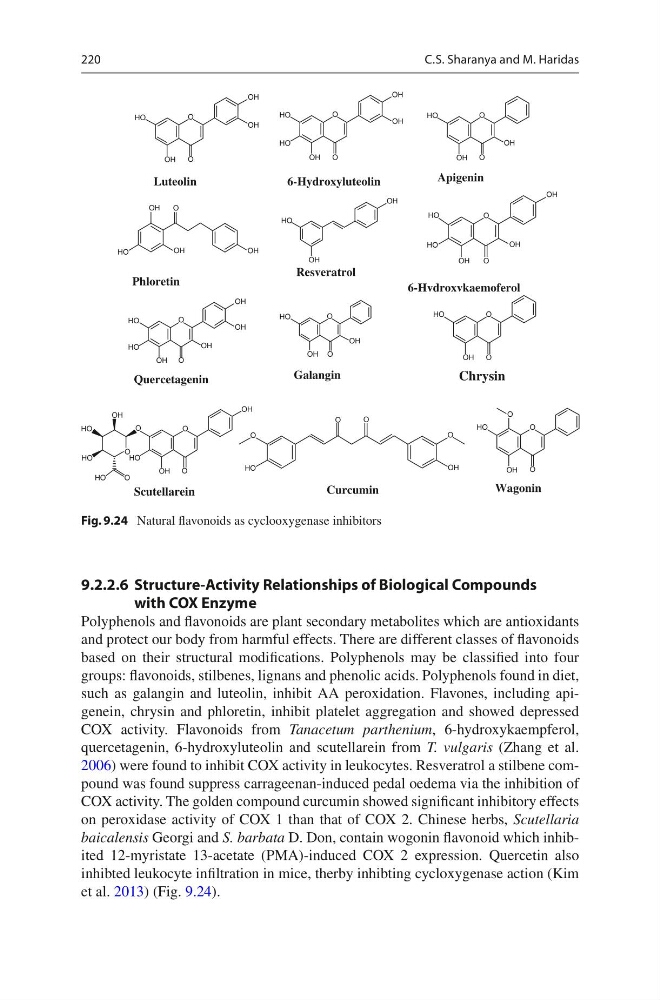
such as galangin and luteolin, inhibit AA peroxidation. Flavones, including apigenein, chrysin and phloretin, inhibit platelet aggregation and showed depressed
COX activity. Flavonoids from Tanacetum parthenium, 6-hydroxykaempferol,
quercetagenin, 6-hydroxyluteolin and scutellarein from T. vulgaris (Zhang et al.
2006) were found to inhibit COX activity in leukocytes. Resveratrol a stilbene compound was found suppress carrageenan-induced pedal oedema via the inhibition of
COX activity. The golden compound curcumin showed significant inhibitory effects
on peroxidase activity of COX 1 than that of COX 2. Chinese herbs, Scutellaria
baicalensis Georgi and S. barbata D. Don, contain wogonin flavonoid which inhibited 12-myristate 13-acetate (PMA)-induced COX 2 expression. Quercetin also
inhibted leukocyte infiltration in mice, therby inhibting cycloxygenase action (Kim
et al. 2013) (Fig. 9.24).
HO
HO
HO
HO
HO
HO
HO
HO
HO
HO
HO
HO
HO
HO
HO
HO
HO
HO
OH
OH
OH
OH
OH
OH
OH
OH
OH
OH
OH
OH
OH
OH
OH
OH
OH
OH
OH
OH
OH
OH
OH
OH
OH
OH
OH
OH
O
O
O
O
O
O
O
O
O
O
O
O
O
O
O
O
O
O
O
O
O
O
O
O
O
O
O
Luteolin
6-Hydroxyluteolin
6-Hvdroxvkaemoferol
Apigenin
Resveratrol
Phloretin
Quercetagenin
Galangin
Chrysin
Wagonin
Curcumin
Scutellarein
Fig. 9.24 Natural flavonoids as cyclooxygenase inhibitors
C.S. Sharanya and M. Haridas
9.2.2.6 Structure-Activity Relationships of Biological Compounds
with COX Enzyme
Polyphenols and flavonoids are plant secondary metabolites which are antioxidants
and protect our body from harmful effects. There are different classes of flavonoids
based on their structural modifications. Polyphenols may be classified into four
groups: flavonoids, stilbenes, lignans and phenolic acids. Polyphenols found in diet,
such as galangin and luteolin, inhibit AA peroxidation. Flavones, including apigenein, chrysin and phloretin, inhibit platelet aggregation and showed depressed
COX activity. Flavonoids from Tanacetum parthenium, 6-hydroxykaempferol,
quercetagenin, 6-hydroxyluteolin and scutellarein from T. vulgaris (Zhang et al.
2006) were found to inhibit COX activity in leukocytes. Resveratrol a stilbene compound was found suppress carrageenan-induced pedal oedema via the inhibition of
COX activity. The golden compound curcumin showed significant inhibitory effects
on peroxidase activity of COX 1 than that of COX 2. Chinese herbs, Scutellaria
baicalensis Georgi and S. barbata D. Don, contain wogonin flavonoid which inhibited 12-myristate 13-acetate (PMA)-induced COX 2 expression. Quercetin also
inhibted leukocyte infiltration in mice, therby inhibting cycloxygenase action (Kim
et al. 2013) (Fig. 9.24).
HO
HO
HO
HO
HO
HO
HO
HO
HO
HO
HO
HO
HO
HO
HO
HO
HO
HO
OH
OH
OH
OH
OH
OH
OH
OH
OH
OH
OH
OH
OH
OH
OH
OH
OH
OH
OH
OH
OH
OH
OH
OH
OH
OH
OH
OH
O
O
O
O
O
O
O
O
O
O
O
O
O
O
O
O
O
O
O
O
O
O
O
O
O
O
O
Luteolin
6-Hydroxyluteolin
6-Hvdroxvkaemoferol
Apigenin
Resveratrol
Phloretin
Quercetagenin
Galangin
Chrysin
Wagonin
Curcumin
Scutellarein
Fig. 9.24 Natural flavonoids as cyclooxygenase inhibitors
C.S. Sharanya and M. Haridas