

140
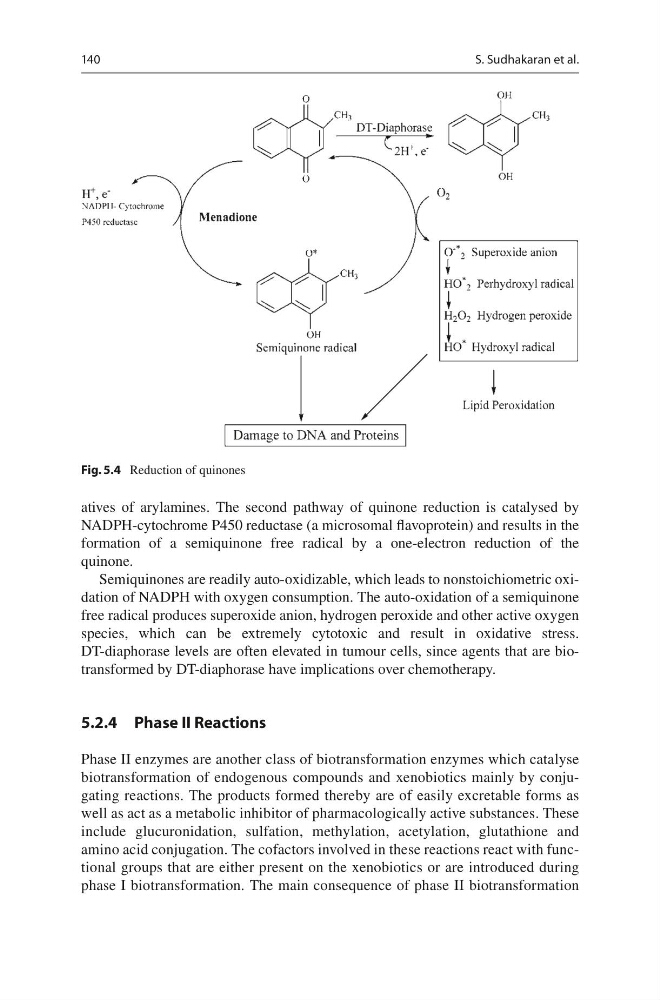
atives of arylamines. The second pathway of quinone reduction is catalysed by
NADPH-cytochrome P450 reductase (a microsomal flavoprotein) and results in the
formation of a semiquinone free radical by a one-electron reduction of the
quinone.
Semiquinones are readily auto-oxidizable, which leads to nonstoichiometric oxidation of NADPH with oxygen consumption. The auto-oxidation of a semiquinone
free radical produces superoxide anion, hydrogen peroxide and other active oxygen
species, which can be extremely cytotoxic and result in oxidative stress.
DT-diaphorase levels are often elevated in tumour cells, since agents that are biotransformed by DT-diaphorase have implications over chemotherapy.
5.2.4 Phase II Reactions
Phase II enzymes are another class of biotransformation enzymes which catalyse
biotransformation of endogenous compounds and xenobiotics mainly by conjugating reactions. The products formed thereby are of easily excretable forms as
well as act as a metabolic inhibitor of pharmacologically active substances. These
include glucuronidation, sulfation, methylation, acetylation, glutathione and
amino acid conjugation. The cofactors involved in these reactions react with functional groups that are either present on the xenobiotics or are introduced during
phase I biotransformation. The main consequence of phase II biotransformation
Fig. 5.4 Reduction of quinones
S. Sudhakaran et al.
atives of arylamines. The second pathway of quinone reduction is catalysed by
NADPH-cytochrome P450 reductase (a microsomal flavoprotein) and results in the
formation of a semiquinone free radical by a one-electron reduction of the
quinone.
Semiquinones are readily auto-oxidizable, which leads to nonstoichiometric oxidation of NADPH with oxygen consumption. The auto-oxidation of a semiquinone
free radical produces superoxide anion, hydrogen peroxide and other active oxygen
species, which can be extremely cytotoxic and result in oxidative stress.
DT-diaphorase levels are often elevated in tumour cells, since agents that are biotransformed by DT-diaphorase have implications over chemotherapy.
5.2.4 Phase II Reactions
Phase II enzymes are another class of biotransformation enzymes which catalyse
biotransformation of endogenous compounds and xenobiotics mainly by conjugating reactions. The products formed thereby are of easily excretable forms as
well as act as a metabolic inhibitor of pharmacologically active substances. These
include glucuronidation, sulfation, methylation, acetylation, glutathione and
amino acid conjugation. The cofactors involved in these reactions react with functional groups that are either present on the xenobiotics or are introduced during
phase I biotransformation. The main consequence of phase II biotransformation
Fig. 5.4 Reduction of quinones
S. Sudhakaran et al.