

139
Carbonyl Reduction Carbonyl reductases are a class of enzymes which catalyse the
reduction of certain aldehydes to primary alcohols and of ketones to secondary alcohols alcohols. These enzymes are monomeric, NADPH-dependent and present in
blood and the cytosolic fraction of the liver, kidney, brain and other tissues and
structurally belong to the short-chain dehydrogenase/reductase (SDR) super family
which includes certain hydroxysteroid dehydrogenases and prostaglandin dehydrogenases. The major circulating metabolite of the antipsychotic drug haloperidol is a
secondary alcohol formed by carbonyl reductases in the blood and liver. The enzyme
shows a high degree of stereoselectivity in the reduction of ketones to secondary
alcohols.
Quinone Reduction The cytosolic flavoprotein NAD(P)H-quinone oxidoreductase,
also known as DT-diaphorase, catalyses the two-electron reduction of quinones to
stable hydroquinone with stoichiometric oxidation of NAD[P]H without oxygen
consumption. The reaction can also be catalysed by carbonyl reductase, especially
in humans. Although there are exceptions, this pathway of quinone reduction is
essentially nontoxic as it is not associated with oxidative stress, unlike the oneelectron reduction of quinones by NADPH-cytochrome P450 reductase (Fig. 5.4).
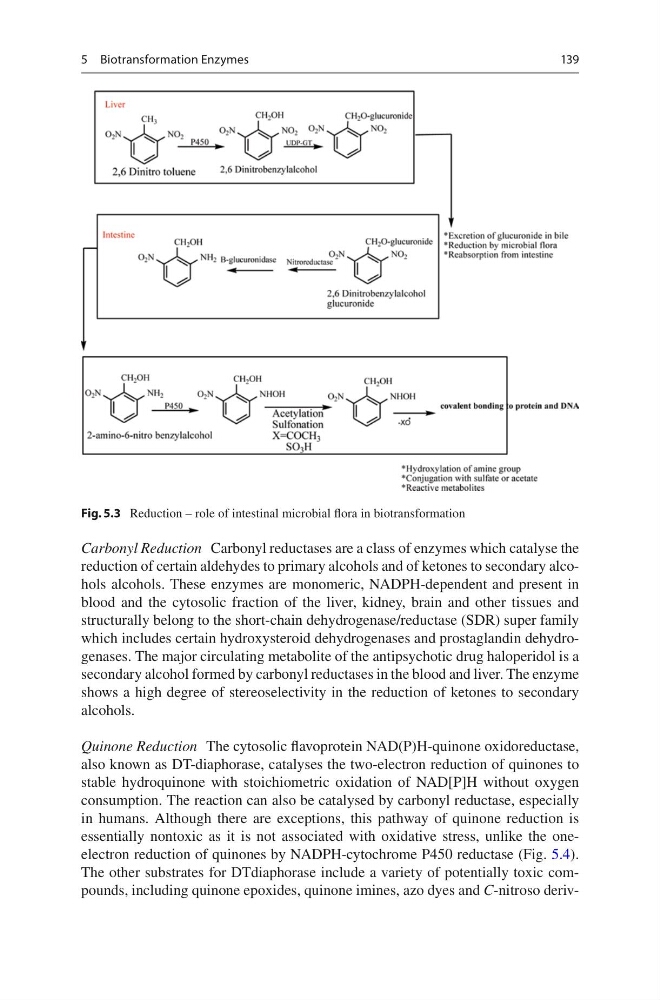
The other substrates for DTdiaphorase include a variety of potentially toxic compounds, including quinone epoxides, quinone imines, azo dyes and C-nitroso derivFig. 5.3 Reduction – role of intestinal microbial flora in biotransformation
5 Biotransformation Enzymes
Carbonyl Reduction Carbonyl reductases are a class of enzymes which catalyse the
reduction of certain aldehydes to primary alcohols and of ketones to secondary alcohols alcohols. These enzymes are monomeric, NADPH-dependent and present in
blood and the cytosolic fraction of the liver, kidney, brain and other tissues and
structurally belong to the short-chain dehydrogenase/reductase (SDR) super family
which includes certain hydroxysteroid dehydrogenases and prostaglandin dehydrogenases. The major circulating metabolite of the antipsychotic drug haloperidol is a
secondary alcohol formed by carbonyl reductases in the blood and liver. The enzyme
shows a high degree of stereoselectivity in the reduction of ketones to secondary
alcohols.
Quinone Reduction The cytosolic flavoprotein NAD(P)H-quinone oxidoreductase,
also known as DT-diaphorase, catalyses the two-electron reduction of quinones to
stable hydroquinone with stoichiometric oxidation of NAD[P]H without oxygen
consumption. The reaction can also be catalysed by carbonyl reductase, especially
in humans. Although there are exceptions, this pathway of quinone reduction is
essentially nontoxic as it is not associated with oxidative stress, unlike the oneelectron reduction of quinones by NADPH-cytochrome P450 reductase (Fig. 5.4).
The other substrates for DTdiaphorase include a variety of potentially toxic compounds, including quinone epoxides, quinone imines, azo dyes and C-nitroso derivFig. 5.3 Reduction – role of intestinal microbial flora in biotransformation
5 Biotransformation Enzymes