

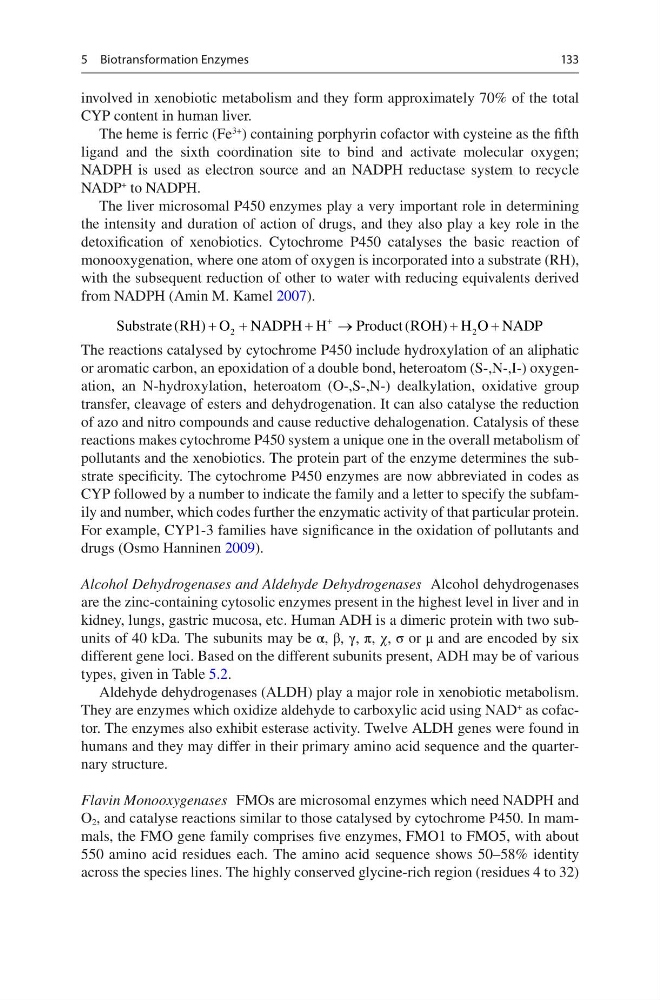
133
involved in xenobiotic metabolism and they form approximately 70% of the total
CYP content in human liver.
The heme is ferric (Fe
3+
) containing porphyrin cofactor with cysteine as the fifth
ligand and the sixth coordination site to bind and activate molecular oxygen;
NADPH is used as electron source and an NADPH reductase system to recycle
NADP
+
to NADPH.
The liver microsomal P450 enzymes play a very important role in determining
the intensity and duration of action of drugs, and they also play a key role in the
detoxification of xenobiotics. Cytochrome P450 catalyses the basic reaction of
monooxygenation, where one atom of oxygen is incorporated into a substrate (RH),
with the subsequent reduction of other to water with reducing equivalents derived
from NADPH (Amin M. Kamel 2007).
Substrate RH O NADPH H
Product ROH H O NADP
( )
(
)
+
+
+
®
+
+
+
2
2
The reactions catalysed by cytochrome P450 include hydroxylation of an aliphatic
or aromatic carbon, an epoxidation of a double bond, heteroatom (S-,N-,I-) oxygenation, an N-hydroxylation, heteroatom (O-,S-,N-) dealkylation, oxidative group
transfer, cleavage of esters and dehydrogenation. It can also catalyse the reduction
of azo and nitro compounds and cause reductive dehalogenation. Catalysis of these
reactions makes cytochrome P450 system a unique one in the overall metabolism of
pollutants and the xenobiotics. The protein part of the enzyme determines the substrate specificity. The cytochrome P450 enzymes are now abbreviated in codes as
CYP followed by a number to indicate the family and a letter to specify the subfamily and number, which codes further the enzymatic activity of that particular protein.
For example, CYP1-3 families have significance in the oxidation of pollutants and
drugs (Osmo Hanninen 2009).
Alcohol Dehydrogenases and Aldehyde Dehydrogenases Alcohol dehydrogenases
are the zinc-containing cytosolic enzymes present in the highest level in liver and in
kidney, lungs, gastric mucosa, etc. Human ADH is a dimeric protein with two subunits of 40 kDa. The subunits may be α, β, γ, π, χ, σ or μ and are encoded by six
different gene loci. Based on the different subunits present, ADH may be of various
types, given in Table 5.2.
Aldehyde dehydrogenases (ALDH) play a major role in xenobiotic metabolism.
They are enzymes which oxidize aldehyde to carboxylic acid using NAD
+
as cofactor. The enzymes also exhibit esterase activity. Twelve ALDH genes were found in
humans and they may differ in their primary amino acid sequence and the quarternary structure.
Flavin Monooxygenases FMOs are microsomal enzymes which need NADPH and
O 2 , and catalyse reactions similar to those catalysed by cytochrome P450. In mammals, the FMO gene family comprises five enzymes, FMO1 to FMO5, with about
550 amino acid residues each. The amino acid sequence shows 50–58% identity
across the species lines. The highly conserved glycine-rich region (residues 4 to 32)
5 Biotransformation Enzymes
involved in xenobiotic metabolism and they form approximately 70% of the total
CYP content in human liver.
The heme is ferric (Fe
3+
) containing porphyrin cofactor with cysteine as the fifth
ligand and the sixth coordination site to bind and activate molecular oxygen;
NADPH is used as electron source and an NADPH reductase system to recycle
NADP
+
to NADPH.
The liver microsomal P450 enzymes play a very important role in determining
the intensity and duration of action of drugs, and they also play a key role in the
detoxification of xenobiotics. Cytochrome P450 catalyses the basic reaction of
monooxygenation, where one atom of oxygen is incorporated into a substrate (RH),
with the subsequent reduction of other to water with reducing equivalents derived
from NADPH (Amin M. Kamel 2007).
Substrate RH O NADPH H
Product ROH H O NADP
( )
(
)
+
+
+
®
+
+
+
2
2
The reactions catalysed by cytochrome P450 include hydroxylation of an aliphatic
or aromatic carbon, an epoxidation of a double bond, heteroatom (S-,N-,I-) oxygenation, an N-hydroxylation, heteroatom (O-,S-,N-) dealkylation, oxidative group
transfer, cleavage of esters and dehydrogenation. It can also catalyse the reduction
of azo and nitro compounds and cause reductive dehalogenation. Catalysis of these
reactions makes cytochrome P450 system a unique one in the overall metabolism of
pollutants and the xenobiotics. The protein part of the enzyme determines the substrate specificity. The cytochrome P450 enzymes are now abbreviated in codes as
CYP followed by a number to indicate the family and a letter to specify the subfamily and number, which codes further the enzymatic activity of that particular protein.
For example, CYP1-3 families have significance in the oxidation of pollutants and
drugs (Osmo Hanninen 2009).
Alcohol Dehydrogenases and Aldehyde Dehydrogenases Alcohol dehydrogenases
are the zinc-containing cytosolic enzymes present in the highest level in liver and in
kidney, lungs, gastric mucosa, etc. Human ADH is a dimeric protein with two subunits of 40 kDa. The subunits may be α, β, γ, π, χ, σ or μ and are encoded by six
different gene loci. Based on the different subunits present, ADH may be of various
types, given in Table 5.2.
Aldehyde dehydrogenases (ALDH) play a major role in xenobiotic metabolism.
They are enzymes which oxidize aldehyde to carboxylic acid using NAD
+
as cofactor. The enzymes also exhibit esterase activity. Twelve ALDH genes were found in
humans and they may differ in their primary amino acid sequence and the quarternary structure.
Flavin Monooxygenases FMOs are microsomal enzymes which need NADPH and
O 2 , and catalyse reactions similar to those catalysed by cytochrome P450. In mammals, the FMO gene family comprises five enzymes, FMO1 to FMO5, with about
550 amino acid residues each. The amino acid sequence shows 50–58% identity
across the species lines. The highly conserved glycine-rich region (residues 4 to 32)
5 Biotransformation Enzymes