

132
oxidation. The most common electron acceptor is molecular oxygen. This can
undergo a 2e- reduction to yield H 2 O 2 or a 4e- reduction to generate water.
Common oxidative reaction includes
• Dehydrogenation (involves a hydride abstraction)
• Hydroxylation of aromatic carbons
• Hydroxylation of aliphatic carbons
• Oxidations involving carbon-heteroatom systems (Amin M. Kamel 2007).
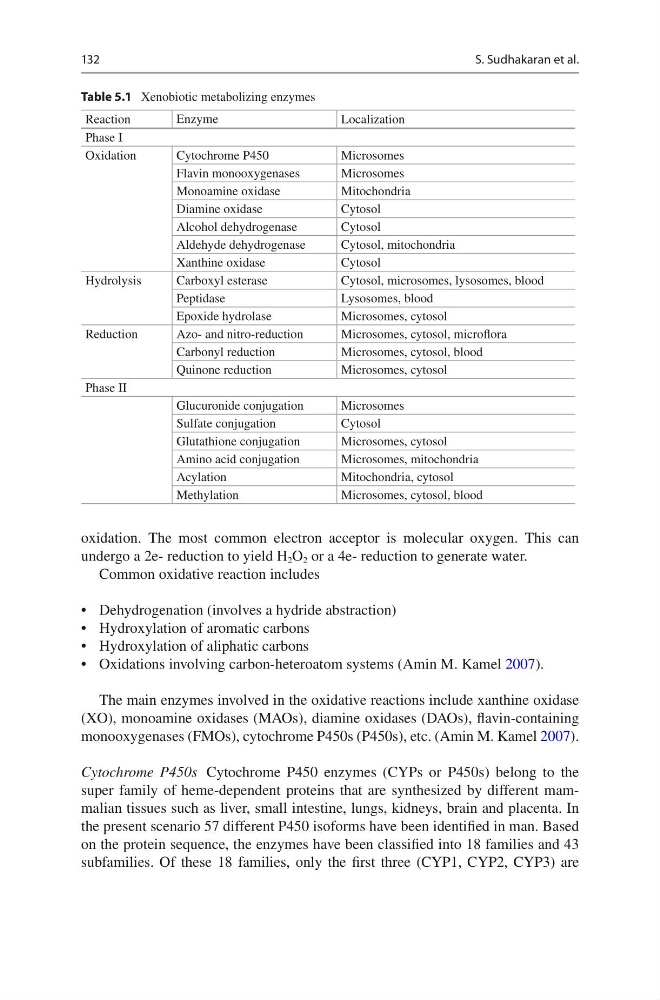
The main enzymes involved in the oxidative reactions include xanthine oxidase
(XO), monoamine oxidases (MAOs), diamine oxidases (DAOs), flavin-containing
monooxygenases (FMOs), cytochrome P450s (P450s), etc. (Amin M. Kamel 2007).
Cytochrome P450s Cytochrome P450 enzymes (CYPs or P450s) belong to the
super family of heme-dependent proteins that are synthesized by different mammalian tissues such as liver, small intestine, lungs, kidneys, brain and placenta. In
the present scenario 57 different P450 isoforms have been identified in man. Based
on the protein sequence, the enzymes have been classified into 18 families and 43
subfamilies. Of these 18 families, only the first three (CYP1, CYP2, CYP3) are
Table 5.1 Xenobiotic metabolizing enzymes
Reaction
Enzyme
Localization
Phase I
Oxidation
Cytochrome P450
Microsomes
Flavin monooxygenases
Microsomes
Monoamine oxidase
Mitochondria
Diamine oxidase
Cytosol
Alcohol dehydrogenase
Cytosol
Aldehyde dehydrogenase
Cytosol, mitochondria
Xanthine oxidase
Cytosol
Hydrolysis
Carboxyl esterase
Cytosol, microsomes, lysosomes, blood
Peptidase
Lysosomes, blood
Epoxide hydrolase
Microsomes, cytosol
Reduction
Azo- and nitro-reduction
Microsomes, cytosol, microflora
Carbonyl reduction
Microsomes, cytosol, blood
Quinone reduction
Microsomes, cytosol
Phase II
Glucuronide conjugation
Microsomes
Sulfate conjugation
Cytosol
Glutathione conjugation
Microsomes, cytosol
Amino acid conjugation
Microsomes, mitochondria
Acylation
Mitochondria, cytosol
Methylation
Microsomes, cytosol, blood
S. Sudhakaran et al.
oxidation. The most common electron acceptor is molecular oxygen. This can
undergo a 2e- reduction to yield H 2 O 2 or a 4e- reduction to generate water.
Common oxidative reaction includes
• Dehydrogenation (involves a hydride abstraction)
• Hydroxylation of aromatic carbons
• Hydroxylation of aliphatic carbons
• Oxidations involving carbon-heteroatom systems (Amin M. Kamel 2007).
The main enzymes involved in the oxidative reactions include xanthine oxidase
(XO), monoamine oxidases (MAOs), diamine oxidases (DAOs), flavin-containing
monooxygenases (FMOs), cytochrome P450s (P450s), etc. (Amin M. Kamel 2007).
Cytochrome P450s Cytochrome P450 enzymes (CYPs or P450s) belong to the
super family of heme-dependent proteins that are synthesized by different mammalian tissues such as liver, small intestine, lungs, kidneys, brain and placenta. In
the present scenario 57 different P450 isoforms have been identified in man. Based
on the protein sequence, the enzymes have been classified into 18 families and 43
subfamilies. Of these 18 families, only the first three (CYP1, CYP2, CYP3) are
Table 5.1 Xenobiotic metabolizing enzymes
Reaction
Enzyme
Localization
Phase I
Oxidation
Cytochrome P450
Microsomes
Flavin monooxygenases
Microsomes
Monoamine oxidase
Mitochondria
Diamine oxidase
Cytosol
Alcohol dehydrogenase
Cytosol
Aldehyde dehydrogenase
Cytosol, mitochondria
Xanthine oxidase
Cytosol
Hydrolysis
Carboxyl esterase
Cytosol, microsomes, lysosomes, blood
Peptidase
Lysosomes, blood
Epoxide hydrolase
Microsomes, cytosol
Reduction
Azo- and nitro-reduction
Microsomes, cytosol, microflora
Carbonyl reduction
Microsomes, cytosol, blood
Quinone reduction
Microsomes, cytosol
Phase II
Glucuronide conjugation
Microsomes
Sulfate conjugation
Cytosol
Glutathione conjugation
Microsomes, cytosol
Amino acid conjugation
Microsomes, mitochondria
Acylation
Mitochondria, cytosol
Methylation
Microsomes, cytosol, blood
S. Sudhakaran et al.