

115
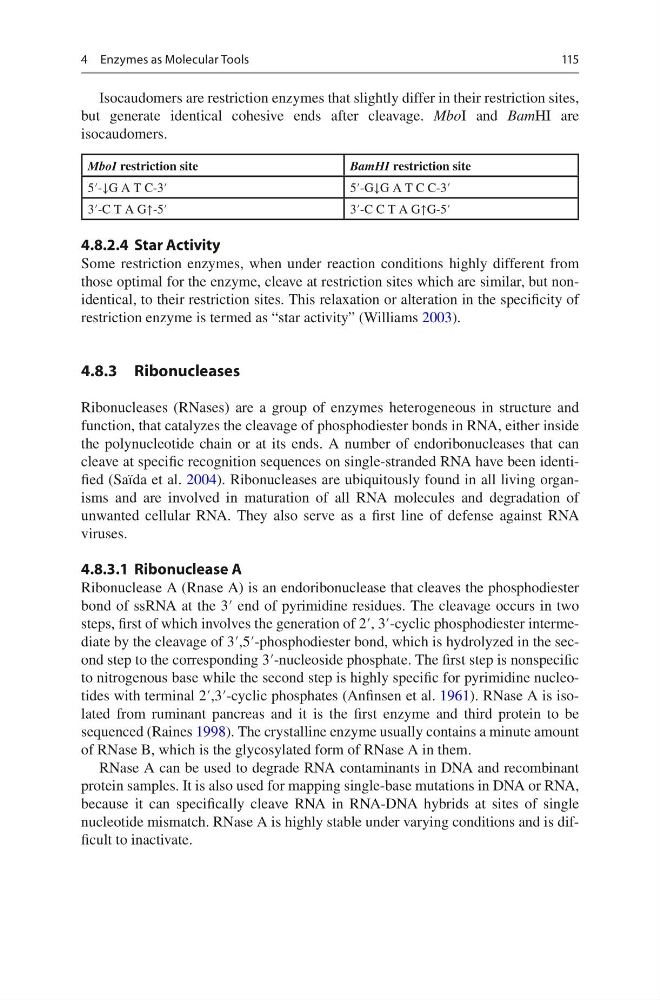
Isocaudomers are restriction enzymes that slightly differ in their restriction sites,
but generate identical cohesive ends after cleavage. MboI and BamHI are
isocaudomers.
MboI restriction site
BamHI restriction site
5′-↓G A T C-3′
5′-G↓G A T C C-3′
3′-C T A G↑-5′
3′-C C T A G↑G-5′
4.8.2.4 Star Activity
Some restriction enzymes, when under reaction conditions highly different from
those optimal for the enzyme, cleave at restriction sites which are similar, but nonidentical, to their restriction sites. This relaxation or alteration in the specificity of
restriction enzyme is termed as “star activity” (Williams 2003).
4.8.3 Ribonucleases
Ribonucleases (RNases) are a group of enzymes heterogeneous in structure and
function, that catalyzes the cleavage of phosphodiester bonds in RNA, either inside
the polynucleotide chain or at its ends. A number of endoribonucleases that can
cleave at specific recognition sequences on single-stranded RNA have been identified (Saïda et al. 2004). Ribonucleases are ubiquitously found in all living organisms and are involved in maturation of all RNA molecules and degradation of
unwanted cellular RNA. They also serve as a first line of defense against RNA
viruses.
4.8.3.1 Ribonuclease A
Ribonuclease A (Rnase A) is an endoribonuclease that cleaves the phosphodiester
bond of ssRNA at the 3′ end of pyrimidine residues. The cleavage occurs in two
steps, first of which involves the generation of 2′, 3′-cyclic phosphodiester intermediate by the cleavage of 3′,5′-phosphodiester bond, which is hydrolyzed in the second step to the corresponding 3′-nucleoside phosphate. The first step is nonspecific
to nitrogenous base while the second step is highly specific for pyrimidine nucleotides with terminal 2′,3′-cyclic phosphates (Anfinsen et al. 1961). RNase A is isolated from ruminant pancreas and it is the first enzyme and third protein to be
sequenced (Raines 1998). The crystalline enzyme usually contains a minute amount
of RNase B, which is the glycosylated form of RNase A in them.
RNase A can be used to degrade RNA contaminants in DNA and recombinant
protein samples. It is also used for mapping single-base mutations in DNA or RNA,
because it can specifically cleave RNA in RNA-DNA hybrids at sites of single
nucleotide mismatch. RNase A is highly stable under varying conditions and is difficult to inactivate.
4 Enzymes as Molecular Tools
Isocaudomers are restriction enzymes that slightly differ in their restriction sites,
but generate identical cohesive ends after cleavage. MboI and BamHI are
isocaudomers.
MboI restriction site
BamHI restriction site
5′-↓G A T C-3′
5′-G↓G A T C C-3′
3′-C T A G↑-5′
3′-C C T A G↑G-5′
4.8.2.4 Star Activity
Some restriction enzymes, when under reaction conditions highly different from
those optimal for the enzyme, cleave at restriction sites which are similar, but nonidentical, to their restriction sites. This relaxation or alteration in the specificity of
restriction enzyme is termed as “star activity” (Williams 2003).
4.8.3 Ribonucleases
Ribonucleases (RNases) are a group of enzymes heterogeneous in structure and
function, that catalyzes the cleavage of phosphodiester bonds in RNA, either inside
the polynucleotide chain or at its ends. A number of endoribonucleases that can
cleave at specific recognition sequences on single-stranded RNA have been identified (Saïda et al. 2004). Ribonucleases are ubiquitously found in all living organisms and are involved in maturation of all RNA molecules and degradation of
unwanted cellular RNA. They also serve as a first line of defense against RNA
viruses.
4.8.3.1 Ribonuclease A
Ribonuclease A (Rnase A) is an endoribonuclease that cleaves the phosphodiester
bond of ssRNA at the 3′ end of pyrimidine residues. The cleavage occurs in two
steps, first of which involves the generation of 2′, 3′-cyclic phosphodiester intermediate by the cleavage of 3′,5′-phosphodiester bond, which is hydrolyzed in the second step to the corresponding 3′-nucleoside phosphate. The first step is nonspecific
to nitrogenous base while the second step is highly specific for pyrimidine nucleotides with terminal 2′,3′-cyclic phosphates (Anfinsen et al. 1961). RNase A is isolated from ruminant pancreas and it is the first enzyme and third protein to be
sequenced (Raines 1998). The crystalline enzyme usually contains a minute amount
of RNase B, which is the glycosylated form of RNase A in them.
RNase A can be used to degrade RNA contaminants in DNA and recombinant
protein samples. It is also used for mapping single-base mutations in DNA or RNA,
because it can specifically cleave RNA in RNA-DNA hybrids at sites of single
nucleotide mismatch. RNase A is highly stable under varying conditions and is difficult to inactivate.
4 Enzymes as Molecular Tools