

114
numerals indicate the order in which the restriction enzyme was discovered in a
particular strain. For example, EcoRI was the first restriction enzyme to be isolated
from Escherichia coli strain RY13.
4.8.2.2 Patterns of DNA Cutting
Type II restriction enzymes that cleave at a position inside their recognition sites can
generate either a blunt end or a staggered end with single-stranded overhangs.
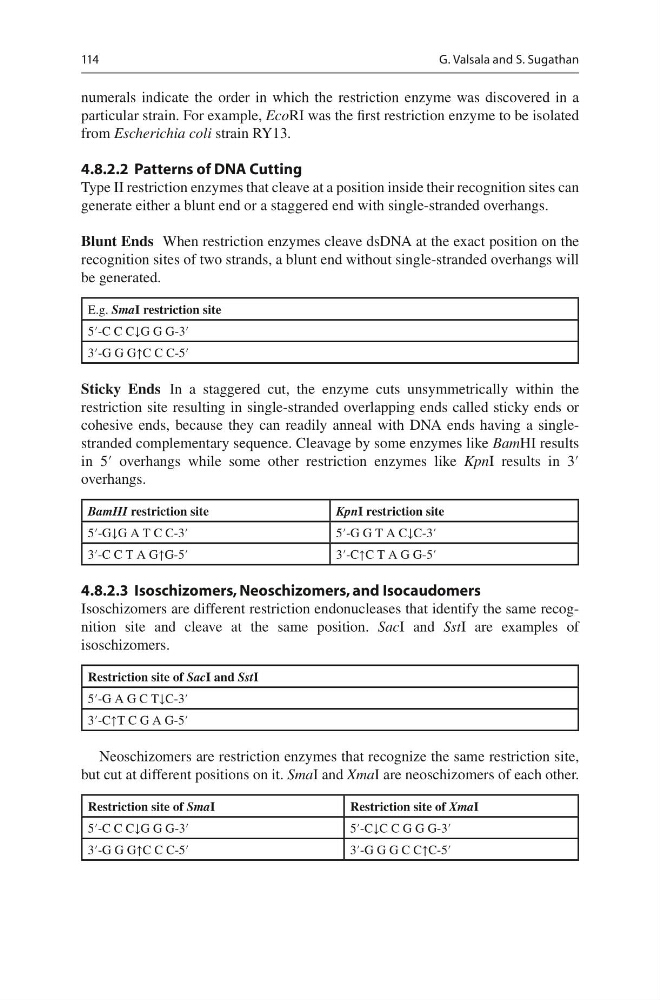
Blunt Ends When restriction enzymes cleave dsDNA at the exact position on the
recognition sites of two strands, a blunt end without single-stranded overhangs will
be generated.
E.g. SmaI restriction site
5′-C C C↓G G G-3′
3′-G G G↑C C C-5′
Sticky Ends In a staggered cut, the enzyme cuts unsymmetrically within the
restriction site resulting in single-stranded overlapping ends called sticky ends or
cohesive ends, because they can readily anneal with DNA ends having a singlestranded complementary sequence. Cleavage by some enzymes like BamHI results
in 5′ overhangs while some other restriction enzymes like KpnI results in 3′
overhangs.
BamHI restriction site
KpnI restriction site
5′-G↓G A T C C-3′
5′-G G T A C↓C-3′
3′-C C T A G↑G-5′
3′-C↑C T A G G-5′
4.8.2.3 Isoschizomers, Neoschizomers, and Isocaudomers
Isoschizomers are different restriction endonucleases that identify the same recognition site and cleave at the same position. SacI and SstI are examples of
isoschizomers.
Restriction site of SacI and SstI
5′-G A G C T↓C-3′
3′-C↑T C G A G-5′
Neoschizomers are restriction enzymes that recognize the same restriction site,
but cut at different positions on it. SmaI and XmaI are neoschizomers of each other.
Restriction site of SmaI
Restriction site of XmaI
5′-C C C↓G G G-3′
5′-C↓C C G G G-3′
3′-G G G↑C C C-5′
3′-G G G C C↑C-5′
G. Valsala and S. Sugathan
numerals indicate the order in which the restriction enzyme was discovered in a
particular strain. For example, EcoRI was the first restriction enzyme to be isolated
from Escherichia coli strain RY13.
4.8.2.2 Patterns of DNA Cutting
Type II restriction enzymes that cleave at a position inside their recognition sites can
generate either a blunt end or a staggered end with single-stranded overhangs.
Blunt Ends When restriction enzymes cleave dsDNA at the exact position on the
recognition sites of two strands, a blunt end without single-stranded overhangs will
be generated.
E.g. SmaI restriction site
5′-C C C↓G G G-3′
3′-G G G↑C C C-5′
Sticky Ends In a staggered cut, the enzyme cuts unsymmetrically within the
restriction site resulting in single-stranded overlapping ends called sticky ends or
cohesive ends, because they can readily anneal with DNA ends having a singlestranded complementary sequence. Cleavage by some enzymes like BamHI results
in 5′ overhangs while some other restriction enzymes like KpnI results in 3′
overhangs.
BamHI restriction site
KpnI restriction site
5′-G↓G A T C C-3′
5′-G G T A C↓C-3′
3′-C C T A G↑G-5′
3′-C↑C T A G G-5′
4.8.2.3 Isoschizomers, Neoschizomers, and Isocaudomers
Isoschizomers are different restriction endonucleases that identify the same recognition site and cleave at the same position. SacI and SstI are examples of
isoschizomers.
Restriction site of SacI and SstI
5′-G A G C T↓C-3′
3′-C↑T C G A G-5′
Neoschizomers are restriction enzymes that recognize the same restriction site,
but cut at different positions on it. SmaI and XmaI are neoschizomers of each other.
Restriction site of SmaI
Restriction site of XmaI
5′-C C C↓G G G-3′
5′-C↓C C G G G-3′
3′-G G G↑C C C-5′
3′-G G G C C↑C-5′
G. Valsala and S. Sugathan