

Apoptosis and Cell Culture Technology
231
Apoptosis is, by contrast, a regulated and controlled process, determined in
a generally pre-programmed manner. There is increasing evidence that this
self-demise process occurs in most animal cell types and is controlled by
a putative "yin-yang" mechanism involving the activation of killer genes and the
deactivation of survival genes. Clearly, this raises the possibility that modifying
the apoptotic response of cells in the bioreactor may suppress or delay the
induction of death in response to chemical and physical stress. This may lead to
the generation of more robust cells lines, which are able to survive more extreme
bioreactor operation strategies.
3.1 Morphological Features of Apoptosis
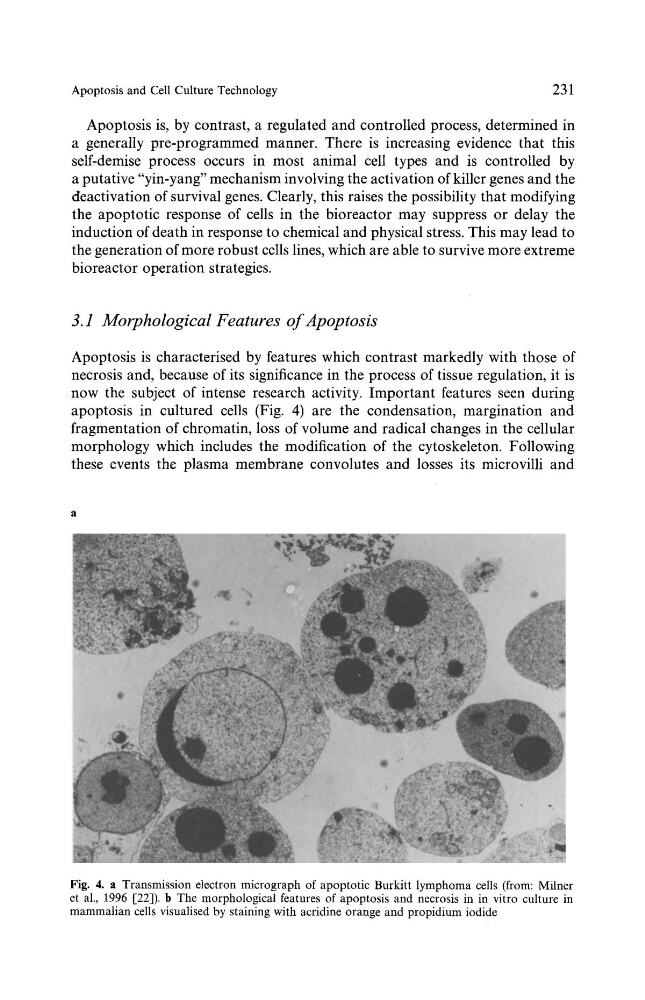
Apoptosis is characterised by features which contrast markedly with those of
necrosis and, because of its significance in the process of tissue regulation, it is
now the subject of intense research activity, Important features seen during
apoptosis in cultured cells (Fig. 4) are the condensation, margination and
fragmentation of chromatin, loss of volume and radical changes in the cellular
morphology which includes the modification of the cytoskeleton. Following
these events the plasma membrane convolutes and losses its microvilli and
Fig. 4. a Transmission electron micrograph of apoptotic Burkitt lymphoma cells (from: Milner
et al., 1996 [22]). h The morphological features of apoptosis and necrosis in in vitro culture in
mammalian cells visualised by staining with acridine orange and propidium iodide
231
Apoptosis is, by contrast, a regulated and controlled process, determined in
a generally pre-programmed manner. There is increasing evidence that this
self-demise process occurs in most animal cell types and is controlled by
a putative "yin-yang" mechanism involving the activation of killer genes and the
deactivation of survival genes. Clearly, this raises the possibility that modifying
the apoptotic response of cells in the bioreactor may suppress or delay the
induction of death in response to chemical and physical stress. This may lead to
the generation of more robust cells lines, which are able to survive more extreme
bioreactor operation strategies.
3.1 Morphological Features of Apoptosis
Apoptosis is characterised by features which contrast markedly with those of
necrosis and, because of its significance in the process of tissue regulation, it is
now the subject of intense research activity, Important features seen during
apoptosis in cultured cells (Fig. 4) are the condensation, margination and
fragmentation of chromatin, loss of volume and radical changes in the cellular
morphology which includes the modification of the cytoskeleton. Following
these events the plasma membrane convolutes and losses its microvilli and
Fig. 4. a Transmission electron micrograph of apoptotic Burkitt lymphoma cells (from: Milner
et al., 1996 [22]). h The morphological features of apoptosis and necrosis in in vitro culture in
mammalian cells visualised by staining with acridine orange and propidium iodide