

220
J.-F. Cornet et al.
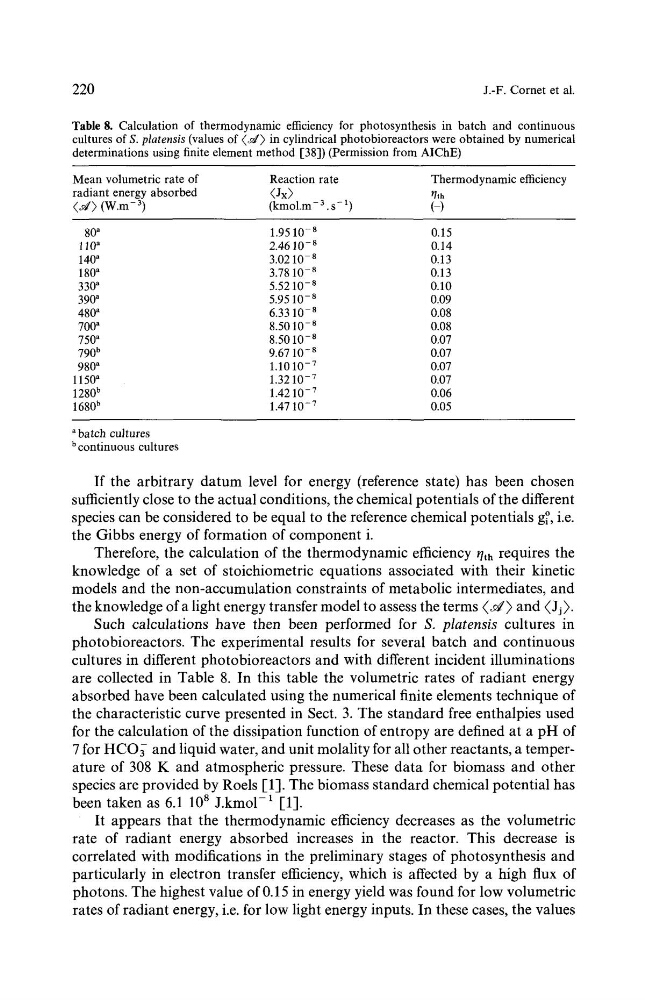
Table 8. Calculation of thermodynamic efficiency for photosynthesis in batch and continuous
cultures of S. platensis (values of (zr in cylindrical photobioreactors were obtained by numerical
determinations using finite element method [38]) (Permission from AIChE)
Mean volumetric rate of
Reaction rate
Thermodynamic efficiency
radiant energy absorbed
(Jx)
rhh
(d) (W.m -3)
(kmol.m- 3. s -1)
( )
80 a
1.95 10 -s
0.15
110 a
2.4610 -s
0.14
140 a
3.02 10 s
0.13
180"
3.78 10 -s
0.13
330 a
5.5210 -8
0.10
390 ~
5.95 10- s
0.09
480 a
6.33 10 s
0.08
700 a
8.5010 - s
0.08
750"
8.5010- s
0.07
790 b
9.6710- s
0.07
980 a
1.1010 -7
0.07
1150 a
1.3210 -7
0.07
1280 b
1.4210- 7
0.06
1680 b
1.47 10- 7
0.05
a batch cultures
b continuous cultures
If the arbitrary datum level for energy (reference state) has been chosen
sufficiently close to the actual conditions, the chemical potentials of the different
species can be considered to be equal to the reference chemical potentials gO, i.e.
the Gibbs energy of formation of component i.
Therefore, the calculation of the thermodynamic efficiency t/t h requires the
knowledge of a set of stoichiometric equations associated with their kinetic
models and the non-accumulation constraints of metabolic intermediates, and
the knowledge of a light energy transfer model to assess the terms (~r and (Jj).
Such calculations have then been performed for S. platensis cultures in
photobioreactors. The experimental results for several batch and continuous
cultures in different photobioreactors and with different incident illuminations
are collected in Table 8. In this table the volumetric rates of radiant energy
absorbed have been calculated using the numerical finite elements technique of
the characteristic curve presented in Sect. 3. The standard free enthalpies used
for the calculation of the dissipation function of entropy are defined at a pH of
7 for HCO3 and liquid water, and unit molality for all other reactants, a temperature of 308 K and atmospheric pressure. These data for biomass and other
species are provided by Roels [1]. The biomass standard chemical potential has
been taken as 6.1 l0 s J.kmol-1 [1].
It appears that the thermodynamic efficiency decreases as the volumetric
rate of radiant energy absorbed increases in the reactor. This decrease is
correlated with modifications in the preliminary stages of photosynthesis and
particularly in electron transfer efficiency, which is affected by a high flux of
photons. The highest value of 0.15 in energy yield was found for low volumetric
rates of radiant energy, i.e. for low light energy inputs. In these cases, the values
J.-F. Cornet et al.
Table 8. Calculation of thermodynamic efficiency for photosynthesis in batch and continuous
cultures of S. platensis (values of (zr in cylindrical photobioreactors were obtained by numerical
determinations using finite element method [38]) (Permission from AIChE)
Mean volumetric rate of
Reaction rate
Thermodynamic efficiency
radiant energy absorbed
(Jx)
rhh
(d) (W.m -3)
(kmol.m- 3. s -1)
( )
80 a
1.95 10 -s
0.15
110 a
2.4610 -s
0.14
140 a
3.02 10 s
0.13
180"
3.78 10 -s
0.13
330 a
5.5210 -8
0.10
390 ~
5.95 10- s
0.09
480 a
6.33 10 s
0.08
700 a
8.5010 - s
0.08
750"
8.5010- s
0.07
790 b
9.6710- s
0.07
980 a
1.1010 -7
0.07
1150 a
1.3210 -7
0.07
1280 b
1.4210- 7
0.06
1680 b
1.47 10- 7
0.05
a batch cultures
b continuous cultures
If the arbitrary datum level for energy (reference state) has been chosen
sufficiently close to the actual conditions, the chemical potentials of the different
species can be considered to be equal to the reference chemical potentials gO, i.e.
the Gibbs energy of formation of component i.
Therefore, the calculation of the thermodynamic efficiency t/t h requires the
knowledge of a set of stoichiometric equations associated with their kinetic
models and the non-accumulation constraints of metabolic intermediates, and
the knowledge of a light energy transfer model to assess the terms (~r and (Jj).
Such calculations have then been performed for S. platensis cultures in
photobioreactors. The experimental results for several batch and continuous
cultures in different photobioreactors and with different incident illuminations
are collected in Table 8. In this table the volumetric rates of radiant energy
absorbed have been calculated using the numerical finite elements technique of
the characteristic curve presented in Sect. 3. The standard free enthalpies used
for the calculation of the dissipation function of entropy are defined at a pH of
7 for HCO3 and liquid water, and unit molality for all other reactants, a temperature of 308 K and atmospheric pressure. These data for biomass and other
species are provided by Roels [1]. The biomass standard chemical potential has
been taken as 6.1 l0 s J.kmol-1 [1].
It appears that the thermodynamic efficiency decreases as the volumetric
rate of radiant energy absorbed increases in the reactor. This decrease is
correlated with modifications in the preliminary stages of photosynthesis and
particularly in electron transfer efficiency, which is affected by a high flux of
photons. The highest value of 0.15 in energy yield was found for low volumetric
rates of radiant energy, i.e. for low light energy inputs. In these cases, the values