

Kinetics and Energetics of Photosynthetic Micro-Organisms in Photobioreactors
219
It may be concluded that the theoretical predictions of the P/2e - ratio are in
close agreement with the experimental values obtained for different limitation
conditions. At the present time, it should be stressed that the two asymptotic
values of P/2e-, 1.21 and 1.71, correspond strictly to the values obtained for
carbonate and nitrate limitation conditions respectively. Furthermore, the changes in biomass compositions with light energy availability, i.e. increase in
exopolysaccharide fraction with increase in incident light flux, are qualitatively
represented by the theoretical model. This confirms the usefulness and the
potential of such a biochemically structured approach associated with a thermodynamic analysis of energy transduction processes, for representing not only the
overall production and consumption rates but also the internal composition of
biomass and the variation of conversion yields with external conditions. In this
respect, the thermodynamics of linear energy converters and the relevant optimization of the entropy production rate which must be considered as a function of
the external constraints imposed on the system is a promising tool for handling
the expressions of the conversions yields.
6.2 Thermodynamic Efficiency for Batch and Continuous Cultures
The above analysis implicitly leads to the determination of the macroscopic
thermodynamic efficiency and of the enthalpy efficiency, the definitions of which
are still being debated [103-110]. This point can now be clarified.
The conversion of radiant light energy into chemical energy at microscopic
or macroscopic levels is described by three types of balance equations:
mass balance (Sect. 2);
photonic phase balance knowing the expression of the local volumetric
rate of radiant energy absorbed (Sect. 3);
- energy balances accounting for the interchanges of energy between the
material phase and the photonic phase.
The entropy balance is obtained from the Gibbs equation, splitting the
rate of entropy accumulation into a source term and a convective term
[38, 98, 99]. This last balance affords the expression for the dissipation function,
and the thermodynamic treatment of energy conversion using the thermodynamics of irreversible processes which is concerned with the study or relations
between rates and affinities. This enables one to establish the thermodynamic
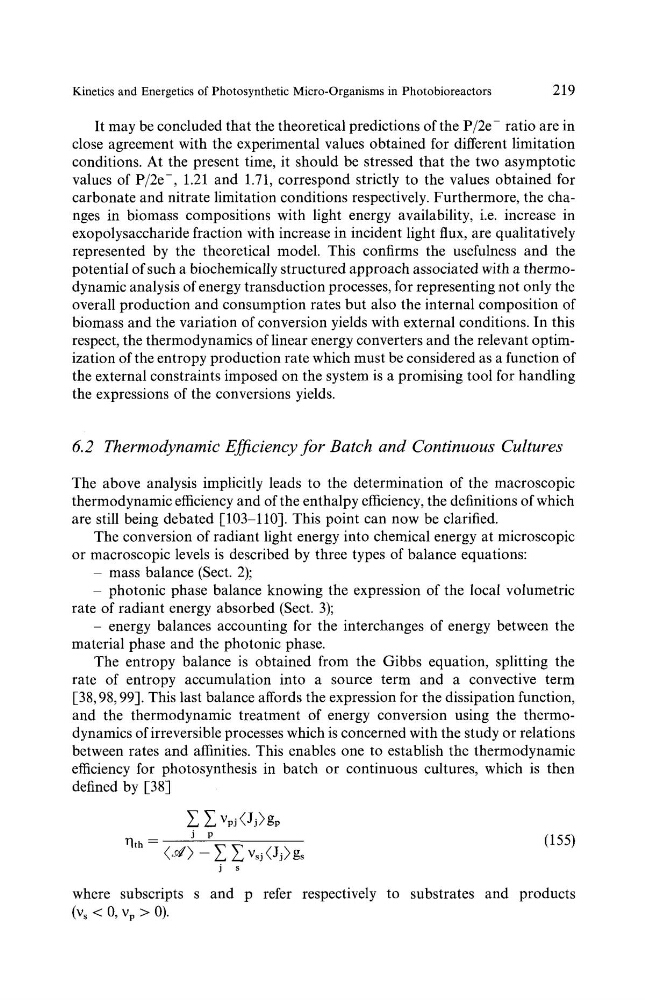
efficiency for photosynthesis in batch or continuous cultures, which is then
defined by [38]
~ Vpj (Jj)gp
Thh=
J P
(155)
(~r -- ~ ~ Vs~(Jj)gs
j s
where subscripts s and p refer respectively to substrates and products
(vs < 0, vp > 0).
219
It may be concluded that the theoretical predictions of the P/2e - ratio are in
close agreement with the experimental values obtained for different limitation
conditions. At the present time, it should be stressed that the two asymptotic
values of P/2e-, 1.21 and 1.71, correspond strictly to the values obtained for
carbonate and nitrate limitation conditions respectively. Furthermore, the changes in biomass compositions with light energy availability, i.e. increase in
exopolysaccharide fraction with increase in incident light flux, are qualitatively
represented by the theoretical model. This confirms the usefulness and the
potential of such a biochemically structured approach associated with a thermodynamic analysis of energy transduction processes, for representing not only the
overall production and consumption rates but also the internal composition of
biomass and the variation of conversion yields with external conditions. In this
respect, the thermodynamics of linear energy converters and the relevant optimization of the entropy production rate which must be considered as a function of
the external constraints imposed on the system is a promising tool for handling
the expressions of the conversions yields.
6.2 Thermodynamic Efficiency for Batch and Continuous Cultures
The above analysis implicitly leads to the determination of the macroscopic
thermodynamic efficiency and of the enthalpy efficiency, the definitions of which
are still being debated [103-110]. This point can now be clarified.
The conversion of radiant light energy into chemical energy at microscopic
or macroscopic levels is described by three types of balance equations:
mass balance (Sect. 2);
photonic phase balance knowing the expression of the local volumetric
rate of radiant energy absorbed (Sect. 3);
- energy balances accounting for the interchanges of energy between the
material phase and the photonic phase.
The entropy balance is obtained from the Gibbs equation, splitting the
rate of entropy accumulation into a source term and a convective term
[38, 98, 99]. This last balance affords the expression for the dissipation function,
and the thermodynamic treatment of energy conversion using the thermodynamics of irreversible processes which is concerned with the study or relations
between rates and affinities. This enables one to establish the thermodynamic
efficiency for photosynthesis in batch or continuous cultures, which is then
defined by [38]
~ Vpj (Jj)gp
Thh=
J P
(155)
(~r -- ~ ~ Vs~(Jj)gs
j s
where subscripts s and p refer respectively to substrates and products
(vs < 0, vp > 0).