

Kinetics and Energetics of Photosynthetic Micro-Organisms in Photobioreactors
211
anabolic events and no longer by a single stoichiometric equation. One
way could be to correlate empirically each of these rates as functions of
energy availability. The approach which is presented here uses, first, a
detailed description of metabolic pathways for characterizing the two
anabolic events, and second, an analysis of the thermodynamic efficiency of
chemical energy producing machinery. This leads to a biochemically structured
model.
6.1 Coupling photophosphorylations and Photosynthesis:
A TP/2e- Determination and Biomass Composition Prediction
6.1.1 Basic Formalisation for a Structured Model of S. platensis Growth
As previously stated in Sect. 2, to match the consumption of the reduced factors
(considered here as NADPH, H +) and the ATP consumption for an anabolic
process, it is necessary to consider two additive stoichiometric equations: one for
NADP + reduction (water photolysis, Eq. 28) and one for ATP regeneration
(Eq. 29). This investigation of light energy influence upon rates and biomass
composition will therefore need four stoichiometric equations: two for anabolic
processes (Eqs. 25 and 26) and two for light energy conversion into chemical
energy (ATP) and into reducing power (NADPH, H +). Considering a pseudosteady state assumption for ATP and cofactors, the four reaction rates must
satisfy two constraints leaving two rates that must be independently correlated.
By comparison, the previous approach, which uses a single stoichiometric
equation for total biomass formation leads to one rate equation which has to be
determined on the basis of the light transfer model, when light energy transfer is
the rate limiting process.
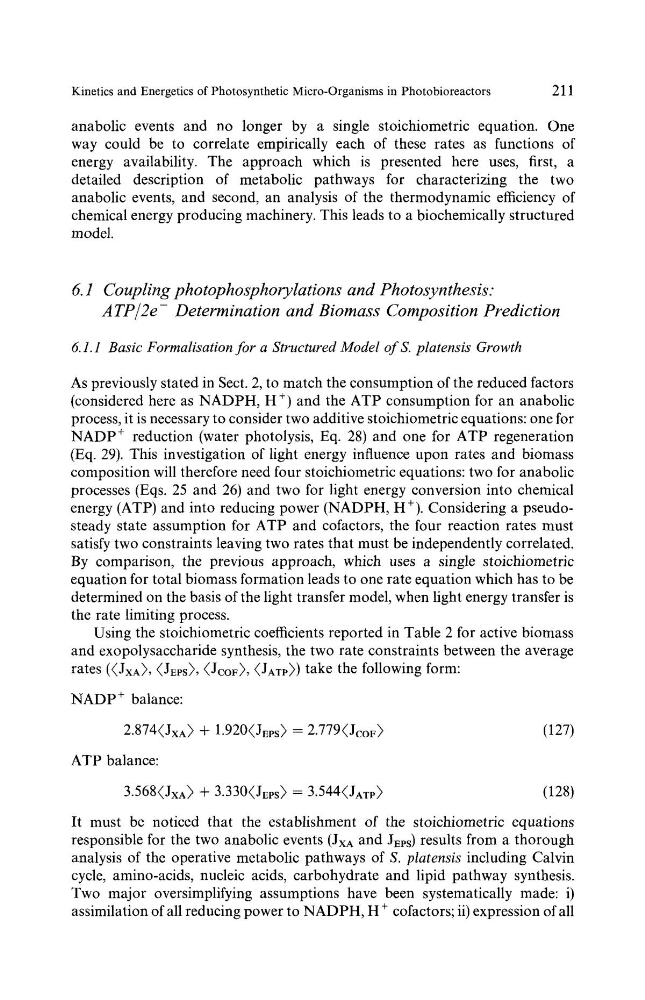
Using the stoichiometric coefficients reported in Table 2 for active biomass
and exopolysaccharide synthesis, the two rate constraints between the average
rates ((JxA), (JEPs), (Jcov), (JATI')) take the following form:
NADP + balance:
2.874(JxA) + 1.920(JEPs) = 2.779(Jcov)
ATP balance:
(127)
3.568(Jxa) + 3.330(JEPs) = 3.544(JATp)
(128)
It must be noticed that the establishment of the stoichiometric equations
responsible for the two anabolic events (JxA and JEps) results from a thorough
analysis of the operative metabolic pathways of S. platensis including Calvin
cycle, amino-acids, nucleic acids, carbohydrate and lipid pathway synthesis.
Two major oversimplifying assumptions have been systematically made: i)
assimilation of all reducing power to NADPH, H + cofactors; ii) expression of all
211
anabolic events and no longer by a single stoichiometric equation. One
way could be to correlate empirically each of these rates as functions of
energy availability. The approach which is presented here uses, first, a
detailed description of metabolic pathways for characterizing the two
anabolic events, and second, an analysis of the thermodynamic efficiency of
chemical energy producing machinery. This leads to a biochemically structured
model.
6.1 Coupling photophosphorylations and Photosynthesis:
A TP/2e- Determination and Biomass Composition Prediction
6.1.1 Basic Formalisation for a Structured Model of S. platensis Growth
As previously stated in Sect. 2, to match the consumption of the reduced factors
(considered here as NADPH, H +) and the ATP consumption for an anabolic
process, it is necessary to consider two additive stoichiometric equations: one for
NADP + reduction (water photolysis, Eq. 28) and one for ATP regeneration
(Eq. 29). This investigation of light energy influence upon rates and biomass
composition will therefore need four stoichiometric equations: two for anabolic
processes (Eqs. 25 and 26) and two for light energy conversion into chemical
energy (ATP) and into reducing power (NADPH, H +). Considering a pseudosteady state assumption for ATP and cofactors, the four reaction rates must
satisfy two constraints leaving two rates that must be independently correlated.
By comparison, the previous approach, which uses a single stoichiometric
equation for total biomass formation leads to one rate equation which has to be
determined on the basis of the light transfer model, when light energy transfer is
the rate limiting process.
Using the stoichiometric coefficients reported in Table 2 for active biomass
and exopolysaccharide synthesis, the two rate constraints between the average
rates ((JxA), (JEPs), (Jcov), (JATI')) take the following form:
NADP + balance:
2.874(JxA) + 1.920(JEPs) = 2.779(Jcov)
ATP balance:
(127)
3.568(Jxa) + 3.330(JEPs) = 3.544(JATp)
(128)
It must be noticed that the establishment of the stoichiometric equations
responsible for the two anabolic events (JxA and JEps) results from a thorough
analysis of the operative metabolic pathways of S. platensis including Calvin
cycle, amino-acids, nucleic acids, carbohydrate and lipid pathway synthesis.
Two major oversimplifying assumptions have been systematically made: i)
assimilation of all reducing power to NADPH, H + cofactors; ii) expression of all