

210
J.-F. Cornet et al.
Table 7. Effect of bicarbonate limitations on the Spirulina mass volumetric growth rate in total
biomass obtained in batch cultures vs the CO2 amount in the gas phase. The maximum growth rate
is obtained for an incident radiant energy flux of 200 W.m -z in a cylindrical photobioreactor of 51
CO 2 amount in the
Mass volumetric
Ratio
incoming gas flow rate
rate in biomass
(rxT)
(ppm)
(rx~). 10 3 (kg.m- 3. h- 1)
(rxT)max
Maximum mass volumetric
11.0
1
growth rate under only light
limitation (F0 = 200 W.m-2)
(rxT)max
2800
9.0
0.82
2100
7.5
0.68
1400
5.6
0.51
700
3.3
0.30
350
1.9
0.17
2 the culture may be limited by the bicarbonate concentration in the liquid
medium. In this case, the problem is very similar to that of mineral limitations
and this requires a kinetic equation relating the mass volumetric rate of biomass
under light limitation (rxx) and the bicarbonate concentration in the medium.
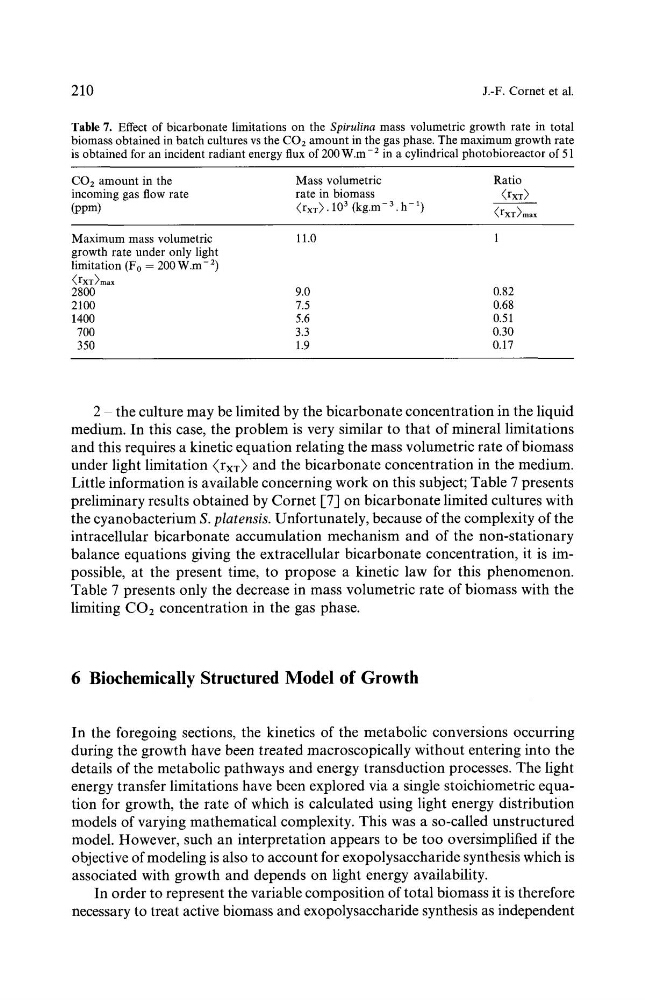
Little information is available concerning work on this subject; Table 7 presents
preliminary results obtained by Cornet [7] on bicarbonate limited cultures with
the cyanobacterium S. platensis. Unfortunately, because of the complexity of the
intracellular bicarbonate accumulation mechanism and of the non-stationary
balance equations giving the extracellular bicarbonate concentration, it is impossible, at the present time, to propose a kinetic law for this phenomenon.
Table 7 presents only the decrease in mass volumetric rate of biomass with the
limiting CO/concentration in the gas phase.
6 Biochemically Structured Model of Growth
In the foregoing sections, the kinetics of the metabolic conversions occurring
during the growth have been treated macroscopically without entering into the
details of the metabolic pathways and energy transduction processes. The light
energy transfer limitations have been explored via a single stoichiometric equation for growth, the rate of which is calculated using light energy distribution
models of varying mathematical complexity. This was a so-called unstructured
model. However, such an interpretation appears to be too oversimplified if the
objective of modeling is also to account for exopolysaccharide synthesis which is
associated with growth and depends on light energy availability.
In order to represent the variable composition of total biomass it is therefore
necessary to treat active biomass and exopolysaccharide synthesis as independent
J.-F. Cornet et al.
Table 7. Effect of bicarbonate limitations on the Spirulina mass volumetric growth rate in total
biomass obtained in batch cultures vs the CO2 amount in the gas phase. The maximum growth rate
is obtained for an incident radiant energy flux of 200 W.m -z in a cylindrical photobioreactor of 51
CO 2 amount in the
Mass volumetric
Ratio
incoming gas flow rate
rate in biomass
(rxT)
(ppm)
(rx~). 10 3 (kg.m- 3. h- 1)
(rxT)max
Maximum mass volumetric
11.0
1
growth rate under only light
limitation (F0 = 200 W.m-2)
(rxT)max
2800
9.0
0.82
2100
7.5
0.68
1400
5.6
0.51
700
3.3
0.30
350
1.9
0.17
2 the culture may be limited by the bicarbonate concentration in the liquid
medium. In this case, the problem is very similar to that of mineral limitations
and this requires a kinetic equation relating the mass volumetric rate of biomass
under light limitation (rxx) and the bicarbonate concentration in the medium.
Little information is available concerning work on this subject; Table 7 presents
preliminary results obtained by Cornet [7] on bicarbonate limited cultures with
the cyanobacterium S. platensis. Unfortunately, because of the complexity of the
intracellular bicarbonate accumulation mechanism and of the non-stationary
balance equations giving the extracellular bicarbonate concentration, it is impossible, at the present time, to propose a kinetic law for this phenomenon.
Table 7 presents only the decrease in mass volumetric rate of biomass with the
limiting CO/concentration in the gas phase.
6 Biochemically Structured Model of Growth
In the foregoing sections, the kinetics of the metabolic conversions occurring
during the growth have been treated macroscopically without entering into the
details of the metabolic pathways and energy transduction processes. The light
energy transfer limitations have been explored via a single stoichiometric equation for growth, the rate of which is calculated using light energy distribution
models of varying mathematical complexity. This was a so-called unstructured
model. However, such an interpretation appears to be too oversimplified if the
objective of modeling is also to account for exopolysaccharide synthesis which is
associated with growth and depends on light energy availability.
In order to represent the variable composition of total biomass it is therefore
necessary to treat active biomass and exopolysaccharide synthesis as independent