

208
J.-F. Cornet et al.
In order to complete the reaction scheme, the water dissociation equilibrium
must be considered (ionic product Ke):
H + + OH- ~ HzO
(120)
Furthermore, when the liquid medium contains calcium ions with no complexant, the solubility product for CaCO 3 must be considered:
Ca z+ + CO~- -~ CaCO 3
(121)
with K s = Cc,2+ Cco ~
(122)
For synthetic culture media, the equilibrium constants Kp K2, Kevs the
temperature are available in the literature [92]. For example, at 25 ~
K 1 = 4.38- 10 -7 mol'1-1, K z = 4.65-10 -11 mol'1-1, and Ke = 10-14 mo1-1-1.
5.3 Conservation Law for the C02-HCOa-CO~- System
In the general case, in an aerated WTR at fixed pH with no presumption
concerning batch or continuous processing, the following differential system,
deduced from the above reaction scheme, may be written for the liquid phase:
fdC~
dt
'd' [ CHco~
dt
-
EkLa(C~*o~ C~)
,e
......
-+ D(Cco~ -- Cco~) -- kl Cco~ + k_ 1 CHCO; CH+
-- D(C~co; - C~ico~) + k'l C~o~ + k-2C~co]-Ch+ - k'-i
'
'
k '
Yc/xT
CHCO~ CH +- 2CHco;
(rxT).
MHCO~
dC~- _ D(C~Eo ~ _ C~o~ ) + k2Chco; - k-2C~o~-Ch+
dt
(123)
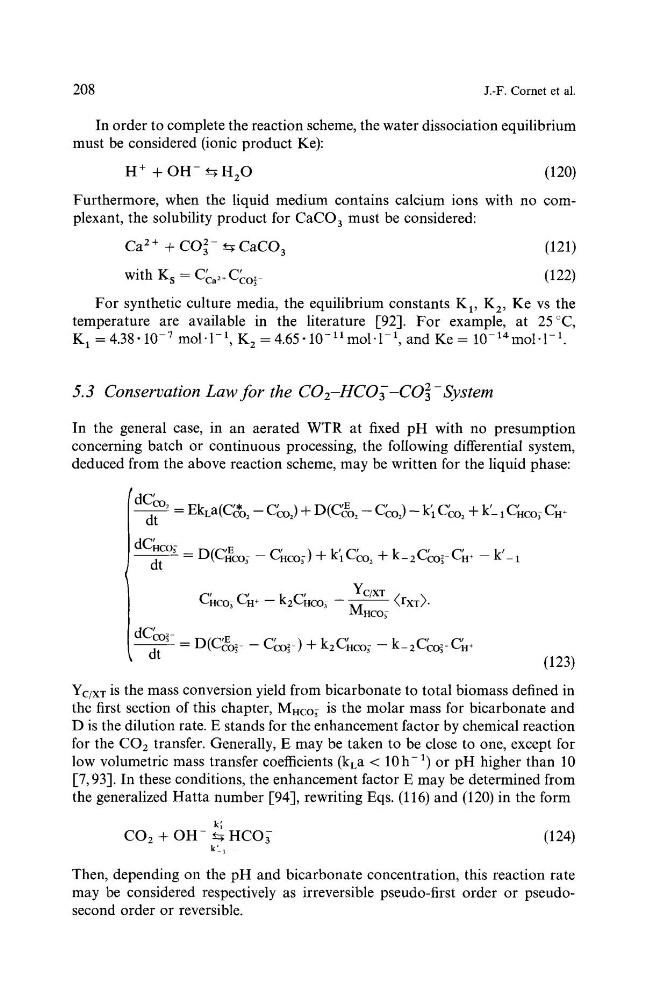
YC/XT is the mass conversion yield from bicarbonate to total biomass defined in
the first section of this chapter, MHco~ is the molar mass for bicarbonate and
D is the dilution rate. E stands for the enhancement factor by chemical reaction
for the CO2 transfer. Generally, E may be taken to be close to one, except for
low volumetric mass transfer coefficients (kLa < 10 h-1) or pH higher than 10
[7, 93]. In these conditions, the enhancement factor E may be determined from
the generalized Hatta number [94], rewriting Eqs. (116) and (120) in the form
k;
CO2 + OH- ~ HCO3
(124)
k' _~
Then, depending on the pH and bicarbonate concentration, this reaction rate
may be considered respectively as irreversible pseudo-first order or pseudosecond order or reversible.
J.-F. Cornet et al.
In order to complete the reaction scheme, the water dissociation equilibrium
must be considered (ionic product Ke):
H + + OH- ~ HzO
(120)
Furthermore, when the liquid medium contains calcium ions with no complexant, the solubility product for CaCO 3 must be considered:
Ca z+ + CO~- -~ CaCO 3
(121)
with K s = Cc,2+ Cco ~
(122)
For synthetic culture media, the equilibrium constants Kp K2, Kevs the
temperature are available in the literature [92]. For example, at 25 ~
K 1 = 4.38- 10 -7 mol'1-1, K z = 4.65-10 -11 mol'1-1, and Ke = 10-14 mo1-1-1.
5.3 Conservation Law for the C02-HCOa-CO~- System
In the general case, in an aerated WTR at fixed pH with no presumption
concerning batch or continuous processing, the following differential system,
deduced from the above reaction scheme, may be written for the liquid phase:
fdC~
dt
'd' [ CHco~
dt
-
EkLa(C~*o~ C~)
,e
......
-+ D(Cco~ -- Cco~) -- kl Cco~ + k_ 1 CHCO; CH+
-- D(C~co; - C~ico~) + k'l C~o~ + k-2C~co]-Ch+ - k'-i
'
'
k '
Yc/xT
CHCO~ CH +- 2CHco;
(rxT).
MHCO~
dC~- _ D(C~Eo ~ _ C~o~ ) + k2Chco; - k-2C~o~-Ch+
dt
(123)
YC/XT is the mass conversion yield from bicarbonate to total biomass defined in
the first section of this chapter, MHco~ is the molar mass for bicarbonate and
D is the dilution rate. E stands for the enhancement factor by chemical reaction
for the CO2 transfer. Generally, E may be taken to be close to one, except for
low volumetric mass transfer coefficients (kLa < 10 h-1) or pH higher than 10
[7, 93]. In these conditions, the enhancement factor E may be determined from
the generalized Hatta number [94], rewriting Eqs. (116) and (120) in the form
k;
CO2 + OH- ~ HCO3
(124)
k' _~
Then, depending on the pH and bicarbonate concentration, this reaction rate
may be considered respectively as irreversible pseudo-first order or pseudosecond order or reversible.