

Kinetics and Energetics of Photosynthetic Micro-Organisms in Photobioreactors
207
2 - non-limiting concentration of bicarbonate: The bioconversion rates depend
on other parameters (light energy transfer, mineral limitations). However, the
CO2 balance remains to be solved because the total dissolved carbon concentration can either slowly increase or decrease, depending on the process parameters
and on the physiological activity of the micro-organisms.
5.2 Physical and Chemical Equilibria for the C02-HC03-CO zSystem
5.2.1 Gas-Liquid Equilibrium
For the most commonly encountered conditions (low CO 2 partial pressure) in
aeration of photosynthetic cultures, the CO 2 fugacity coefficient is equal to 1.
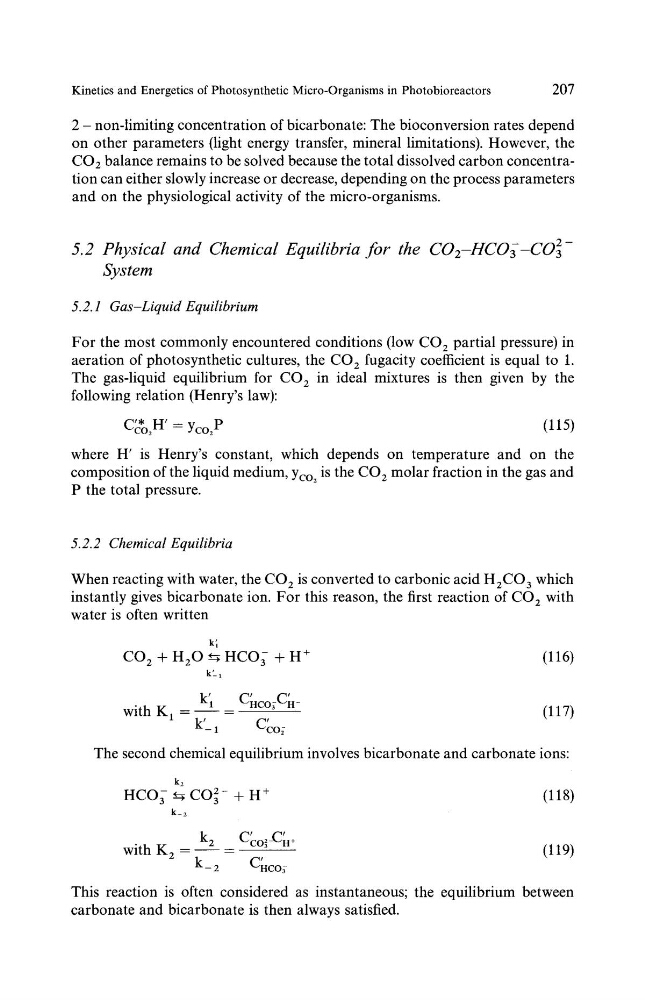
The gas-liquid equilibrium for CO 2 in ideal mixtures is then given by the
following relation (Henry's law):
C'* I4'
(115)
co2.1 = Yco2P
where H' is Henry's constant, which depends on temperature and on the
composition of the liquid medium, Yco2 is the CO 2 molar fraction in the gas and
P the total pressure.
5.2.2 Chemical Equilibria
When reacting with water, the CO 2 is converted to carbonic acid H2CO 3 which
instantly gives bicarbonate ion. For this reason, the first reaction of CO 2 with
water is often written
kl
CO 2 -~ H20 ~ HCO 3 + H +
(116)
k'-i
t
t
t
kl
Cnco~Cnwith K 1 - -- -
,
(117)
k'_ 1
Cco~
The second chemical equilibrium involves bicarbonate and carbonate ions:
k2
HCO; ~ CO 2- + H +
(118)
k 2
k2
CcoICH +
with K 2 - -- -
(119)
k-2
CHCO~
This reaction is often considered as instantaneous; the equilibrium between
carbonate and bicarbonate is then always satisfied.
207
2 - non-limiting concentration of bicarbonate: The bioconversion rates depend
on other parameters (light energy transfer, mineral limitations). However, the
CO2 balance remains to be solved because the total dissolved carbon concentration can either slowly increase or decrease, depending on the process parameters
and on the physiological activity of the micro-organisms.
5.2 Physical and Chemical Equilibria for the C02-HC03-CO zSystem
5.2.1 Gas-Liquid Equilibrium
For the most commonly encountered conditions (low CO 2 partial pressure) in
aeration of photosynthetic cultures, the CO 2 fugacity coefficient is equal to 1.
The gas-liquid equilibrium for CO 2 in ideal mixtures is then given by the
following relation (Henry's law):
C'* I4'
(115)
co2.1 = Yco2P
where H' is Henry's constant, which depends on temperature and on the
composition of the liquid medium, Yco2 is the CO 2 molar fraction in the gas and
P the total pressure.
5.2.2 Chemical Equilibria
When reacting with water, the CO 2 is converted to carbonic acid H2CO 3 which
instantly gives bicarbonate ion. For this reason, the first reaction of CO 2 with
water is often written
kl
CO 2 -~ H20 ~ HCO 3 + H +
(116)
k'-i
t
t
t
kl
Cnco~Cnwith K 1 - -- -
,
(117)
k'_ 1
Cco~
The second chemical equilibrium involves bicarbonate and carbonate ions:
k2
HCO; ~ CO 2- + H +
(118)
k 2
k2
CcoICH +
with K 2 - -- -
(119)
k-2
CHCO~
This reaction is often considered as instantaneous; the equilibrium between
carbonate and bicarbonate is then always satisfied.