

Kinetics and Energetics of Photosynthetic Micro-Organisms in Photobioreactors
163
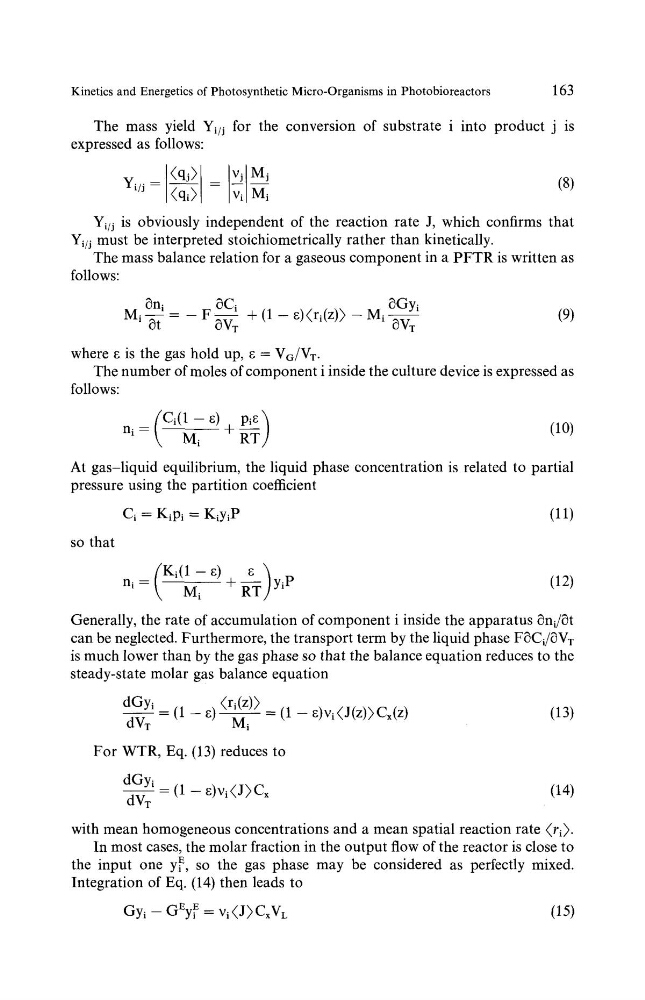
The mass yield Yi/j for the conversion of substrate i into product j is
expressed as follows:
(qj)
V~ Mj
=
=
(8)
Y~/j is obviously independent of the reaction rate J, which confirms that
Y~/j must be interpreted stoichiometrically rather than kinetically.
The mass balance relation for a gaseous component in a PFTR is written as
follows:
~ni
F ~Ci
~Gyi
Mi at -
5VT + (1 -- e)(ri(z)) -- Mi ~--~T
(9)
where e is the gas hold up, ~ = V6/VT.
The number of moles of component i inside the culture device is expressed as
follows:
(Ci(1- 8)Pi~
ni : \
M i
q- RTJ
(10)
At gas-liquid equilibrium, the liquid phase concentration is related to partial
pressure using the partition coefficient
Ci :
KiPi = KiYiP
(11)
so that
(Ki(1 -- ~) + ~TT)yiP
(12)
Generally, the rate of accumulation of component i inside the apparatus ~nl/~t
can be neglected. Furthermore, the transport term by the liquid phase F~Ci/SVT
is much lower than by the gas phase so that the balance equation reduces to the
steady-state molar gas balance equation
dGyi
(ri(z))
-
(1 - 8)= (1 - 8)vi(J(z))fx(Z)
(13)
dVT
Mi
For WTR, Eq. (13) reduces to
dGyi - (1 - e)v~(J)Cx
(14)
dVT
with mean homogeneous concentrations and a mean spatial reaction rate (ri).
In most cases, the molar fraction in the output flow of the reactor is close to
the input one yi ~, so the gas phase may be considered as perfectly mixed.
Integration of Eq. (14) then leads to
Gyi - G~y E = vi (J) CxVL
(15)
163
The mass yield Yi/j for the conversion of substrate i into product j is
expressed as follows:
(qj)
V~ Mj
=
=
(8)
Y~/j is obviously independent of the reaction rate J, which confirms that
Y~/j must be interpreted stoichiometrically rather than kinetically.
The mass balance relation for a gaseous component in a PFTR is written as
follows:
~ni
F ~Ci
~Gyi
Mi at -
5VT + (1 -- e)(ri(z)) -- Mi ~--~T
(9)
where e is the gas hold up, ~ = V6/VT.
The number of moles of component i inside the culture device is expressed as
follows:
(Ci(1- 8)Pi~
ni : \
M i
q- RTJ
(10)
At gas-liquid equilibrium, the liquid phase concentration is related to partial
pressure using the partition coefficient
Ci :
KiPi = KiYiP
(11)
so that
(Ki(1 -- ~) + ~TT)yiP
(12)
Generally, the rate of accumulation of component i inside the apparatus ~nl/~t
can be neglected. Furthermore, the transport term by the liquid phase F~Ci/SVT
is much lower than by the gas phase so that the balance equation reduces to the
steady-state molar gas balance equation
dGyi
(ri(z))
-
(1 - 8)= (1 - 8)vi(J(z))fx(Z)
(13)
dVT
Mi
For WTR, Eq. (13) reduces to
dGyi - (1 - e)v~(J)Cx
(14)
dVT
with mean homogeneous concentrations and a mean spatial reaction rate (ri).
In most cases, the molar fraction in the output flow of the reactor is close to
the input one yi ~, so the gas phase may be considered as perfectly mixed.
Integration of Eq. (14) then leads to
Gyi - G~y E = vi (J) CxVL
(15)