

162
J.-F. Cornet et al.
2.1.2 Balance Equations
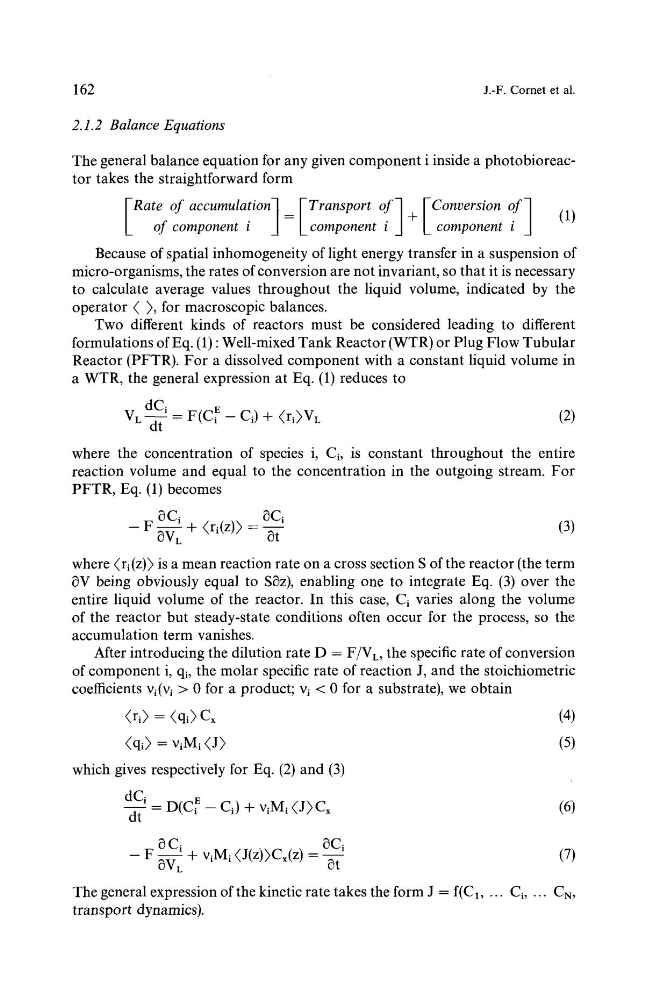
The general balance equation for any given component i inside a photobioreactor takes the straightforward form
of component i I
L component i J L component
Because of spatial inhomogeneity of light energy transfer in a suspension of
micro-organisms, the rates of conversion are not invariant, so that it is necessary
to calculate average values throughout the liquid volume, indicated by the
operator (), for macroscopic balances.
Two different kinds of reactors must be considered leading to different
formulations of Eq. (1) : Well-mixed Tank Reactor (WTR) or Plug Flow Tubular
Reactor (PFTR). For a dissolved component with a constant liquid volume in
a WTR, the general expression at Eq. (1) reduces to
dCi = F(C~ - el) + (rl)VL
(2)
VL~iwhere the concentration of species i, Ci, is constant throughout the entire
reaction volume and equal to the concentration in the outgoing stream. For
PFTR, Eq. (1) becomes
-
F ~Ci
~Ci
~VL + (ri(z)) - St
(3)
where (ri(z)) is a mean reaction rate on a cross section S of the reactor (the term
~V being obviously equal to SOz), enabling one to integrate Eq. (3) over the
entire liquid volume of the reactor. In this case, Ci varies along the volume
of the reactor but steady-state conditions often occur for the process, so the
accumulation term vanishes.
After introducing the dilution rate D = F/VL, the specific rate of conversion
of component i, % the molar specific rate of reaction J, and the stoichiometric
coefficients vi(vl > 0 for a product; vi < 0 for a substrate), we obtain
(ri> = (ql) Cx
(4)
(qi) = viMi (J)
(5)
which gives respectively for Eq. (2) and (3)
dCi _ D(C~ - Ci) + viMi (J)Cx
(6)
dt
_F~Ci ~V L -[- vim i (J(z))Cx(z)
OCi St
(7)
The general expression of the kinetic rate takes the form J = f(Cl, ... Ci, ... CN,
transport dynamics).
J.-F. Cornet et al.
2.1.2 Balance Equations
The general balance equation for any given component i inside a photobioreactor takes the straightforward form
of component i I
L component i J L component
Because of spatial inhomogeneity of light energy transfer in a suspension of
micro-organisms, the rates of conversion are not invariant, so that it is necessary
to calculate average values throughout the liquid volume, indicated by the
operator (), for macroscopic balances.
Two different kinds of reactors must be considered leading to different
formulations of Eq. (1) : Well-mixed Tank Reactor (WTR) or Plug Flow Tubular
Reactor (PFTR). For a dissolved component with a constant liquid volume in
a WTR, the general expression at Eq. (1) reduces to
dCi = F(C~ - el) + (rl)VL
(2)
VL~iwhere the concentration of species i, Ci, is constant throughout the entire
reaction volume and equal to the concentration in the outgoing stream. For
PFTR, Eq. (1) becomes
-
F ~Ci
~Ci
~VL + (ri(z)) - St
(3)
where (ri(z)) is a mean reaction rate on a cross section S of the reactor (the term
~V being obviously equal to SOz), enabling one to integrate Eq. (3) over the
entire liquid volume of the reactor. In this case, Ci varies along the volume
of the reactor but steady-state conditions often occur for the process, so the
accumulation term vanishes.
After introducing the dilution rate D = F/VL, the specific rate of conversion
of component i, % the molar specific rate of reaction J, and the stoichiometric
coefficients vi(vl > 0 for a product; vi < 0 for a substrate), we obtain
(ri> = (ql) Cx
(4)
(qi) = viMi (J)
(5)
which gives respectively for Eq. (2) and (3)
dCi _ D(C~ - Ci) + viMi (J)Cx
(6)
dt
_F~Ci ~V L -[- vim i (J(z))Cx(z)
OCi St
(7)
The general expression of the kinetic rate takes the form J = f(Cl, ... Ci, ... CN,
transport dynamics).