

Antimicrobial Peptides of Lactic Acid Bacteria: Mode of Action, Genetics and Biosynthesis
49
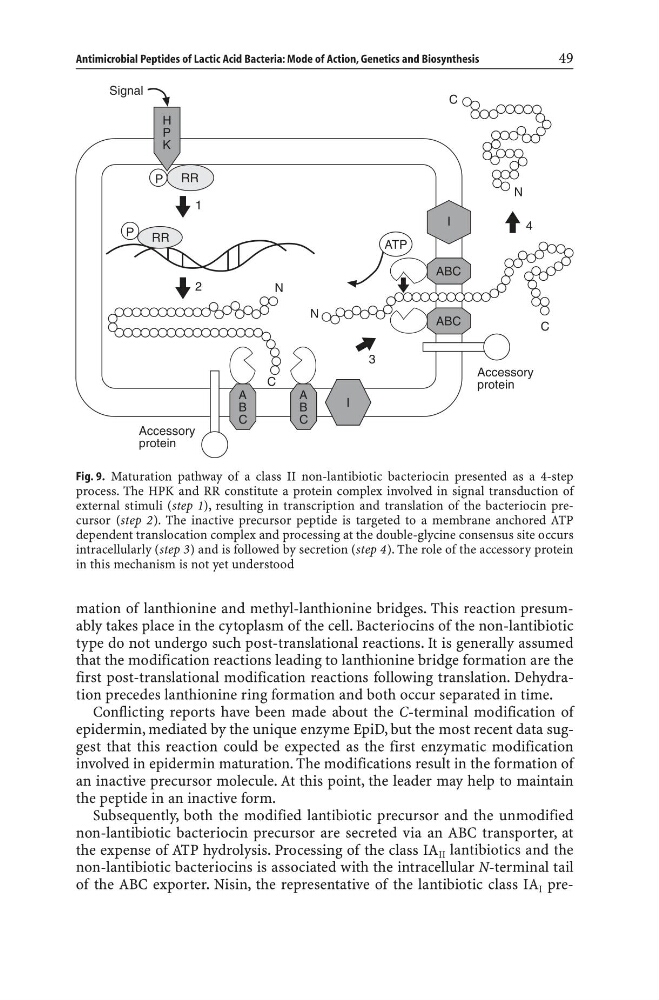
Fig. 9. Maturation pathway of a class II non-lantibiotic bacteriocin presented as a 4-step
process. The HPK and RR constitute a protein complex involved in signal transduction of
external stimuli (step 1), resulting in transcription and translation of the bacteriocin precursor (step 2). The inactive precursor peptide is targeted to a membrane anchored ATP
dependent translocation complex and processing at the double-glycine consensus site occurs
intracellularly (step 3) and is followed by secretion (step 4). The role of the accessory protein
in this mechanism is not yet understood
mation of lanthionine and methyl-lanthionine bridges. This reaction presumably takes place in the cytoplasm of the cell. Bacteriocins of the non-lantibiotic
type do not undergo such post-translational reactions. It is generally assumed
that the modification reactions leading to lanthionine bridge formation are the
first post-translational modification reactions following translation. Dehydration precedes lanthionine ring formation and both occur separated in time.
Conflicting reports have been made about the C-terminal modification of
epidermin, mediated by the unique enzyme EpiD, but the most recent data suggest that this reaction could be expected as the first enzymatic modification
involved in epidermin maturation. The modifications result in the formation of
an inactive precursor molecule. At this point, the leader may help to maintain
the peptide in an inactive form.
Subsequently, both the modified lantibiotic precursor and the unmodified
non-lantibiotic bacteriocin precursor are secreted via an ABC transporter, at
the expense of ATP hydrolysis. Processing of the class IA II lantibiotics and the
non-lantibiotic bacteriocins is associated with the intracellular N-terminal tail
of the ABC exporter. Nisin, the representative of the lantibiotic class IA I pre-
49
Fig. 9. Maturation pathway of a class II non-lantibiotic bacteriocin presented as a 4-step
process. The HPK and RR constitute a protein complex involved in signal transduction of
external stimuli (step 1), resulting in transcription and translation of the bacteriocin precursor (step 2). The inactive precursor peptide is targeted to a membrane anchored ATP
dependent translocation complex and processing at the double-glycine consensus site occurs
intracellularly (step 3) and is followed by secretion (step 4). The role of the accessory protein
in this mechanism is not yet understood
mation of lanthionine and methyl-lanthionine bridges. This reaction presumably takes place in the cytoplasm of the cell. Bacteriocins of the non-lantibiotic
type do not undergo such post-translational reactions. It is generally assumed
that the modification reactions leading to lanthionine bridge formation are the
first post-translational modification reactions following translation. Dehydration precedes lanthionine ring formation and both occur separated in time.
Conflicting reports have been made about the C-terminal modification of
epidermin, mediated by the unique enzyme EpiD, but the most recent data suggest that this reaction could be expected as the first enzymatic modification
involved in epidermin maturation. The modifications result in the formation of
an inactive precursor molecule. At this point, the leader may help to maintain
the peptide in an inactive form.
Subsequently, both the modified lantibiotic precursor and the unmodified
non-lantibiotic bacteriocin precursor are secreted via an ABC transporter, at
the expense of ATP hydrolysis. Processing of the class IA II lantibiotics and the
non-lantibiotic bacteriocins is associated with the intracellular N-terminal tail
of the ABC exporter. Nisin, the representative of the lantibiotic class IA I pre-