

an inducing signal activates, via the two-component signaling pathway, the
promoters responsible for the expression of the operons involved in bacteriocin
production. In the case of nisin, production and immunity have shown to be
autoregulated. Expression of several inducible class II non-lantibiotic bacteriocins (e.g. sakacin A, sakacin P, plantaricin P) is controlled by a bacteriocin-like
peptide, processed at a double-glycine consensus sequence site which lacks
antagonistic activity. The two-component signal transduction system has not
yet been shown for most of the class II non-lantibiotic bacteriocins, which may
therefore display a constitutive expression. Transcription results in the concerted production of the proteins constituting the modification and secretion
machinery, together with the inactive bacteriocin precursor molecule.
In case of the lantibiotics, this precursor contains free cysteines and no
dehydrated residues. The lantibiotic precursor molecule is directed, presumably
by virtue of the leader peptide, to a membrane-located complex containing the
modifying enzymes NisB (possibly involved in dehydration) and NisC (conceivably involved in establishing the thioether bonds). Lantibiotics of the class
IA II type (lactococcin DR, cytolysin, lactocin S) lack genes of the nisB and nisC
type in their corresponding operons [207]. It is assumed but not yet established
that one protein belonging to the so called CylM family mediates a one-step for48
E. Sablon et al.
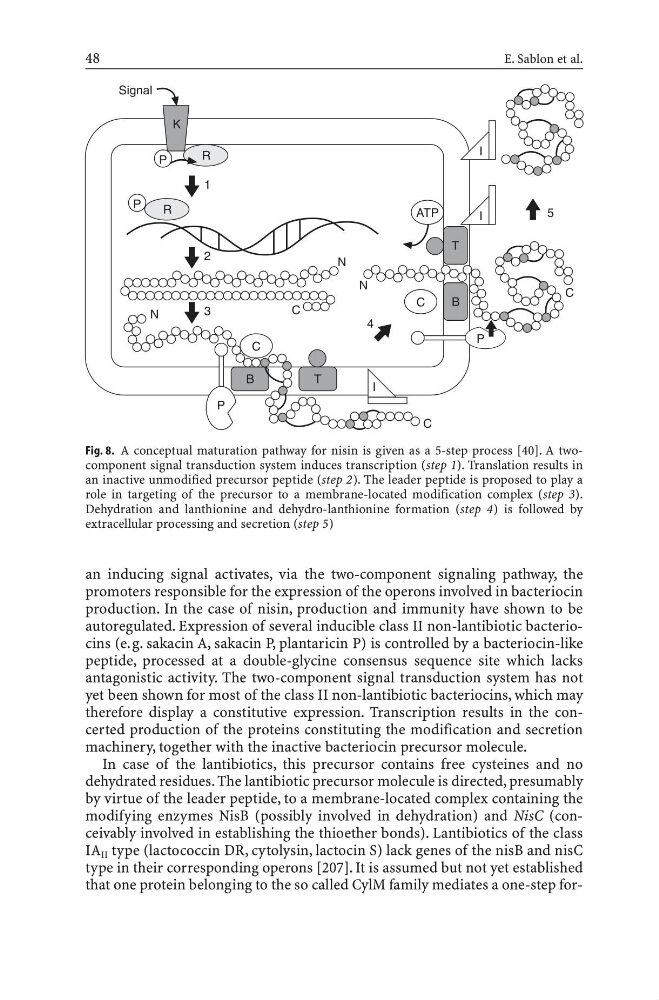
Fig. 8. A conceptual maturation pathway for nisin is given as a 5-step process [40]. A twocomponent signal transduction system induces transcription (step 1). Translation results in
an inactive unmodified precursor peptide (step 2). The leader peptide is proposed to play a
role in targeting of the precursor to a membrane-located modification complex (step 3).
Dehydration and lanthionine and dehydro-lanthionine formation (step 4) is followed by
extracellular processing and secretion (step 5)
promoters responsible for the expression of the operons involved in bacteriocin
production. In the case of nisin, production and immunity have shown to be
autoregulated. Expression of several inducible class II non-lantibiotic bacteriocins (e.g. sakacin A, sakacin P, plantaricin P) is controlled by a bacteriocin-like
peptide, processed at a double-glycine consensus sequence site which lacks
antagonistic activity. The two-component signal transduction system has not
yet been shown for most of the class II non-lantibiotic bacteriocins, which may
therefore display a constitutive expression. Transcription results in the concerted production of the proteins constituting the modification and secretion
machinery, together with the inactive bacteriocin precursor molecule.
In case of the lantibiotics, this precursor contains free cysteines and no
dehydrated residues. The lantibiotic precursor molecule is directed, presumably
by virtue of the leader peptide, to a membrane-located complex containing the
modifying enzymes NisB (possibly involved in dehydration) and NisC (conceivably involved in establishing the thioether bonds). Lantibiotics of the class
IA II type (lactococcin DR, cytolysin, lactocin S) lack genes of the nisB and nisC
type in their corresponding operons [207]. It is assumed but not yet established
that one protein belonging to the so called CylM family mediates a one-step for48
E. Sablon et al.
Fig. 8. A conceptual maturation pathway for nisin is given as a 5-step process [40]. A twocomponent signal transduction system induces transcription (step 1). Translation results in
an inactive unmodified precursor peptide (step 2). The leader peptide is proposed to play a
role in targeting of the precursor to a membrane-located modification complex (step 3).
Dehydration and lanthionine and dehydro-lanthionine formation (step 4) is followed by
extracellular processing and secretion (step 5)