

4.1
Flotation of Yeast Cells
Systematic investigations of microbial cell recovery by foam flotation were performed by Hansenula polymorpha [113–117] and Saccharomyces cerevisiae
[118–123] in continuous operation. The equipment used for flotation was often
identical to that used for protein flotation. The microorganisms were cultivated
in laboratory reactors on synthetic media in the absence of antifoam agents in
continuous operation and the cell-containing cultivation medium was collected
in a buffer storage and was fed into the middle of the column, at the top of the
interface between the bubble and the foam layers. The height of the interface
was controlled by an overflow. The foam left the column at the top. The cells
were recovered from the foam liquid by a mechanical foam destroyer. The liquid
residue left the column through an overflow [113] (Fig. 6).
Hansenula polymorpha was cultivated in synthetic medium in the absence
of an antifoam agent in stirred tank reactors (B20; B Braun, Melsungen and
LF 14; Chemap), as well as in the 45-l tower loop reactor described by Buchholz et al. [124]. The foam was controlled by a mechanical foam destroyer
(Fundafoam; Chemap) and by a destroyer constructed and built at the Institute of Technical Chemistry, University of Hannover, respectively. The
influence of substrate type (glucose, ethanol and methanol) and concentrations
of substrates and cells, the growth limiting component (O 2 , P, and N), pH
value, temperature, and presence of flocculation agent (CaCl 2 ) on the process
performance was investigated.
4.1.1
Characterization of Process Performance
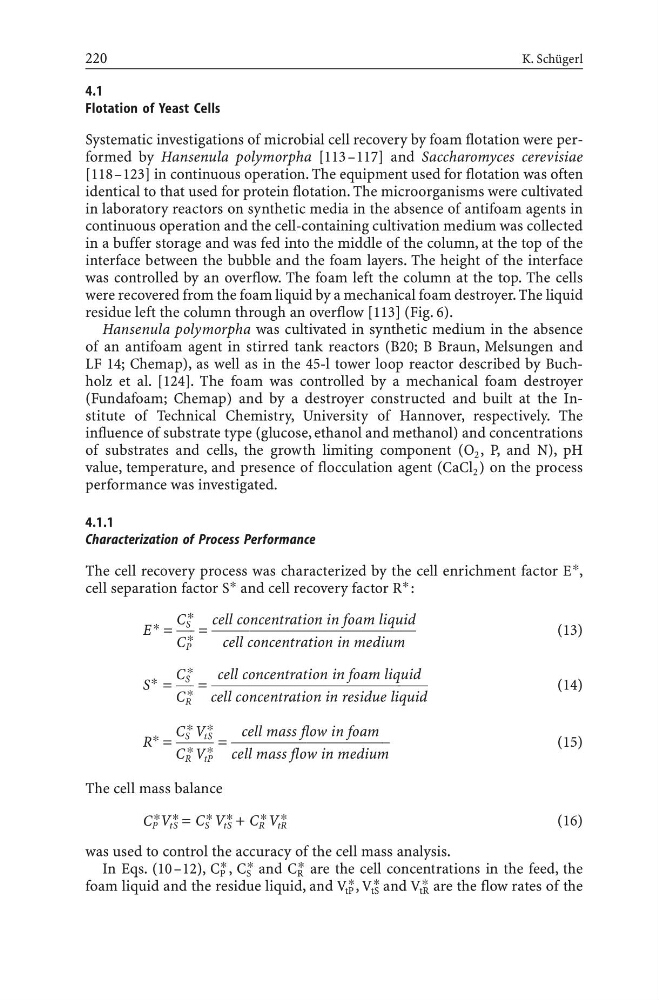
The cell recovery process was characterized by the cell enrichment factor E*,
cell separation factor S * and cell recovery factor R*:
C S * cell concentration in foam liquid
E* = 41 = 000004
(13)
C P *
cell concentration in medium
C S *
cell concentration in foam liquid
S* = 41 = 000008
(14)
C R * cell concentration in residue liquid
C S * V *
tS
cell mass flow in foam
R* = 0 = 00002
(15)
C R * V *
tP
cell mass flow in medium
The cell mass balance
C P * V *
tS = C S * V *
tS + C R * V *
tR
(16)
was used to control the accuracy of the cell mass analysis.
In Eqs. (10–12), C P * , C S * and C R * are the cell concentrations in the feed, the
foam liquid and the residue liquid, and V *
tP , V *
tS and V *
tR are the flow rates of the
220
K. Schügerl
Flotation of Yeast Cells
Systematic investigations of microbial cell recovery by foam flotation were performed by Hansenula polymorpha [113–117] and Saccharomyces cerevisiae
[118–123] in continuous operation. The equipment used for flotation was often
identical to that used for protein flotation. The microorganisms were cultivated
in laboratory reactors on synthetic media in the absence of antifoam agents in
continuous operation and the cell-containing cultivation medium was collected
in a buffer storage and was fed into the middle of the column, at the top of the
interface between the bubble and the foam layers. The height of the interface
was controlled by an overflow. The foam left the column at the top. The cells
were recovered from the foam liquid by a mechanical foam destroyer. The liquid
residue left the column through an overflow [113] (Fig. 6).
Hansenula polymorpha was cultivated in synthetic medium in the absence
of an antifoam agent in stirred tank reactors (B20; B Braun, Melsungen and
LF 14; Chemap), as well as in the 45-l tower loop reactor described by Buchholz et al. [124]. The foam was controlled by a mechanical foam destroyer
(Fundafoam; Chemap) and by a destroyer constructed and built at the Institute of Technical Chemistry, University of Hannover, respectively. The
influence of substrate type (glucose, ethanol and methanol) and concentrations
of substrates and cells, the growth limiting component (O 2 , P, and N), pH
value, temperature, and presence of flocculation agent (CaCl 2 ) on the process
performance was investigated.
4.1.1
Characterization of Process Performance
The cell recovery process was characterized by the cell enrichment factor E*,
cell separation factor S * and cell recovery factor R*:
C S * cell concentration in foam liquid
E* = 41 = 000004
(13)
C P *
cell concentration in medium
C S *
cell concentration in foam liquid
S* = 41 = 000008
(14)
C R * cell concentration in residue liquid
C S * V *
tS
cell mass flow in foam
R* = 0 = 00002
(15)
C R * V *
tP
cell mass flow in medium
The cell mass balance
C P * V *
tS = C S * V *
tS + C R * V *
tR
(16)
was used to control the accuracy of the cell mass analysis.
In Eqs. (10–12), C P * , C S * and C R * are the cell concentrations in the feed, the
foam liquid and the residue liquid, and V *
tP , V *
tS and V *
tR are the flow rates of the
220
K. Schügerl