

instantaneously reacted to the addition of an AFA (SE9) to the medium
[51].
Most research groups have determined the oxygen transfer rate as a function
of the AFAs, and only a few have investigated their influence on the cell growth
and viability [51–54]. The toxicity of different antifoam agents on Aspergillus
niger was tested in Petri dishes [52]. In addition respiration tests were performed in a Warburg apparatus. Most of the antifoam agents inhibited the
growth of the fungus. The respiration of A. niger was diminished by AFAs as
well; unfortunately, too high AFA concentrations (1%) were applied in these
investigations. In practice, the applied AFA concentrations are orders of
magnitude lower.
Only Koch et al. [51] monitored the fluid dynamic properties of a two-phase
system and the biological behavior of the cells during the same cultivation.
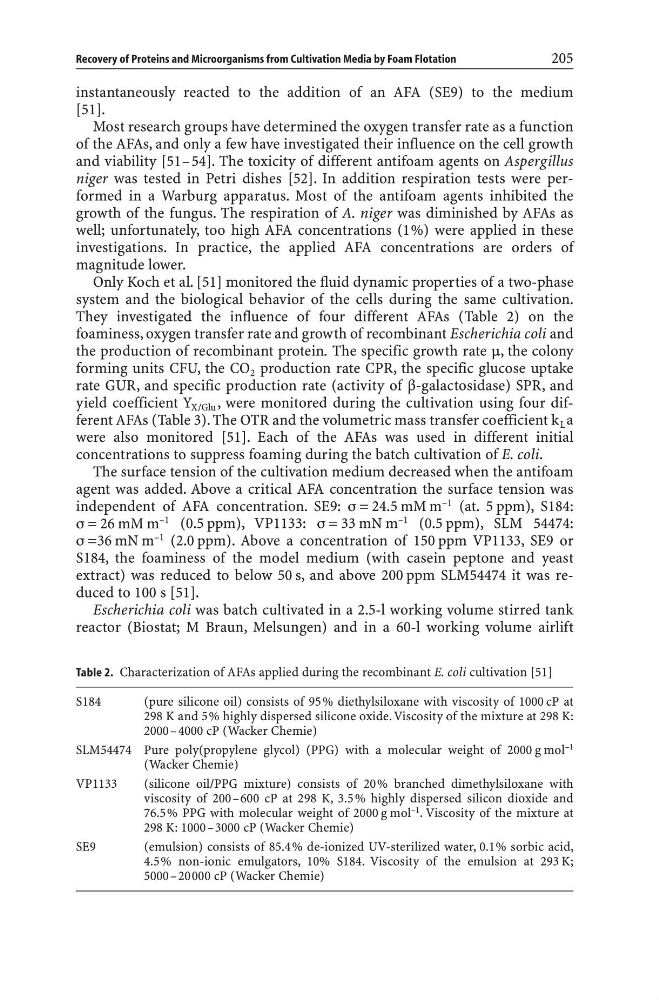
They investigated the influence of four different AFAs (Table 2) on the
foaminess, oxygen transfer rate and growth of recombinant Escherichia coli and
the production of recombinant protein. The specific growth rate m, the colony
forming units CFU, the CO 2 production rate CPR, the specific glucose uptake
rate GUR, and specific production rate (activity of b-galactosidase) SPR, and
yield coefficient Y X/Glu , were monitored during the cultivation using four different AFAs (Table 3). The OTR and the volumetric mass transfer coefficient k L a
were also monitored [51]. Each of the AFAs was used in different initial
concentrations to suppress foaming during the batch cultivation of E. coli.
The surface tension of the cultivation medium decreased when the antifoam
agent was added. Above a critical AFA concentration the surface tension was
independent of AFA concentration. SE9: s = 24.5 mM m –1 (at. 5 ppm), S184:
s = 26 mM m –1 (0.5 ppm), VP1133: s = 33 mN m –1 (0.5 ppm), SLM 54474:
s =36 mN m –1 (2.0 ppm). Above a concentration of 150 ppm VP1133, SE9 or
S184, the foaminess of the model medium (with casein peptone and yeast
extract) was reduced to below 50 s, and above 200 ppm SLM54474 it was reduced to 100 s [51].
Escherichia coli was batch cultivated in a 2.5-l working volume stirred tank
reactor (Biostat; M Braun, Melsungen) and in a 60-l working volume airlift
Recovery of Proteins and Microorganisms from Cultivation Media by Foam Flotation
205
Table 2. Characterization of AFAs applied during the recombinant E. coli cultivation [51]
S184
(pure silicone oil) consists of 95% diethylsiloxane with viscosity of 1000 cP at
298 K and 5% highly dispersed silicone oxide. Viscosity of the mixture at 298 K:
2000–4000 cP (Wacker Chemie)
SLM54474 Pure poly(propylene glycol) (PPG) with a molecular weight of 2000 g mol –1
(Wacker Chemie)
VP1133
(silicone oil/PPG mixture) consists of 20% branched dimethylsiloxane with
viscosity of 200–600 cP at 298 K, 3.5% highly dispersed silicon dioxide and
76.5% PPG with molecular weight of 2000 g mol –1 . Viscosity of the mixture at
298 K: 1000–3000 cP (Wacker Chemie)
SE9
(emulsion) consists of 85.4% de-ionized UV-sterilized water, 0.1% sorbic acid,
4.5% non-ionic emulgators, 10% S184. Viscosity of the emulsion at 293 K;
5000–20000 cP (Wacker Chemie)
[51].
Most research groups have determined the oxygen transfer rate as a function
of the AFAs, and only a few have investigated their influence on the cell growth
and viability [51–54]. The toxicity of different antifoam agents on Aspergillus
niger was tested in Petri dishes [52]. In addition respiration tests were performed in a Warburg apparatus. Most of the antifoam agents inhibited the
growth of the fungus. The respiration of A. niger was diminished by AFAs as
well; unfortunately, too high AFA concentrations (1%) were applied in these
investigations. In practice, the applied AFA concentrations are orders of
magnitude lower.
Only Koch et al. [51] monitored the fluid dynamic properties of a two-phase
system and the biological behavior of the cells during the same cultivation.
They investigated the influence of four different AFAs (Table 2) on the
foaminess, oxygen transfer rate and growth of recombinant Escherichia coli and
the production of recombinant protein. The specific growth rate m, the colony
forming units CFU, the CO 2 production rate CPR, the specific glucose uptake
rate GUR, and specific production rate (activity of b-galactosidase) SPR, and
yield coefficient Y X/Glu , were monitored during the cultivation using four different AFAs (Table 3). The OTR and the volumetric mass transfer coefficient k L a
were also monitored [51]. Each of the AFAs was used in different initial
concentrations to suppress foaming during the batch cultivation of E. coli.
The surface tension of the cultivation medium decreased when the antifoam
agent was added. Above a critical AFA concentration the surface tension was
independent of AFA concentration. SE9: s = 24.5 mM m –1 (at. 5 ppm), S184:
s = 26 mM m –1 (0.5 ppm), VP1133: s = 33 mN m –1 (0.5 ppm), SLM 54474:
s =36 mN m –1 (2.0 ppm). Above a concentration of 150 ppm VP1133, SE9 or
S184, the foaminess of the model medium (with casein peptone and yeast
extract) was reduced to below 50 s, and above 200 ppm SLM54474 it was reduced to 100 s [51].
Escherichia coli was batch cultivated in a 2.5-l working volume stirred tank
reactor (Biostat; M Braun, Melsungen) and in a 60-l working volume airlift
Recovery of Proteins and Microorganisms from Cultivation Media by Foam Flotation
205
Table 2. Characterization of AFAs applied during the recombinant E. coli cultivation [51]
S184
(pure silicone oil) consists of 95% diethylsiloxane with viscosity of 1000 cP at
298 K and 5% highly dispersed silicone oxide. Viscosity of the mixture at 298 K:
2000–4000 cP (Wacker Chemie)
SLM54474 Pure poly(propylene glycol) (PPG) with a molecular weight of 2000 g mol –1
(Wacker Chemie)
VP1133
(silicone oil/PPG mixture) consists of 20% branched dimethylsiloxane with
viscosity of 200–600 cP at 298 K, 3.5% highly dispersed silicon dioxide and
76.5% PPG with molecular weight of 2000 g mol –1 . Viscosity of the mixture at
298 K: 1000–3000 cP (Wacker Chemie)
SE9
(emulsion) consists of 85.4% de-ionized UV-sterilized water, 0.1% sorbic acid,
4.5% non-ionic emulgators, 10% S184. Viscosity of the emulsion at 293 K;
5000–20000 cP (Wacker Chemie)