

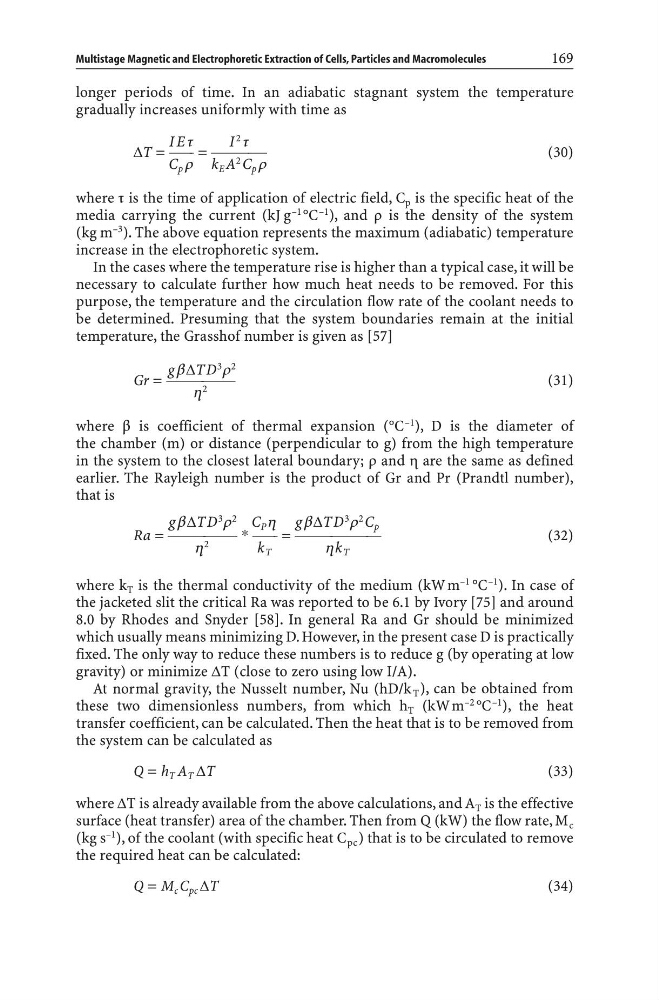
longer periods of time. In an adiabatic stagnant system the temperature
gradually increases uniformly with time as
I Et
I 2 t
DT = 61 = 05
(30)
C p Ç k E A 2 C p Ç
where t is the time of application of electric field, C p is the specific heat of the
media carrying the current (kJ g –1 °C –1 ), and Ç is the density of the system
(kg m –3 ). The above equation represents the maximum (adiabatic) temperature
increase in the electrophoretic system.
In the cases where the temperature rise is higher than a typical case, it will be
necessary to calculate further how much heat needs to be removed. For this
purpose, the temperature and the circulation flow rate of the coolant needs to
be determined. Presuming that the system boundaries remain at the initial
temperature, the Grasshof number is given as [57]
gbDTD 3 Ç 2
Gr = 09
(31)
h 2
where b is coefficient of thermal expansion (°C –1 ), D is the diameter of
the chamber (m) or distance (perpendicular to g) from the high temperature
in the system to the closest lateral boundary; Ç and h are the same as defined
earlier. The Rayleigh number is the product of Gr and Pr (Prandtl number),
that is
gbDTD 3 Ç 2 C P h gbDTD 3 Ç 2 C p
Ra = 09 * 61 = 004
(32)
h 2
k T
hk T
where k T is the thermal conductivity of the medium (kWm –1 °C –1 ). In case of
the jacketed slit the critical Ra was reported to be 6.1 by Ivory [75] and around
8.0 by Rhodes and Snyder [58]. In general Ra and Gr should be minimized
which usually means minimizing D. However, in the present case D is practically
fixed. The only way to reduce these numbers is to reduce g (by operating at low
gravity) or minimize DT (close to zero using low I/A).
At normal gravity, the Nusselt number, Nu (hD/k T ), can be obtained from
these two dimensionless numbers, from which h T (kWm –2 °C –1 ), the heat
transfer coefficient, can be calculated. Then the heat that is to be removed from
the system can be calculated as
Q = h T A T DT
(33)
where DT is already available from the above calculations, and A T is the effective
surface (heat transfer) area of the chamber. Then from Q (kW) the flow rate, M c
(kg s –1 ), of the coolant (with specific heat C pc ) that is to be circulated to remove
the required heat can be calculated:
Q = M c C pc DT
(34)
Multistage Magnetic and Electrophoretic Extraction of Cells, Particles and Macromolecules
169
gradually increases uniformly with time as
I Et
I 2 t
DT = 61 = 05
(30)
C p Ç k E A 2 C p Ç
where t is the time of application of electric field, C p is the specific heat of the
media carrying the current (kJ g –1 °C –1 ), and Ç is the density of the system
(kg m –3 ). The above equation represents the maximum (adiabatic) temperature
increase in the electrophoretic system.
In the cases where the temperature rise is higher than a typical case, it will be
necessary to calculate further how much heat needs to be removed. For this
purpose, the temperature and the circulation flow rate of the coolant needs to
be determined. Presuming that the system boundaries remain at the initial
temperature, the Grasshof number is given as [57]
gbDTD 3 Ç 2
Gr = 09
(31)
h 2
where b is coefficient of thermal expansion (°C –1 ), D is the diameter of
the chamber (m) or distance (perpendicular to g) from the high temperature
in the system to the closest lateral boundary; Ç and h are the same as defined
earlier. The Rayleigh number is the product of Gr and Pr (Prandtl number),
that is
gbDTD 3 Ç 2 C P h gbDTD 3 Ç 2 C p
Ra = 09 * 61 = 004
(32)
h 2
k T
hk T
where k T is the thermal conductivity of the medium (kWm –1 °C –1 ). In case of
the jacketed slit the critical Ra was reported to be 6.1 by Ivory [75] and around
8.0 by Rhodes and Snyder [58]. In general Ra and Gr should be minimized
which usually means minimizing D. However, in the present case D is practically
fixed. The only way to reduce these numbers is to reduce g (by operating at low
gravity) or minimize DT (close to zero using low I/A).
At normal gravity, the Nusselt number, Nu (hD/k T ), can be obtained from
these two dimensionless numbers, from which h T (kWm –2 °C –1 ), the heat
transfer coefficient, can be calculated. Then the heat that is to be removed from
the system can be calculated as
Q = h T A T DT
(33)
where DT is already available from the above calculations, and A T is the effective
surface (heat transfer) area of the chamber. Then from Q (kW) the flow rate, M c
(kg s –1 ), of the coolant (with specific heat C pc ) that is to be circulated to remove
the required heat can be calculated:
Q = M c C pc DT
(34)
Multistage Magnetic and Electrophoretic Extraction of Cells, Particles and Macromolecules
169