

be given by
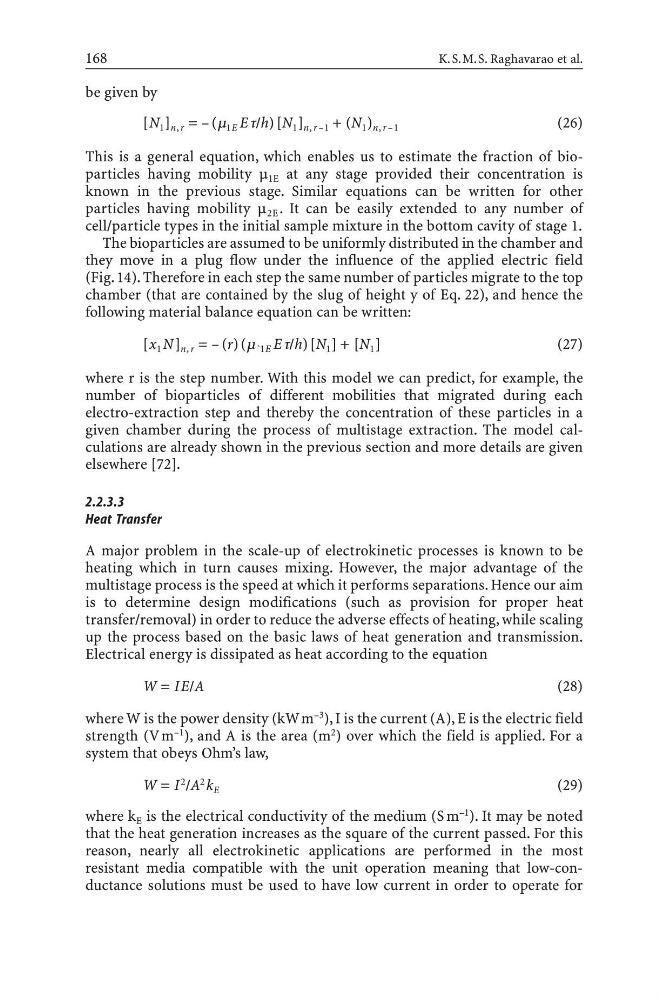
[N 1 ] n, r = – (m 1E Et/h) [N 1 ] n, r –1 + (N 1 ) n, r –1
(26)
This is a general equation, which enables us to estimate the fraction of bioparticles having mobility m 1E at any stage provided their concentration is
known in the previous stage. Similar equations can be written for other
particles having mobility m 2E . It can be easily extended to any number of
cell/particle types in the initial sample mixture in the bottom cavity of stage 1.
The bioparticles are assumed to be uniformly distributed in the chamber and
they move in a plug flow under the influence of the applied electric field
(Fig. 14). Therefore in each step the same number of particles migrate to the top
chamber (that are contained by the slug of height y of Eq. 22), and hence the
following material balance equation can be written:
[x 1 N] n, r = – (r) (m `1E Et/h) [N 1 ] + [N 1 ]
(27)
where r is the step number. With this model we can predict, for example, the
number of bioparticles of different mobilities that migrated during each
electro-extraction step and thereby the concentration of these particles in a
given chamber during the process of multistage extraction. The model calculations are already shown in the previous section and more details are given
elsewhere [72].
2.2.3.3
Heat Transfer
A major problem in the scale-up of electrokinetic processes is known to be
heating which in turn causes mixing. However, the major advantage of the
multistage process is the speed at which it performs separations. Hence our aim
is to determine design modifications (such as provision for proper heat
transfer/removal) in order to reduce the adverse effects of heating, while scaling
up the process based on the basic laws of heat generation and transmission.
Electrical energy is dissipated as heat according to the equation
W = IE/A
(28)
where W is the power density (kWm –3 ), I is the current (A), E is the electric field
strength (Vm –1 ), and A is the area (m 2 ) over which the field is applied. For a
system that obeys Ohm’s law,
W = I 2 /A 2 k E
(29)
where k E is the electrical conductivity of the medium (S m –1 ). It may be noted
that the heat generation increases as the square of the current passed. For this
reason, nearly all electrokinetic applications are performed in the most
resistant media compatible with the unit operation meaning that low-conductance solutions must be used to have low current in order to operate for
168
K.S.M.S. Raghavarao et al.
[N 1 ] n, r = – (m 1E Et/h) [N 1 ] n, r –1 + (N 1 ) n, r –1
(26)
This is a general equation, which enables us to estimate the fraction of bioparticles having mobility m 1E at any stage provided their concentration is
known in the previous stage. Similar equations can be written for other
particles having mobility m 2E . It can be easily extended to any number of
cell/particle types in the initial sample mixture in the bottom cavity of stage 1.
The bioparticles are assumed to be uniformly distributed in the chamber and
they move in a plug flow under the influence of the applied electric field
(Fig. 14). Therefore in each step the same number of particles migrate to the top
chamber (that are contained by the slug of height y of Eq. 22), and hence the
following material balance equation can be written:
[x 1 N] n, r = – (r) (m `1E Et/h) [N 1 ] + [N 1 ]
(27)
where r is the step number. With this model we can predict, for example, the
number of bioparticles of different mobilities that migrated during each
electro-extraction step and thereby the concentration of these particles in a
given chamber during the process of multistage extraction. The model calculations are already shown in the previous section and more details are given
elsewhere [72].
2.2.3.3
Heat Transfer
A major problem in the scale-up of electrokinetic processes is known to be
heating which in turn causes mixing. However, the major advantage of the
multistage process is the speed at which it performs separations. Hence our aim
is to determine design modifications (such as provision for proper heat
transfer/removal) in order to reduce the adverse effects of heating, while scaling
up the process based on the basic laws of heat generation and transmission.
Electrical energy is dissipated as heat according to the equation
W = IE/A
(28)
where W is the power density (kWm –3 ), I is the current (A), E is the electric field
strength (Vm –1 ), and A is the area (m 2 ) over which the field is applied. For a
system that obeys Ohm’s law,
W = I 2 /A 2 k E
(29)
where k E is the electrical conductivity of the medium (S m –1 ). It may be noted
that the heat generation increases as the square of the current passed. For this
reason, nearly all electrokinetic applications are performed in the most
resistant media compatible with the unit operation meaning that low-conductance solutions must be used to have low current in order to operate for
168
K.S.M.S. Raghavarao et al.