

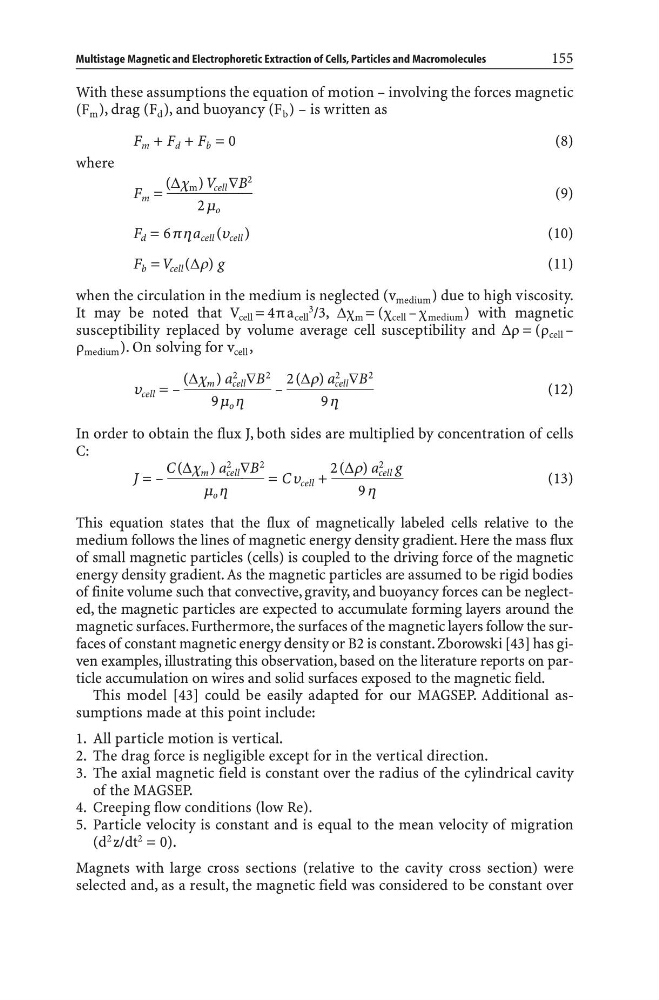
With these assumptions the equation of motion – involving the forces magnetic
(F m ), drag (F d ), and buoyancy (F b ) – is written as
F m + F d + F b = 0
(8)
where
(Dc m ) V cell —B 2
F m = 003
(9)
2m o
F d = 6pha cell (u cell )
(10)
F b = V cell (DÇ) g
(11)
when the circulation in the medium is neglected (v medium ) due to high viscosity.
It may be noted that V cell = 4pa cell
3 /3, Dc m = (c cell – c medium ) with magnetic
susceptibility replaced by volume average cell susceptibility and DÇ = (Ç cell –
Ç medium ). On solving for v cell ,
(Dc m ) a 2
cell —B 2 2(DÇ) a 2
cell —B 2
u cell = – 003 – 003
(12)
9m o h
9h
In order to obtain the flux J, both sides are multiplied by concentration of cells
C:
C(Dc m ) a 2
cell —B 2
2(DÇ) a 2
cell g
J = – 006 = Cu cell + 09
(13)
m o h
9h
This equation states that the flux of magnetically labeled cells relative to the
medium follows the lines of magnetic energy density gradient. Here the mass flux
of small magnetic particles (cells) is coupled to the driving force of the magnetic
energy density gradient. As the magnetic particles are assumed to be rigid bodies
of finite volume such that convective, gravity, and buoyancy forces can be neglected, the magnetic particles are expected to accumulate forming layers around the
magnetic surfaces. Furthermore, the surfaces of the magnetic layers follow the surfaces of constant magnetic energy density or B2 is constant. Zborowski [43] has given examples, illustrating this observation, based on the literature reports on particle accumulation on wires and solid surfaces exposed to the magnetic field.
This model [43] could be easily adapted for our MAGSEP. Additional assumptions made at this point include:
1. All particle motion is vertical.
2. The drag force is negligible except for in the vertical direction.
3. The axial magnetic field is constant over the radius of the cylindrical cavity
of the MAGSEP.
4. Creeping flow conditions (low Re).
5. Particle velocity is constant and is equal to the mean velocity of migration
(d 2 z/dt 2 = 0).
Magnets with large cross sections (relative to the cavity cross section) were
selected and, as a result, the magnetic field was considered to be constant over
Multistage Magnetic and Electrophoretic Extraction of Cells, Particles and Macromolecules
155
(F m ), drag (F d ), and buoyancy (F b ) – is written as
F m + F d + F b = 0
(8)
where
(Dc m ) V cell —B 2
F m = 003
(9)
2m o
F d = 6pha cell (u cell )
(10)
F b = V cell (DÇ) g
(11)
when the circulation in the medium is neglected (v medium ) due to high viscosity.
It may be noted that V cell = 4pa cell
3 /3, Dc m = (c cell – c medium ) with magnetic
susceptibility replaced by volume average cell susceptibility and DÇ = (Ç cell –
Ç medium ). On solving for v cell ,
(Dc m ) a 2
cell —B 2 2(DÇ) a 2
cell —B 2
u cell = – 003 – 003
(12)
9m o h
9h
In order to obtain the flux J, both sides are multiplied by concentration of cells
C:
C(Dc m ) a 2
cell —B 2
2(DÇ) a 2
cell g
J = – 006 = Cu cell + 09
(13)
m o h
9h
This equation states that the flux of magnetically labeled cells relative to the
medium follows the lines of magnetic energy density gradient. Here the mass flux
of small magnetic particles (cells) is coupled to the driving force of the magnetic
energy density gradient. As the magnetic particles are assumed to be rigid bodies
of finite volume such that convective, gravity, and buoyancy forces can be neglected, the magnetic particles are expected to accumulate forming layers around the
magnetic surfaces. Furthermore, the surfaces of the magnetic layers follow the surfaces of constant magnetic energy density or B2 is constant. Zborowski [43] has given examples, illustrating this observation, based on the literature reports on particle accumulation on wires and solid surfaces exposed to the magnetic field.
This model [43] could be easily adapted for our MAGSEP. Additional assumptions made at this point include:
1. All particle motion is vertical.
2. The drag force is negligible except for in the vertical direction.
3. The axial magnetic field is constant over the radius of the cylindrical cavity
of the MAGSEP.
4. Creeping flow conditions (low Re).
5. Particle velocity is constant and is equal to the mean velocity of migration
(d 2 z/dt 2 = 0).
Magnets with large cross sections (relative to the cavity cross section) were
selected and, as a result, the magnetic field was considered to be constant over
Multistage Magnetic and Electrophoretic Extraction of Cells, Particles and Macromolecules
155