

tangent to the direction of vector F m . In general, due to non-linear relationship
between the magnetic force F m and the magnetic field H, the lines of magnetic
force do not follow the lines of magnetic field B. In other words, even in homogenous media, the lines of magnetic field do not represent the lines of force exerted on the elementary dipole. The correct representation of such forces are the
lines of the magnetic force F m . This is drastically different from the static electric
field, in which electric force lines are synonymous with electric field lines.
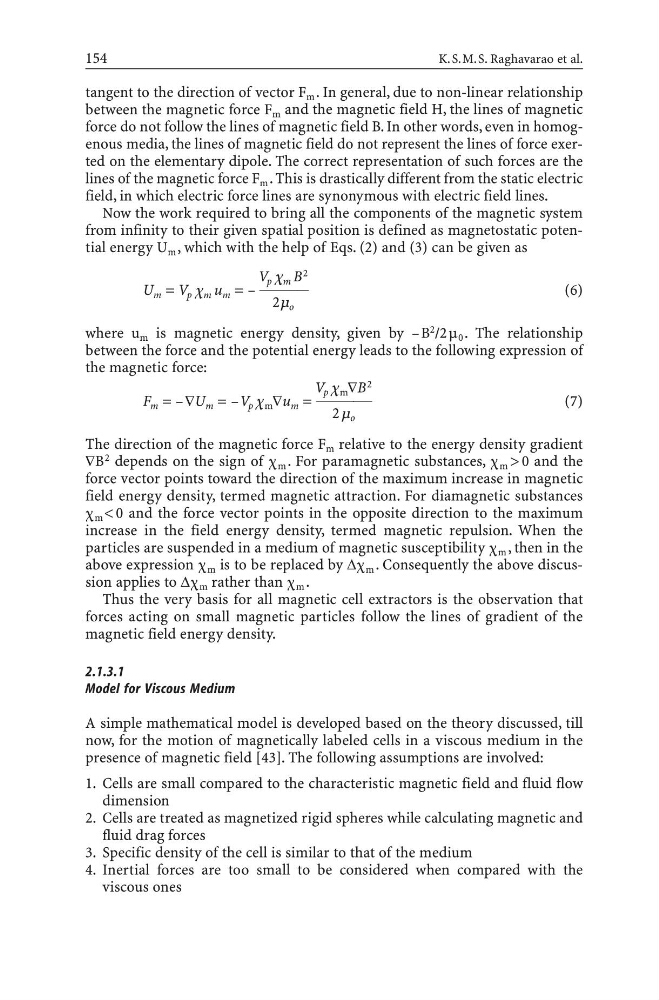
Now the work required to bring all the components of the magnetic system
from infinity to their given spatial position is defined as magnetostatic potential energy U m , which with the help of Eqs. (2) and (3) can be given as
V p c m B 2
U m = V p c m u m = – 03
(6)
2m o
where u m is magnetic energy density, given by –B 2 /2m 0 . The relationship
between the force and the potential energy leads to the following expression of
the magnetic force:
V p c m —B 2
F m = –—U m = –V p c m —u m = 05
(7)
2m o
The direction of the magnetic force F m relative to the energy density gradient
—B 2 depends on the sign of c m . For paramagnetic substances, c m > 0 and the
force vector points toward the direction of the maximum increase in magnetic
field energy density, termed magnetic attraction. For diamagnetic substances
c m < 0 and the force vector points in the opposite direction to the maximum
increase in the field energy density, termed magnetic repulsion. When the
particles are suspended in a medium of magnetic susceptibility c m , then in the
above expression c m is to be replaced by Dc m . Consequently the above discussion applies to Dc m rather than c m .
Thus the very basis for all magnetic cell extractors is the observation that
forces acting on small magnetic particles follow the lines of gradient of the
magnetic field energy density.
2.1.3.1
Model for Viscous Medium
A simple mathematical model is developed based on the theory discussed, till
now, for the motion of magnetically labeled cells in a viscous medium in the
presence of magnetic field [43]. The following assumptions are involved:
1. Cells are small compared to the characteristic magnetic field and fluid flow
dimension
2. Cells are treated as magnetized rigid spheres while calculating magnetic and
fluid drag forces
3. Specific density of the cell is similar to that of the medium
4. Inertial forces are too small to be considered when compared with the
viscous ones
154
K.S.M.S. Raghavarao et al.
between the magnetic force F m and the magnetic field H, the lines of magnetic
force do not follow the lines of magnetic field B. In other words, even in homogenous media, the lines of magnetic field do not represent the lines of force exerted on the elementary dipole. The correct representation of such forces are the
lines of the magnetic force F m . This is drastically different from the static electric
field, in which electric force lines are synonymous with electric field lines.
Now the work required to bring all the components of the magnetic system
from infinity to their given spatial position is defined as magnetostatic potential energy U m , which with the help of Eqs. (2) and (3) can be given as
V p c m B 2
U m = V p c m u m = – 03
(6)
2m o
where u m is magnetic energy density, given by –B 2 /2m 0 . The relationship
between the force and the potential energy leads to the following expression of
the magnetic force:
V p c m —B 2
F m = –—U m = –V p c m —u m = 05
(7)
2m o
The direction of the magnetic force F m relative to the energy density gradient
—B 2 depends on the sign of c m . For paramagnetic substances, c m > 0 and the
force vector points toward the direction of the maximum increase in magnetic
field energy density, termed magnetic attraction. For diamagnetic substances
c m < 0 and the force vector points in the opposite direction to the maximum
increase in the field energy density, termed magnetic repulsion. When the
particles are suspended in a medium of magnetic susceptibility c m , then in the
above expression c m is to be replaced by Dc m . Consequently the above discussion applies to Dc m rather than c m .
Thus the very basis for all magnetic cell extractors is the observation that
forces acting on small magnetic particles follow the lines of gradient of the
magnetic field energy density.
2.1.3.1
Model for Viscous Medium
A simple mathematical model is developed based on the theory discussed, till
now, for the motion of magnetically labeled cells in a viscous medium in the
presence of magnetic field [43]. The following assumptions are involved:
1. Cells are small compared to the characteristic magnetic field and fluid flow
dimension
2. Cells are treated as magnetized rigid spheres while calculating magnetic and
fluid drag forces
3. Specific density of the cell is similar to that of the medium
4. Inertial forces are too small to be considered when compared with the
viscous ones
154
K.S.M.S. Raghavarao et al.