

magnetic separation industry has made considerable progress in this regard,
but the commercial technology to date has been limited to binary separation
methods. The innovation presented here represents progress by finally providing a reliable method for differential magnetic separation on the basis of
small differences in surface composition.
The model equations (discussed in Sect. 2.1.3) are used as the basis for the
design of a multistage separation system where the separation driving force is
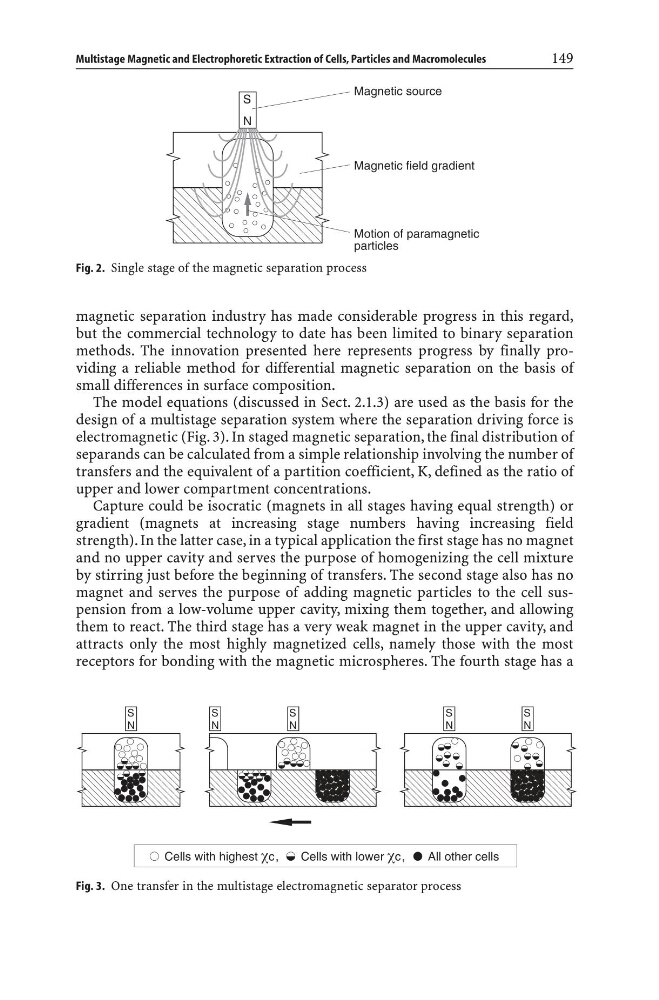
electromagnetic (Fig. 3). In staged magnetic separation, the final distribution of
separands can be calculated from a simple relationship involving the number of
transfers and the equivalent of a partition coefficient, K, defined as the ratio of
upper and lower compartment concentrations.
Capture could be isocratic (magnets in all stages having equal strength) or
gradient (magnets at increasing stage numbers having increasing field
strength). In the latter case, in a typical application the first stage has no magnet
and no upper cavity and serves the purpose of homogenizing the cell mixture
by stirring just before the beginning of transfers. The second stage also has no
magnet and serves the purpose of adding magnetic particles to the cell suspension from a low-volume upper cavity, mixing them together, and allowing
them to react. The third stage has a very weak magnet in the upper cavity, and
attracts only the most highly magnetized cells, namely those with the most
receptors for bonding with the magnetic microspheres. The fourth stage has a
Multistage Magnetic and Electrophoretic Extraction of Cells, Particles and Macromolecules
149
Fig. 2. Single stage of the magnetic separation process
Fig. 3. One transfer in the multistage electromagnetic separator process
but the commercial technology to date has been limited to binary separation
methods. The innovation presented here represents progress by finally providing a reliable method for differential magnetic separation on the basis of
small differences in surface composition.
The model equations (discussed in Sect. 2.1.3) are used as the basis for the
design of a multistage separation system where the separation driving force is
electromagnetic (Fig. 3). In staged magnetic separation, the final distribution of
separands can be calculated from a simple relationship involving the number of
transfers and the equivalent of a partition coefficient, K, defined as the ratio of
upper and lower compartment concentrations.
Capture could be isocratic (magnets in all stages having equal strength) or
gradient (magnets at increasing stage numbers having increasing field
strength). In the latter case, in a typical application the first stage has no magnet
and no upper cavity and serves the purpose of homogenizing the cell mixture
by stirring just before the beginning of transfers. The second stage also has no
magnet and serves the purpose of adding magnetic particles to the cell suspension from a low-volume upper cavity, mixing them together, and allowing
them to react. The third stage has a very weak magnet in the upper cavity, and
attracts only the most highly magnetized cells, namely those with the most
receptors for bonding with the magnetic microspheres. The fourth stage has a
Multistage Magnetic and Electrophoretic Extraction of Cells, Particles and Macromolecules
149
Fig. 2. Single stage of the magnetic separation process
Fig. 3. One transfer in the multistage electromagnetic separator process