

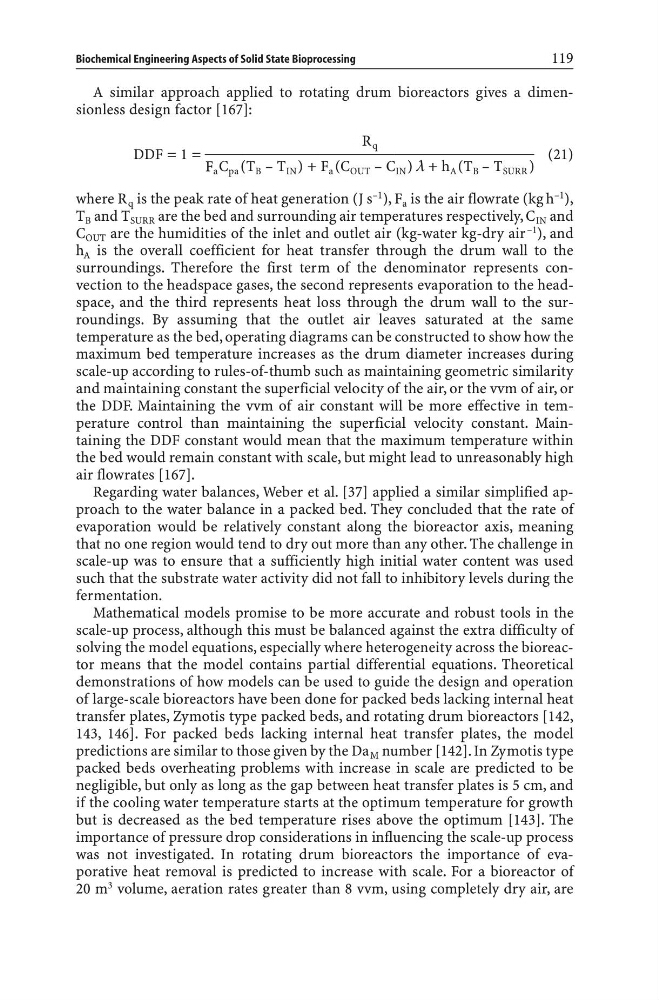
A similar approach applied to rotating drum bioreactors gives a dimensionless design factor [167]:
R q
DDF = 1 = 000000007 (21)
F a C pa (T B – T IN ) + F a (C OUT – C IN ) l + h A (T B – T SURR )
where R q is the peak rate of heat generation (J s –1 ), F a is the air flowrate (kg h –1 ),
T B and T SURR are the bed and surrounding air temperatures respectively, C IN and
C OUT are the humidities of the inlet and outlet air (kg-water kg-dry air –1 ), and
h A is the overall coefficient for heat transfer through the drum wall to the
surroundings. Therefore the first term of the denominator represents convection to the headspace gases, the second represents evaporation to the headspace, and the third represents heat loss through the drum wall to the surroundings. By assuming that the outlet air leaves saturated at the same
temperature as the bed, operating diagrams can be constructed to show how the
maximum bed temperature increases as the drum diameter increases during
scale-up according to rules-of-thumb such as maintaining geometric similarity
and maintaining constant the superficial velocity of the air, or the vvm of air, or
the DDF. Maintaining the vvm of air constant will be more effective in temperature control than maintaining the superficial velocity constant. Maintaining the DDF constant would mean that the maximum temperature within
the bed would remain constant with scale, but might lead to unreasonably high
air flowrates [167].
Regarding water balances, Weber et al. [37] applied a similar simplified approach to the water balance in a packed bed. They concluded that the rate of
evaporation would be relatively constant along the bioreactor axis, meaning
that no one region would tend to dry out more than any other. The challenge in
scale-up was to ensure that a sufficiently high initial water content was used
such that the substrate water activity did not fall to inhibitory levels during the
fermentation.
Mathematical models promise to be more accurate and robust tools in the
scale-up process, although this must be balanced against the extra difficulty of
solving the model equations, especially where heterogeneity across the bioreactor means that the model contains partial differential equations. Theoretical
demonstrations of how models can be used to guide the design and operation
of large-scale bioreactors have been done for packed beds lacking internal heat
transfer plates, Zymotis type packed beds, and rotating drum bioreactors [142,
143, 146]. For packed beds lacking internal heat transfer plates, the model
predictions are similar to those given by the Da M number [142]. In Zymotis type
packed beds overheating problems with increase in scale are predicted to be
negligible, but only as long as the gap between heat transfer plates is 5 cm, and
if the cooling water temperature starts at the optimum temperature for growth
but is decreased as the bed temperature rises above the optimum [143]. The
importance of pressure drop considerations in influencing the scale-up process
was not investigated. In rotating drum bioreactors the importance of evaporative heat removal is predicted to increase with scale. For a bioreactor of
20 m 3 volume, aeration rates greater than 8 vvm, using completely dry air, are
Biochemical Engineering Aspects of Solid State Bioprocessing
119
R q
DDF = 1 = 000000007 (21)
F a C pa (T B – T IN ) + F a (C OUT – C IN ) l + h A (T B – T SURR )
where R q is the peak rate of heat generation (J s –1 ), F a is the air flowrate (kg h –1 ),
T B and T SURR are the bed and surrounding air temperatures respectively, C IN and
C OUT are the humidities of the inlet and outlet air (kg-water kg-dry air –1 ), and
h A is the overall coefficient for heat transfer through the drum wall to the
surroundings. Therefore the first term of the denominator represents convection to the headspace gases, the second represents evaporation to the headspace, and the third represents heat loss through the drum wall to the surroundings. By assuming that the outlet air leaves saturated at the same
temperature as the bed, operating diagrams can be constructed to show how the
maximum bed temperature increases as the drum diameter increases during
scale-up according to rules-of-thumb such as maintaining geometric similarity
and maintaining constant the superficial velocity of the air, or the vvm of air, or
the DDF. Maintaining the vvm of air constant will be more effective in temperature control than maintaining the superficial velocity constant. Maintaining the DDF constant would mean that the maximum temperature within
the bed would remain constant with scale, but might lead to unreasonably high
air flowrates [167].
Regarding water balances, Weber et al. [37] applied a similar simplified approach to the water balance in a packed bed. They concluded that the rate of
evaporation would be relatively constant along the bioreactor axis, meaning
that no one region would tend to dry out more than any other. The challenge in
scale-up was to ensure that a sufficiently high initial water content was used
such that the substrate water activity did not fall to inhibitory levels during the
fermentation.
Mathematical models promise to be more accurate and robust tools in the
scale-up process, although this must be balanced against the extra difficulty of
solving the model equations, especially where heterogeneity across the bioreactor means that the model contains partial differential equations. Theoretical
demonstrations of how models can be used to guide the design and operation
of large-scale bioreactors have been done for packed beds lacking internal heat
transfer plates, Zymotis type packed beds, and rotating drum bioreactors [142,
143, 146]. For packed beds lacking internal heat transfer plates, the model
predictions are similar to those given by the Da M number [142]. In Zymotis type
packed beds overheating problems with increase in scale are predicted to be
negligible, but only as long as the gap between heat transfer plates is 5 cm, and
if the cooling water temperature starts at the optimum temperature for growth
but is decreased as the bed temperature rises above the optimum [143]. The
importance of pressure drop considerations in influencing the scale-up process
was not investigated. In rotating drum bioreactors the importance of evaporative heat removal is predicted to increase with scale. For a bioreactor of
20 m 3 volume, aeration rates greater than 8 vvm, using completely dry air, are
Biochemical Engineering Aspects of Solid State Bioprocessing
119