

Rather the work has only shown theoretically how these approaches could be
used to guide the design and operation of large-scale bioreactors.
The basic approach to using mass and energy balances as a scale-up tool was
pointed out by Saucedo-Castaneda et al. [144]: if the dynamic balance equations
for water and for energy can be equated to zero, then the water content and the
temperature will not change with time. Furthermore if this equality with zero
can be maintained as scale increases, then the large-scale bioreactor should
operate equally as well as the small scale bioreactor. The challenge is then to
find operating conditions for the bioreactor that will allow the water and energy
balances to remain equal to zero as scale increases.
Regarding the prevention of undesirably high temperatures within the
bioreactor, a relatively simple approach is to concentrate on the time of peak
heat generation. This approach was demonstrated by Mitchell et al. [142] for
packed bed bioreactors without internal heat transfer plates and Hardin et al.
[166] for rotating drum bioreactors. Following the strategy of SaucedoCastaneda et al. [144], estimates are made of the peak heat generation and heat
removal terms. They are equated by taking a ratio of peak heat generation to
peak heat removal and equating the ratio to one.
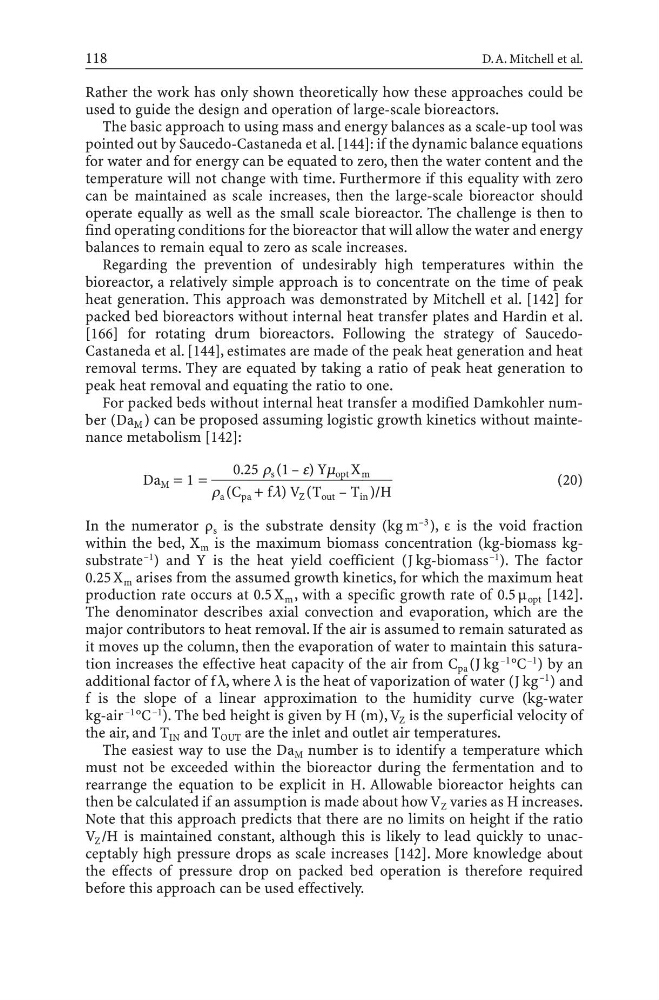
For packed beds without internal heat transfer a modified Damkohler number (Da M ) can be proposed assuming logistic growth kinetics without maintenance metabolism [142]:
0.25 Ç s (1 – e) Ym opt X m
Da M = 1 = 00008
(20)
Ç a (C pa + fl) V Z (T out – T in )/H
In the numerator Ç s is the substrate density (kg m –3 ), e is the void fraction
within the bed, X m is the maximum biomass concentration (kg-biomass kgsubstrate –1 ) and Y is the heat yield coefficient (J kg-biomass –1 ). The factor
0.25 X m arises from the assumed growth kinetics, for which the maximum heat
production rate occurs at 0.5 X m , with a specific growth rate of 0.5 m opt [142].
The denominator describes axial convection and evaporation, which are the
major contributors to heat removal. If the air is assumed to remain saturated as
it moves up the column, then the evaporation of water to maintain this saturation increases the effective heat capacity of the air from C pa (J kg –1 °C –1 ) by an
additional factor of f l, where l is the heat of vaporization of water (J kg –1 ) and
f is the slope of a linear approximation to the humidity curve (kg-water
kg-air –1 °C –1 ). The bed height is given by H (m), V Z is the superficial velocity of
the air, and T IN and T OUT are the inlet and outlet air temperatures.
The easiest way to use the Da M number is to identify a temperature which
must not be exceeded within the bioreactor during the fermentation and to
rearrange the equation to be explicit in H. Allowable bioreactor heights can
then be calculated if an assumption is made about how V Z varies as H increases.
Note that this approach predicts that there are no limits on height if the ratio
V Z /H is maintained constant, although this is likely to lead quickly to unacceptably high pressure drops as scale increases [142]. More knowledge about
the effects of pressure drop on packed bed operation is therefore required
before this approach can be used effectively.
118
D.A. Mitchell et al.
used to guide the design and operation of large-scale bioreactors.
The basic approach to using mass and energy balances as a scale-up tool was
pointed out by Saucedo-Castaneda et al. [144]: if the dynamic balance equations
for water and for energy can be equated to zero, then the water content and the
temperature will not change with time. Furthermore if this equality with zero
can be maintained as scale increases, then the large-scale bioreactor should
operate equally as well as the small scale bioreactor. The challenge is then to
find operating conditions for the bioreactor that will allow the water and energy
balances to remain equal to zero as scale increases.
Regarding the prevention of undesirably high temperatures within the
bioreactor, a relatively simple approach is to concentrate on the time of peak
heat generation. This approach was demonstrated by Mitchell et al. [142] for
packed bed bioreactors without internal heat transfer plates and Hardin et al.
[166] for rotating drum bioreactors. Following the strategy of SaucedoCastaneda et al. [144], estimates are made of the peak heat generation and heat
removal terms. They are equated by taking a ratio of peak heat generation to
peak heat removal and equating the ratio to one.
For packed beds without internal heat transfer a modified Damkohler number (Da M ) can be proposed assuming logistic growth kinetics without maintenance metabolism [142]:
0.25 Ç s (1 – e) Ym opt X m
Da M = 1 = 00008
(20)
Ç a (C pa + fl) V Z (T out – T in )/H
In the numerator Ç s is the substrate density (kg m –3 ), e is the void fraction
within the bed, X m is the maximum biomass concentration (kg-biomass kgsubstrate –1 ) and Y is the heat yield coefficient (J kg-biomass –1 ). The factor
0.25 X m arises from the assumed growth kinetics, for which the maximum heat
production rate occurs at 0.5 X m , with a specific growth rate of 0.5 m opt [142].
The denominator describes axial convection and evaporation, which are the
major contributors to heat removal. If the air is assumed to remain saturated as
it moves up the column, then the evaporation of water to maintain this saturation increases the effective heat capacity of the air from C pa (J kg –1 °C –1 ) by an
additional factor of f l, where l is the heat of vaporization of water (J kg –1 ) and
f is the slope of a linear approximation to the humidity curve (kg-water
kg-air –1 °C –1 ). The bed height is given by H (m), V Z is the superficial velocity of
the air, and T IN and T OUT are the inlet and outlet air temperatures.
The easiest way to use the Da M number is to identify a temperature which
must not be exceeded within the bioreactor during the fermentation and to
rearrange the equation to be explicit in H. Allowable bioreactor heights can
then be calculated if an assumption is made about how V Z varies as H increases.
Note that this approach predicts that there are no limits on height if the ratio
V Z /H is maintained constant, although this is likely to lead quickly to unacceptably high pressure drops as scale increases [142]. More knowledge about
the effects of pressure drop on packed bed operation is therefore required
before this approach can be used effectively.
118
D.A. Mitchell et al.