

fusivity within the bed. In modeling work, Smits et al. [100] showed that, for a
bed depth of 10 cm from the surface, oxygen became limiting during the
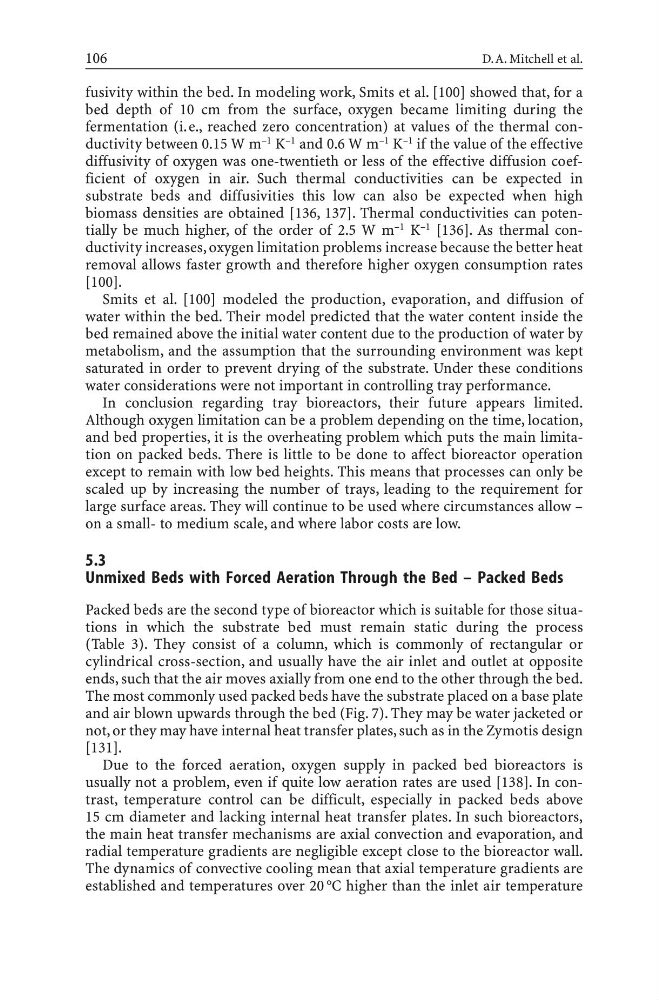
fermentation (i.e., reached zero concentration) at values of the thermal conductivity between 0.15 W m –1 K –1 and 0.6 W m –1 K –1 if the value of the effective
diffusivity of oxygen was one-twentieth or less of the effective diffusion coefficient of oxygen in air. Such thermal conductivities can be expected in
substrate beds and diffusivities this low can also be expected when high
biomass densities are obtained [136, 137]. Thermal conductivities can potentially be much higher, of the order of 2.5 W m –1 K –1 [136]. As thermal conductivity increases, oxygen limitation problems increase because the better heat
removal allows faster growth and therefore higher oxygen consumption rates
[100].
Smits et al. [100] modeled the production, evaporation, and diffusion of
water within the bed. Their model predicted that the water content inside the
bed remained above the initial water content due to the production of water by
metabolism, and the assumption that the surrounding environment was kept
saturated in order to prevent drying of the substrate. Under these conditions
water considerations were not important in controlling tray performance.
In conclusion regarding tray bioreactors, their future appears limited.
Although oxygen limitation can be a problem depending on the time, location,
and bed properties, it is the overheating problem which puts the main limitation on packed beds. There is little to be done to affect bioreactor operation
except to remain with low bed heights. This means that processes can only be
scaled up by increasing the number of trays, leading to the requirement for
large surface areas. They will continue to be used where circumstances allow –
on a small- to medium scale, and where labor costs are low.
5.3
Unmixed Beds with Forced Aeration Through the Bed – Packed Beds
Packed beds are the second type of bioreactor which is suitable for those situations in which the substrate bed must remain static during the process
(Table 3). They consist of a column, which is commonly of rectangular or
cylindrical cross-section, and usually have the air inlet and outlet at opposite
ends, such that the air moves axially from one end to the other through the bed.
The most commonly used packed beds have the substrate placed on a base plate
and air blown upwards through the bed (Fig. 7). They may be water jacketed or
not, or they may have internal heat transfer plates, such as in the Zymotis design
[131].
Due to the forced aeration, oxygen supply in packed bed bioreactors is
usually not a problem, even if quite low aeration rates are used [138]. In contrast, temperature control can be difficult, especially in packed beds above
15 cm diameter and lacking internal heat transfer plates. In such bioreactors,
the main heat transfer mechanisms are axial convection and evaporation, and
radial temperature gradients are negligible except close to the bioreactor wall.
The dynamics of convective cooling mean that axial temperature gradients are
established and temperatures over 20 °C higher than the inlet air temperature
106
D.A. Mitchell et al.
bed depth of 10 cm from the surface, oxygen became limiting during the
fermentation (i.e., reached zero concentration) at values of the thermal conductivity between 0.15 W m –1 K –1 and 0.6 W m –1 K –1 if the value of the effective
diffusivity of oxygen was one-twentieth or less of the effective diffusion coefficient of oxygen in air. Such thermal conductivities can be expected in
substrate beds and diffusivities this low can also be expected when high
biomass densities are obtained [136, 137]. Thermal conductivities can potentially be much higher, of the order of 2.5 W m –1 K –1 [136]. As thermal conductivity increases, oxygen limitation problems increase because the better heat
removal allows faster growth and therefore higher oxygen consumption rates
[100].
Smits et al. [100] modeled the production, evaporation, and diffusion of
water within the bed. Their model predicted that the water content inside the
bed remained above the initial water content due to the production of water by
metabolism, and the assumption that the surrounding environment was kept
saturated in order to prevent drying of the substrate. Under these conditions
water considerations were not important in controlling tray performance.
In conclusion regarding tray bioreactors, their future appears limited.
Although oxygen limitation can be a problem depending on the time, location,
and bed properties, it is the overheating problem which puts the main limitation on packed beds. There is little to be done to affect bioreactor operation
except to remain with low bed heights. This means that processes can only be
scaled up by increasing the number of trays, leading to the requirement for
large surface areas. They will continue to be used where circumstances allow –
on a small- to medium scale, and where labor costs are low.
5.3
Unmixed Beds with Forced Aeration Through the Bed – Packed Beds
Packed beds are the second type of bioreactor which is suitable for those situations in which the substrate bed must remain static during the process
(Table 3). They consist of a column, which is commonly of rectangular or
cylindrical cross-section, and usually have the air inlet and outlet at opposite
ends, such that the air moves axially from one end to the other through the bed.
The most commonly used packed beds have the substrate placed on a base plate
and air blown upwards through the bed (Fig. 7). They may be water jacketed or
not, or they may have internal heat transfer plates, such as in the Zymotis design
[131].
Due to the forced aeration, oxygen supply in packed bed bioreactors is
usually not a problem, even if quite low aeration rates are used [138]. In contrast, temperature control can be difficult, especially in packed beds above
15 cm diameter and lacking internal heat transfer plates. In such bioreactors,
the main heat transfer mechanisms are axial convection and evaporation, and
radial temperature gradients are negligible except close to the bioreactor wall.
The dynamics of convective cooling mean that axial temperature gradients are
established and temperatures over 20 °C higher than the inlet air temperature
106
D.A. Mitchell et al.