

Direct Analysis of Protein Complexes
61
Direct analysis of protein mixtures has the advantage that proteolytic digestion is
performed in solution. Proteins can be aggressively denatured, reduced and
alkylated and then digested. We denature proteins in 8-M urea and then digest
using trypsin after dilution of the solution to 2-M urea. The collection of peptides
is then separated using HPLC. To maximize sensitivity micro column liquid chromatography has been combined with micro electro spray ionization. Since the low
flow rates of the HPLC help to focus the electro spray at the interface of the mass
spectrometer and increase the elution concentration of peptides, sensitivity is
increased. Gatlin et al. developed a micro column microelectrospray interface that
eliminates the use of frits and junctions and splits the HPLC flow at the head of
the column (Gatlin et al. 1998). This configuration is good for the analysis of reasonably complex protein mixtures and has been applied to the analysis of protein
mixtures obtained in molecular biology experiments.
7
Multi-Dimensional Separations
Identification of proteins contained in mixtures presents a particular challenge to
separations. Since an experiment can have several goals including component
identification and sequence coverage to identify posttranslational modifications,
it is important to achieve the best resolution possible to allow acquisition of mass
spectral data for as many pep tides as possible. To achieve comprehensive component identification we have used multi-dimensional liquid chromatography to
improve the resolution of peptide mixtures. We use a system that combines
strong cation exchange and reversed-phase chromatography. By combining these
two types of separations, pep tides are separated by charge and then by hydrophobicity. To maximize the sensitivity of the method, we sought to transfer as much
material as possible between the two separation media. The method also had to
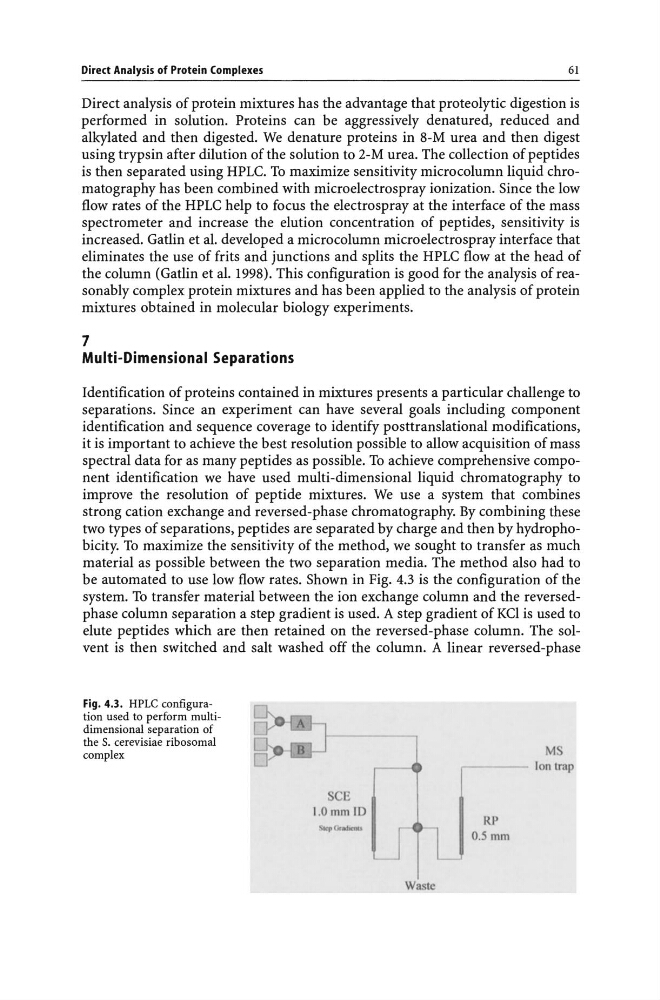
be automated to use low flow rates. Shown in Fig. 4.3 is the configuration of the
system. To transfer material between the ion exchange column and the reversedphase column separation a step gradient is used. A step gradient of KCl is used to
elute pep tides which are then retained on the reversed-phase column. The solvent is then switched and salt washed off the column. A linear reversed-phase
Fig. 4.3. HPLC configuration used to perform multidimensional separation of
the S. cerevisiae ribosomal
complex
E
1.0 mm !O
Waste
RP
O.Smm
M
1011 LTap
61
Direct analysis of protein mixtures has the advantage that proteolytic digestion is
performed in solution. Proteins can be aggressively denatured, reduced and
alkylated and then digested. We denature proteins in 8-M urea and then digest
using trypsin after dilution of the solution to 2-M urea. The collection of peptides
is then separated using HPLC. To maximize sensitivity micro column liquid chromatography has been combined with micro electro spray ionization. Since the low
flow rates of the HPLC help to focus the electro spray at the interface of the mass
spectrometer and increase the elution concentration of peptides, sensitivity is
increased. Gatlin et al. developed a micro column microelectrospray interface that
eliminates the use of frits and junctions and splits the HPLC flow at the head of
the column (Gatlin et al. 1998). This configuration is good for the analysis of reasonably complex protein mixtures and has been applied to the analysis of protein
mixtures obtained in molecular biology experiments.
7
Multi-Dimensional Separations
Identification of proteins contained in mixtures presents a particular challenge to
separations. Since an experiment can have several goals including component
identification and sequence coverage to identify posttranslational modifications,
it is important to achieve the best resolution possible to allow acquisition of mass
spectral data for as many pep tides as possible. To achieve comprehensive component identification we have used multi-dimensional liquid chromatography to
improve the resolution of peptide mixtures. We use a system that combines
strong cation exchange and reversed-phase chromatography. By combining these
two types of separations, pep tides are separated by charge and then by hydrophobicity. To maximize the sensitivity of the method, we sought to transfer as much
material as possible between the two separation media. The method also had to
be automated to use low flow rates. Shown in Fig. 4.3 is the configuration of the
system. To transfer material between the ion exchange column and the reversedphase column separation a step gradient is used. A step gradient of KCl is used to
elute pep tides which are then retained on the reversed-phase column. The solvent is then switched and salt washed off the column. A linear reversed-phase
Fig. 4.3. HPLC configuration used to perform multidimensional separation of
the S. cerevisiae ribosomal
complex
E
1.0 mm !O
Waste
RP
O.Smm
M
1011 LTap