

Proteoglycans: Biological Roles and Strategies
349
more type of GAGs (syndecan-l and aggrecan) and from a few (decorin and biglycan) to hundred chains (aggrecan and versican). Other protein cores may contain hydrophobic transmembrane domains (a-helix) and are found in the cell
membrane PGs, such as the family of syndecans (David 1993). Molecular masses
of protein cores are variable ranging from about 20-kDa for serglycin PG family
to more than 200-kDa for aggrecan, versican and perlecan (Bourdon 1990).
3.3
Structure and Biological Significance of Proteoglycans and Hyaluronan
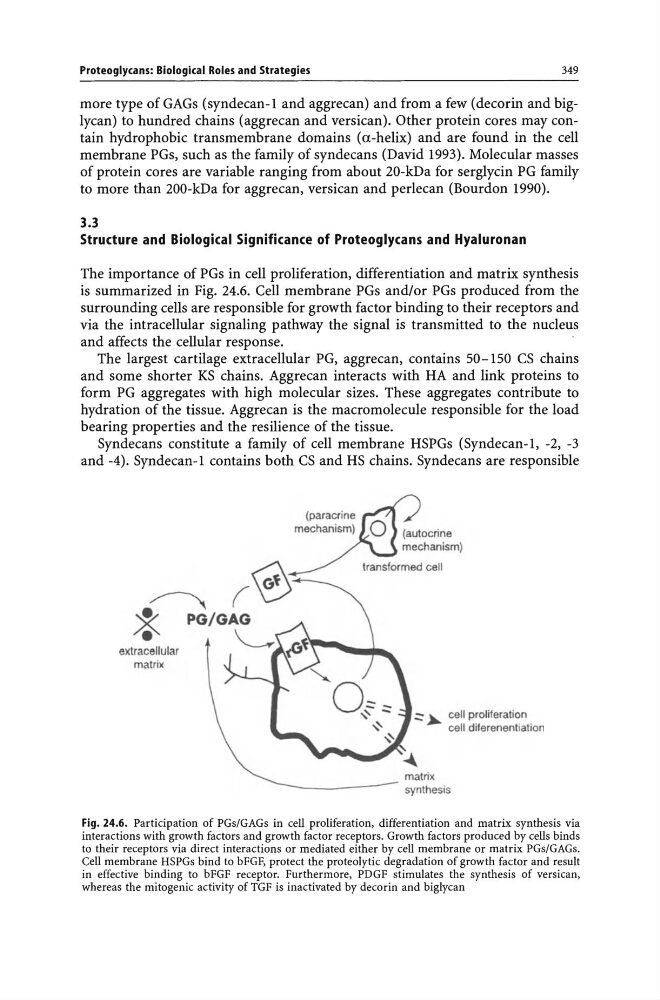
The importance of PGs in cell proliferation, differentiation and matrix synthesis
is summarized in Fig. 24.6. Cell membrane PGs and/or PGs produced from the
surrounding cells are responsible for growth factor binding to their receptors and
via the intracellular signaling pathway the signal is transmitted to the nucleus
and affects the cellular response.
The largest cartilage extracellular PG, aggrecan, contains 50-150 CS chains
and some shorter KS chains. Aggrecan interacts with HA and link proteins to
form PG aggregates with high molecular sizes. These aggregates contribute to
hydration of the tissue. Aggrecan is the macromolecule responsible for the load
bearing properties and the resilience of the tissue.
Syndecans constitute a family of cell membrane HSPGs (Syndecan-l, -2, -3
and -4). Syndecan-l contains both CS and HS chains. Syndecans are responsible
extracellular
matri~
transformed cell
::: ~ celi proliferation
celi diferenenlialion
matrix
-------~ synthesis
Fig. 24.6. Participation of PGs/GAGs in cell proliferation, differentiation and matrix synthesis via
interactions with growth factors and growth factor receptors. Growth factors produced by cells binds
to their receptors via direct interactions or mediated either by cell membrane or matrix PGs/GAGs.
Cell membrane HSPGs bind to bFGF, protect the proteolytic degradation of growth factor and result
in effective binding to bFGF receptor. Furthermore, PDGF stimulates the synthesis of versican,
whereas the mitogenic activity of TGF is inactivated by decorin and biglycan
349
more type of GAGs (syndecan-l and aggrecan) and from a few (decorin and biglycan) to hundred chains (aggrecan and versican). Other protein cores may contain hydrophobic transmembrane domains (a-helix) and are found in the cell
membrane PGs, such as the family of syndecans (David 1993). Molecular masses
of protein cores are variable ranging from about 20-kDa for serglycin PG family
to more than 200-kDa for aggrecan, versican and perlecan (Bourdon 1990).
3.3
Structure and Biological Significance of Proteoglycans and Hyaluronan
The importance of PGs in cell proliferation, differentiation and matrix synthesis
is summarized in Fig. 24.6. Cell membrane PGs and/or PGs produced from the
surrounding cells are responsible for growth factor binding to their receptors and
via the intracellular signaling pathway the signal is transmitted to the nucleus
and affects the cellular response.
The largest cartilage extracellular PG, aggrecan, contains 50-150 CS chains
and some shorter KS chains. Aggrecan interacts with HA and link proteins to
form PG aggregates with high molecular sizes. These aggregates contribute to
hydration of the tissue. Aggrecan is the macromolecule responsible for the load
bearing properties and the resilience of the tissue.
Syndecans constitute a family of cell membrane HSPGs (Syndecan-l, -2, -3
and -4). Syndecan-l contains both CS and HS chains. Syndecans are responsible
extracellular
matri~
transformed cell
::: ~ celi proliferation
celi diferenenlialion
matrix
-------~ synthesis
Fig. 24.6. Participation of PGs/GAGs in cell proliferation, differentiation and matrix synthesis via
interactions with growth factors and growth factor receptors. Growth factors produced by cells binds
to their receptors via direct interactions or mediated either by cell membrane or matrix PGs/GAGs.
Cell membrane HSPGs bind to bFGF, protect the proteolytic degradation of growth factor and result
in effective binding to bFGF receptor. Furthermore, PDGF stimulates the synthesis of versican,
whereas the mitogenic activity of TGF is inactivated by decorin and biglycan