

Protein Sequencing or Genome Sequencing
100
mfz
U"\
roo
-
r'" '"
23
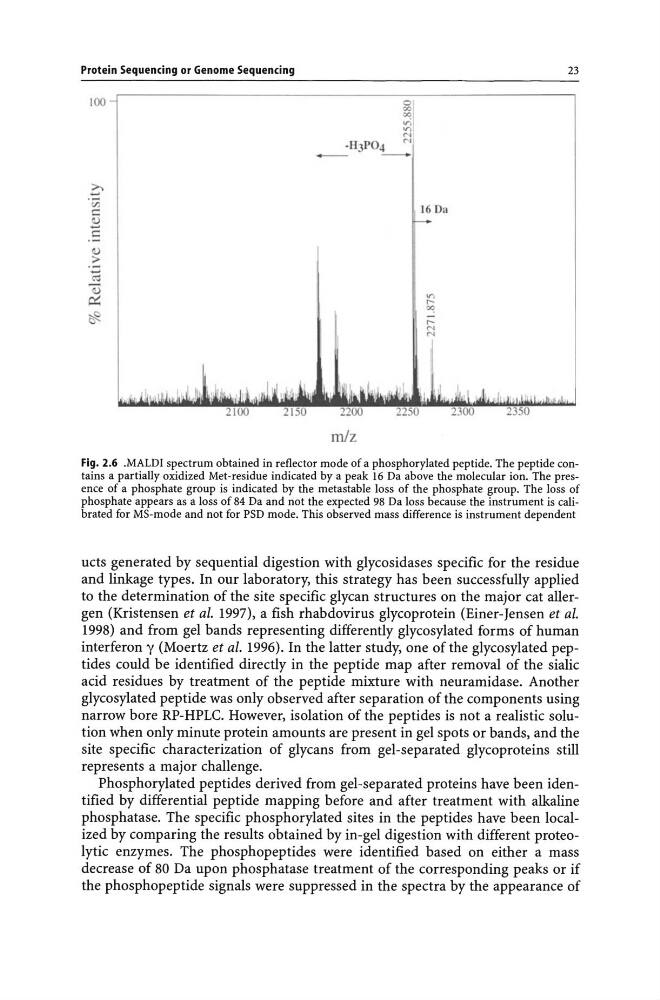
Fig. 2.6 .MALD! spectrum obtained in reflector mode of a phosphorylated peptide. The peptide contains a partially oxidized Met-residue indicated by a peak 16 Da above the molecular ion. The presence of a phosphate group is indicated by the metastable loss of the phosphate group. The loss of
phosphate appears as a loss of 84 Da and not the expected 98 Da loss because the instrument is calibrated for MS-mode and not for PSD mode. This observed mass difference is instrument dependent
ucts generated by sequential digestion with glycosidases specific for the residue
and linkage types. In our laboratory, this strategy has been successfully applied
to the determination of the site specific glycan structures on the major cat allergen (Kristensen et ai. 1997), a fish rhabdovirus glycoprotein (Einer-Jensen et al.
1998) and from gel bands representing differently glycosylated forms of human
interferon y (Moertz et al. 1996). In the latter study, one of the glycosylated peptides could be identified directly in the peptide map after removal of the sialic
acid residues by treatment of the peptide mixture with neuramidase. Another
glycosylated peptide was only observed after separation of the components using
narrow bore RP-HPLC. However, isolation of the peptides is not a realistic solution when only minute protein amounts are present in gel spots or bands, and the
site specific characterization of glycans from gel-separated glycoproteins still
represents a major challenge.
Phosphorylated peptides derived from gel-separated proteins have been identified by differential peptide mapping before and after treatment with alkaline
phosphatase. The specific phosphorylated sites in the peptides have been localized by comparing the results obtained by in-gel digestion with different proteolytic enzymes. The phosphopeptides were identified based on either a mass
decrease of 80 Da upon phosphatase treatment of the corresponding peaks or if
the phosphopeptide signals were suppressed in the spectra by the appearance of
100
mfz
U"\
roo
-
r'" '"
23
Fig. 2.6 .MALD! spectrum obtained in reflector mode of a phosphorylated peptide. The peptide contains a partially oxidized Met-residue indicated by a peak 16 Da above the molecular ion. The presence of a phosphate group is indicated by the metastable loss of the phosphate group. The loss of
phosphate appears as a loss of 84 Da and not the expected 98 Da loss because the instrument is calibrated for MS-mode and not for PSD mode. This observed mass difference is instrument dependent
ucts generated by sequential digestion with glycosidases specific for the residue
and linkage types. In our laboratory, this strategy has been successfully applied
to the determination of the site specific glycan structures on the major cat allergen (Kristensen et ai. 1997), a fish rhabdovirus glycoprotein (Einer-Jensen et al.
1998) and from gel bands representing differently glycosylated forms of human
interferon y (Moertz et al. 1996). In the latter study, one of the glycosylated peptides could be identified directly in the peptide map after removal of the sialic
acid residues by treatment of the peptide mixture with neuramidase. Another
glycosylated peptide was only observed after separation of the components using
narrow bore RP-HPLC. However, isolation of the peptides is not a realistic solution when only minute protein amounts are present in gel spots or bands, and the
site specific characterization of glycans from gel-separated glycoproteins still
represents a major challenge.
Phosphorylated peptides derived from gel-separated proteins have been identified by differential peptide mapping before and after treatment with alkaline
phosphatase. The specific phosphorylated sites in the peptides have been localized by comparing the results obtained by in-gel digestion with different proteolytic enzymes. The phosphopeptides were identified based on either a mass
decrease of 80 Da upon phosphatase treatment of the corresponding peaks or if
the phosphopeptide signals were suppressed in the spectra by the appearance of