

22
P. ROEPSTORFF
4660.1
A
2376.3
B
2000
2500
3000
3500
4000
4500
5000
mlz
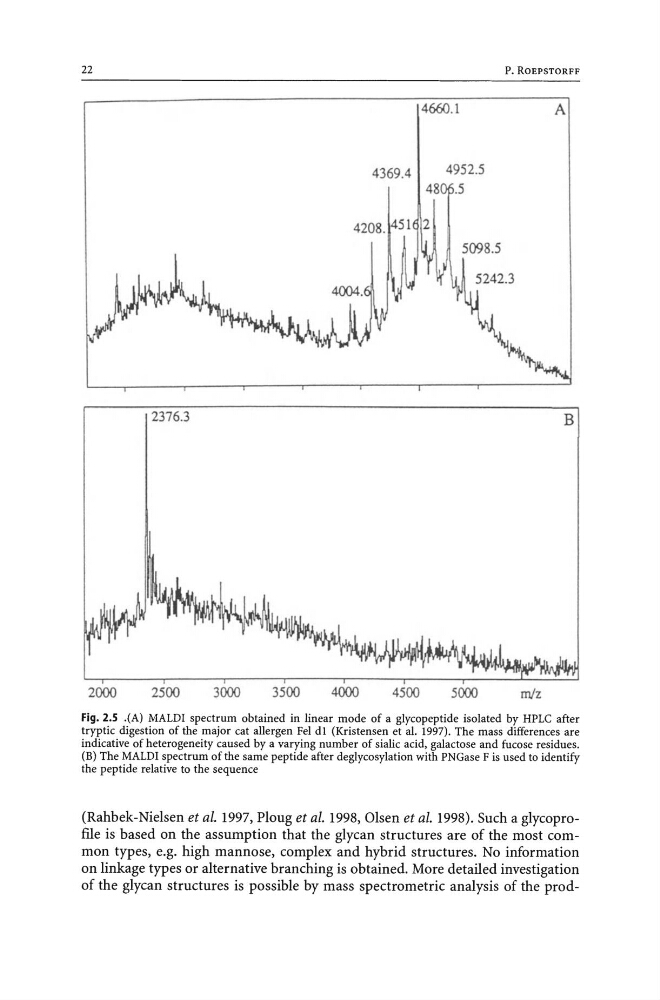
Fig. 2.S .(A) MALDI spectrum obtained in linear mode of a glycopeptide isolated by HPLC after
tryptic digestion of the major cat allergen Fel d1 (Kristensen et al. 1997). The mass differences are
indicative of heterogeneity caused by a varying number of sialic acid, galactose and fucose residues.
(B) The MALDI spectrum of the same peptide after deglycosylation with PNGase F is used to identify
the peptide relative to the sequence
(Rahbek-Nielsen et al. 1997, Ploug et al. 1998, Olsen et al. 1998). Such a glycoproflle is based on the assumption that the glycan structures are of the most common types, e.g. high mannose, complex and hybrid structures. No information
on linkage types or alternative branching is obtained. More detailed investigation
of the glycan structures is possible by mass spectrometric analysis of the prod-
P. ROEPSTORFF
4660.1
A
2376.3
B
2000
2500
3000
3500
4000
4500
5000
mlz
Fig. 2.S .(A) MALDI spectrum obtained in linear mode of a glycopeptide isolated by HPLC after
tryptic digestion of the major cat allergen Fel d1 (Kristensen et al. 1997). The mass differences are
indicative of heterogeneity caused by a varying number of sialic acid, galactose and fucose residues.
(B) The MALDI spectrum of the same peptide after deglycosylation with PNGase F is used to identify
the peptide relative to the sequence
(Rahbek-Nielsen et al. 1997, Ploug et al. 1998, Olsen et al. 1998). Such a glycoproflle is based on the assumption that the glycan structures are of the most common types, e.g. high mannose, complex and hybrid structures. No information
on linkage types or alternative branching is obtained. More detailed investigation
of the glycan structures is possible by mass spectrometric analysis of the prod-