

Exploring Functions for Glycosylation in Host Defence
331
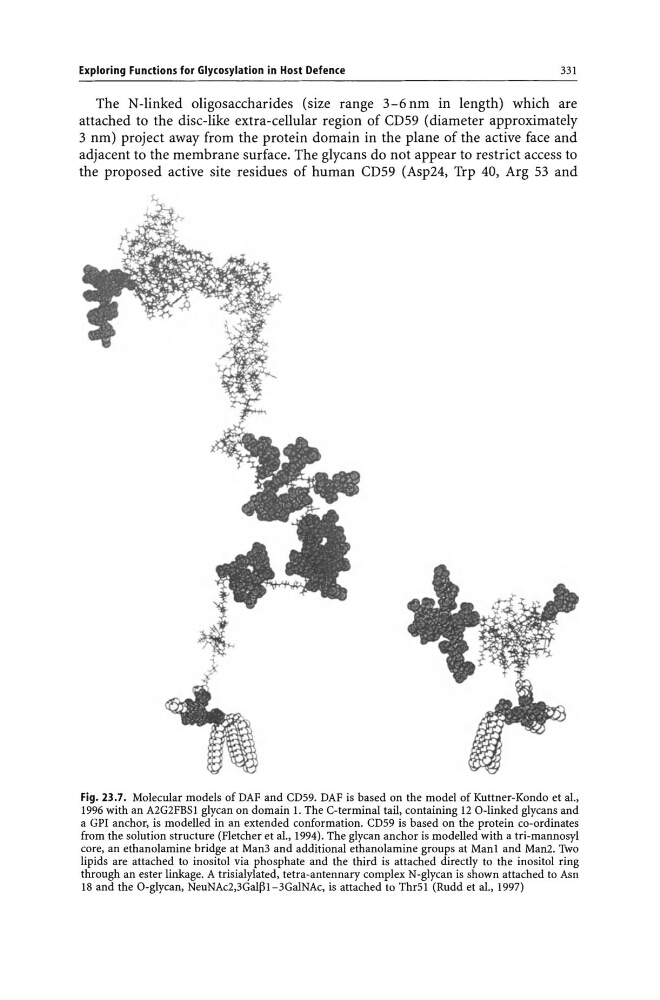
The N-linked oligo saccharides (size range 3-6 nm in length) which are
attached to the disc-like extra-cellular region of CD 59 (diameter approximately
3 nm) project away from the protein domain in the plane of the active face and
adjacent to the membrane surface. The glycans do not appear to restrict access to
the proposed active site residues of human CD59 (Asp24, Trp 40, Arg 53 and
Fig. 23.7. Molecular models of DAF and CD59. DAF is based on the model of Kuttner-Kondo et aI.,
1996 with an A2G2FBS1 glycan on domain 1. The C-terminal tail, containing 12 O-linked glycans and
a GPI anchor, is modelled in an extended conformation. CD59 is based on the protein co-ordinates
from the solution structure (Fletcher et aI., 1994). The glycan anchor is modelled with a tri-mannosyl
core, an ethanolamine bridge at Man3 and additional ethanolamine groups at Man1 and Man2. Two
lipids are attached to inositol via phosphate and the third is attached directly to the inositol ring
through an ester linkage. A trisialylated, tetra-antennary complex N-glycan is shown attached to Asn
18 and the O-glycan, NeuNAc2,3GaI~1-3GalNAc, is attached to ThrSl (Rudd et aI., 1997)
331
The N-linked oligo saccharides (size range 3-6 nm in length) which are
attached to the disc-like extra-cellular region of CD 59 (diameter approximately
3 nm) project away from the protein domain in the plane of the active face and
adjacent to the membrane surface. The glycans do not appear to restrict access to
the proposed active site residues of human CD59 (Asp24, Trp 40, Arg 53 and
Fig. 23.7. Molecular models of DAF and CD59. DAF is based on the model of Kuttner-Kondo et aI.,
1996 with an A2G2FBS1 glycan on domain 1. The C-terminal tail, containing 12 O-linked glycans and
a GPI anchor, is modelled in an extended conformation. CD59 is based on the protein co-ordinates
from the solution structure (Fletcher et aI., 1994). The glycan anchor is modelled with a tri-mannosyl
core, an ethanolamine bridge at Man3 and additional ethanolamine groups at Man1 and Man2. Two
lipids are attached to inositol via phosphate and the third is attached directly to the inositol ring
through an ester linkage. A trisialylated, tetra-antennary complex N-glycan is shown attached to Asn
18 and the O-glycan, NeuNAc2,3GaI~1-3GalNAc, is attached to ThrSl (Rudd et aI., 1997)