

322
P. M. RUDD et al.
glycan sequencing data and oligosaccharide structural information from the Glycobiology Institute data base with protein structural data many glycoproteins can
now be modelled in their entirety. This means that it is now possible to visualise
the sugars in the context of the glycoproteins to which they are attached.
Pivotal to this approach is rapid, sensitive state-of-the-art oligosaccharide
sequencing technology. Strategies have been developed which enable the Nglycosylation of a few micrograms of glycoproteins of major biological interest
purified by SDS PAGE gel (Kuster et aI., 1997) to be analysed in a few days using
MS or HPLC (Rudd et aI., 1997a). The technology is now being extended to analyse O-glycans. These advances open up the possibility of ranking high throughput oligosaccharide sequencing alongside that of proteins and DNA. In this paper
we demonstrate how these strategies have been used to determine the structures
of the oligo saccharides attached to a range of glycoproteins which operate in the
humoral or cellular immune systems. Some of the roles which have been proposed for these sugars include assisting in protein folding and loading of antigenic peptide, providing protease protection, stabilising protein structure and
modulating the organisation and presentation of cell surface glycoproteins. In
autoimmune disease, such as rheumatoid arthritis, altered glycosylation of IgG
may result in the multiple presentation of terminal sugars which can bind to the
mannose binding lectin (MEL). This may contribute to the inflammatory processes through the activation of complement by MEL.
3
Oligosaccharide Sequencing Technology
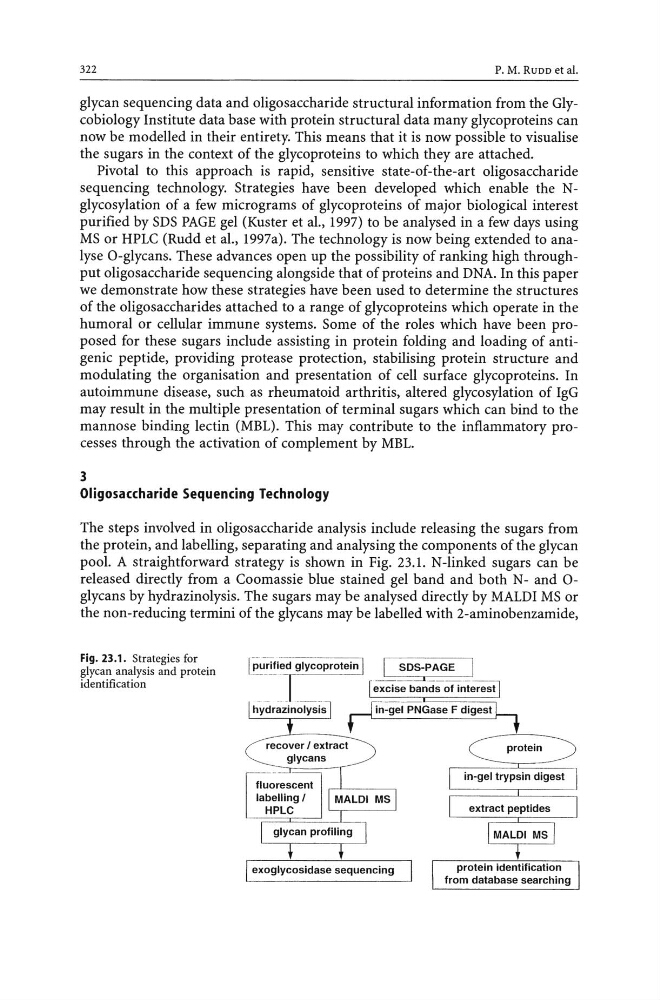
The steps involved in oligosaccharide analysis include releasing the sugars from
the protein, and labelling, separating and analysing the components of the glycan
pool. A straightforward strategy is shown in Fig. 23.1. N-linked sugars can be
released directly from a Coomassie blue stained gel band and both N - and 0glycans by hydrazinolysis. The sugars may be analysed directly by MALDI MS or
the non-reducing termini of the glycans may be labelled with 2-aminobenzamide,
Fig. 23.1. Strategies for
glycan analysis and protein
identification
[pjrIfi~d glycoprotein I I 50S-PAGE I
n I n _n le~~~~f interest]
~n-gel PNGase F digest ~
---~---recover I extract
glycans
I exoglycosidase sequencing
protein
in-gel trypsin digest
P. M. RUDD et al.
glycan sequencing data and oligosaccharide structural information from the Glycobiology Institute data base with protein structural data many glycoproteins can
now be modelled in their entirety. This means that it is now possible to visualise
the sugars in the context of the glycoproteins to which they are attached.
Pivotal to this approach is rapid, sensitive state-of-the-art oligosaccharide
sequencing technology. Strategies have been developed which enable the Nglycosylation of a few micrograms of glycoproteins of major biological interest
purified by SDS PAGE gel (Kuster et aI., 1997) to be analysed in a few days using
MS or HPLC (Rudd et aI., 1997a). The technology is now being extended to analyse O-glycans. These advances open up the possibility of ranking high throughput oligosaccharide sequencing alongside that of proteins and DNA. In this paper
we demonstrate how these strategies have been used to determine the structures
of the oligo saccharides attached to a range of glycoproteins which operate in the
humoral or cellular immune systems. Some of the roles which have been proposed for these sugars include assisting in protein folding and loading of antigenic peptide, providing protease protection, stabilising protein structure and
modulating the organisation and presentation of cell surface glycoproteins. In
autoimmune disease, such as rheumatoid arthritis, altered glycosylation of IgG
may result in the multiple presentation of terminal sugars which can bind to the
mannose binding lectin (MEL). This may contribute to the inflammatory processes through the activation of complement by MEL.
3
Oligosaccharide Sequencing Technology
The steps involved in oligosaccharide analysis include releasing the sugars from
the protein, and labelling, separating and analysing the components of the glycan
pool. A straightforward strategy is shown in Fig. 23.1. N-linked sugars can be
released directly from a Coomassie blue stained gel band and both N - and 0glycans by hydrazinolysis. The sugars may be analysed directly by MALDI MS or
the non-reducing termini of the glycans may be labelled with 2-aminobenzamide,
Fig. 23.1. Strategies for
glycan analysis and protein
identification
[pjrIfi~d glycoprotein I I 50S-PAGE I
n I n _n le~~~~f interest]
~n-gel PNGase F digest ~
---~---recover I extract
glycans
I exoglycosidase sequencing
protein
in-gel trypsin digest