

Biomolecular Interaction of Matrix Metalloproteinases and Their Inhibitors TIMPs
297
'Activated ' MMP
'Superactivated' MMP
Inhibited MMP
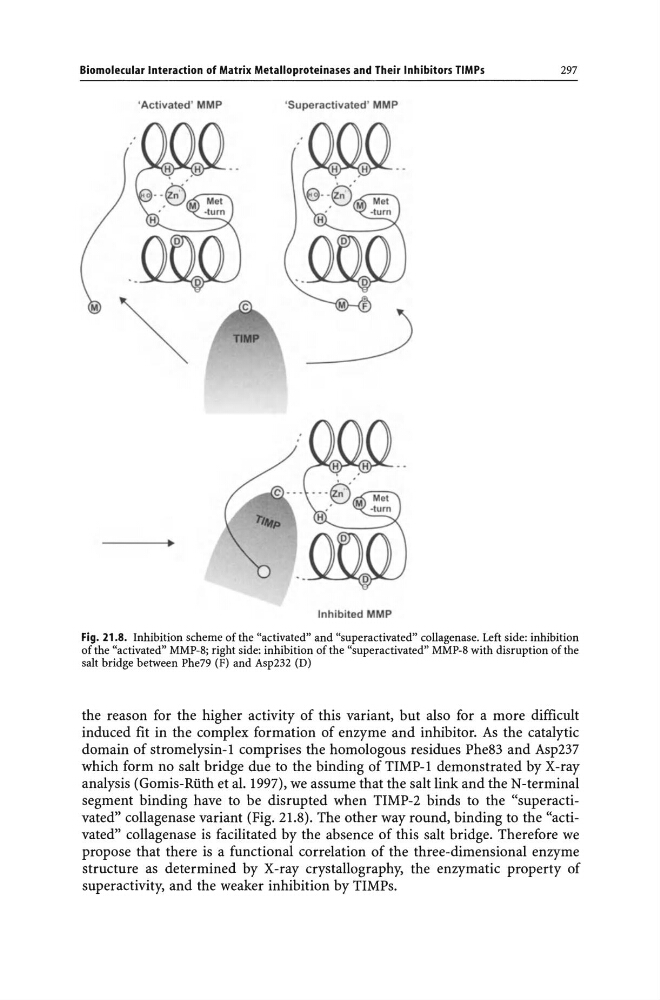
Fig. 21.S. Inhibition scheme of the "activated" and "superactivated" collagenase. Left side: inhibition
of the "activated" MMP-8; right side: inhibition of the "superactivated" MMP-8 with disruption of the
saIt bridge between Phe79 (F) and Asp232 (D)
the reason for the higher activity of this variant, but also for a more difficult
induced fit in the complex formation of enzyme and inhibitor. As the catalytic
domain of stromelysin-1 comprises the homologous residues Phe83 and Asp237
which form no salt bridge due to the binding of TIMP-1 demonstrated by X-ray
analysis (Gomis-Riith et al. 1997), we assume that the salt link and the N-terminal
segment binding have to be disrupted when TIMP-2 binds to the "superactivated" collagenase variant (Fig. 21.8). The other way round, binding to the "activated" collagenase is facilitated by the absence of this salt bridge. Therefore we
propose that there is a functional correlation of the three-dimensional enzyme
structure as determined by X-ray crystallography, the enzymatic property of
superactivity, and the weaker inhibition by TIMPs.
297
'Activated ' MMP
'Superactivated' MMP
Inhibited MMP
Fig. 21.S. Inhibition scheme of the "activated" and "superactivated" collagenase. Left side: inhibition
of the "activated" MMP-8; right side: inhibition of the "superactivated" MMP-8 with disruption of the
saIt bridge between Phe79 (F) and Asp232 (D)
the reason for the higher activity of this variant, but also for a more difficult
induced fit in the complex formation of enzyme and inhibitor. As the catalytic
domain of stromelysin-1 comprises the homologous residues Phe83 and Asp237
which form no salt bridge due to the binding of TIMP-1 demonstrated by X-ray
analysis (Gomis-Riith et al. 1997), we assume that the salt link and the N-terminal
segment binding have to be disrupted when TIMP-2 binds to the "superactivated" collagenase variant (Fig. 21.8). The other way round, binding to the "activated" collagenase is facilitated by the absence of this salt bridge. Therefore we
propose that there is a functional correlation of the three-dimensional enzyme
structure as determined by X-ray crystallography, the enzymatic property of
superactivity, and the weaker inhibition by TIMPs.