

Biomolecular Interaction of Matrix Metalloproteinases and Their Inhibitors TIMPs
293
VASSPA
YIFEID
EP
KF
v S E
2
3
Y R G A A P P K a E F
L
o
I
E
o
P
COOH
AFFKA
H
N,
VI
V T E K N
•
conserved amino acids
disulfide bonds
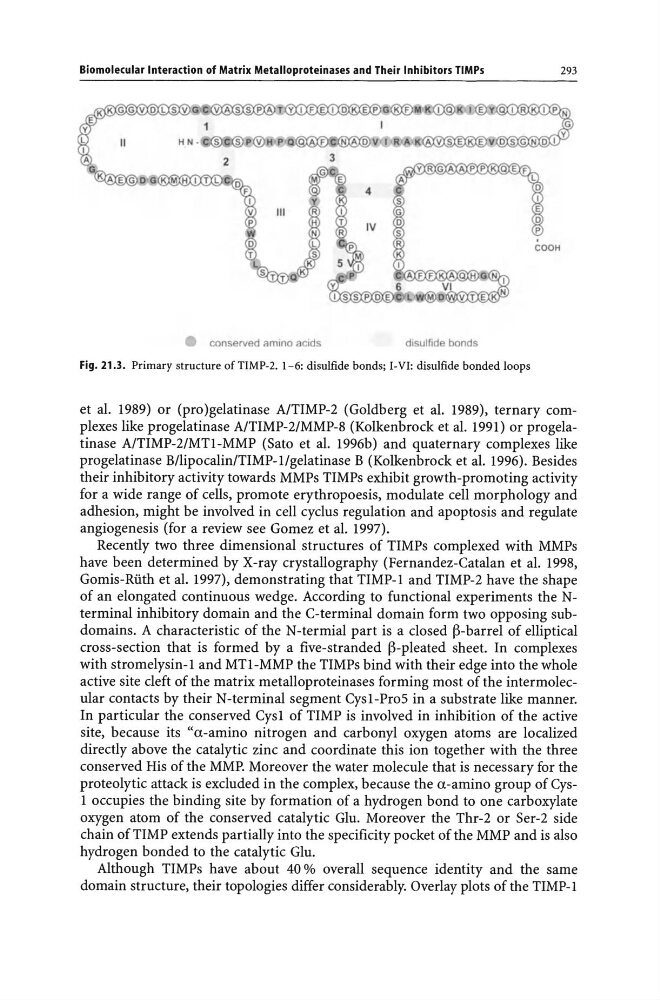
Fig. 21.3. Primary structure of TIMP-2. 1-6: disulfide bonds; I-VI: disulfide bonded loops
et al. 1989) or (pro)gelatinase A/TIMP-2 (Goldberg et al. 1989), ternary complexes like progelatinase A/TIMP-2/MMP-8 (Kolkenbrock et al. 1991) or progelatinase A/TIMP-2/MTl-MMP (Sato et al. 1996b) and quaternary complexes like
progelatinase B/lipocalin/TIMP-l/gelatinase B (Kolkenbrock et al. 1996). Besides
their inhibitory activity towards MMPs TIMPs exhibit growth-promoting activity
for a wide range of cells, promote erythropoesis, modulate cell morphology and
adhesion, might be involved in cell cyclus regulation and apoptosis and regulate
angiogenesis (for a review see Gomez et al. 1997).
Recently two three dimensional structures of TIMPs complexed with MMPs
have been determined by X-ray crystallography (Fernandez-Catalan et al. 1998,
Gomis-Riith et al. 1997), demonstrating that TIMP-1 and TIMP-2 have the shape
of an elongated continuous wedge. According to functional experiments the Nterminal inhibitory domain and the C-terminal domain form two opposing subdomains. A characteristic of the N-termial part is a closed ~-barrel of elliptical
cross-section that is formed by a five-stranded ~-pleated sheet. In complexes
with stromelysin-1 and MTl-MMP the TIMPs bind with their edge into the whole
active site cleft of the matrix metalloproteinases forming most of the intermolecular contacts by their N-terminal segment Cys1-Pr05 in a substrate like manner.
In particular the conserved Cys1 of TIMP is involved in inhibition of the active
site, because its "a-amino nitrogen and carbonyl oxygen atoms are localized
directly above the catalytic zinc and coordinate this ion together with the three
conserved His of the MMP. Moreover the water molecule that is necessary for the
proteolytic attack is excluded in the complex, because the a-amino group of Cys1 occupies the binding site by formation of a hydrogen bond to one carboxylate
oxygen atom of the conserved catalytic Glu. Moreover the Thr-2 or Ser-2 side
chain of TIMP extends partially into the specificity pocket of the MMP and is also
hydrogen bonded to the catalytic Glu.
Although TIMPs have about 40 % overall sequence identity and the same
domain structure, their topologies differ considerably. Overlay plots of the TIMP-1
293
VASSPA
YIFEID
EP
KF
v S E
2
3
Y R G A A P P K a E F
L
o
I
E
o
P
COOH
AFFKA
H
N,
VI
V T E K N
•
conserved amino acids
disulfide bonds
Fig. 21.3. Primary structure of TIMP-2. 1-6: disulfide bonds; I-VI: disulfide bonded loops
et al. 1989) or (pro)gelatinase A/TIMP-2 (Goldberg et al. 1989), ternary complexes like progelatinase A/TIMP-2/MMP-8 (Kolkenbrock et al. 1991) or progelatinase A/TIMP-2/MTl-MMP (Sato et al. 1996b) and quaternary complexes like
progelatinase B/lipocalin/TIMP-l/gelatinase B (Kolkenbrock et al. 1996). Besides
their inhibitory activity towards MMPs TIMPs exhibit growth-promoting activity
for a wide range of cells, promote erythropoesis, modulate cell morphology and
adhesion, might be involved in cell cyclus regulation and apoptosis and regulate
angiogenesis (for a review see Gomez et al. 1997).
Recently two three dimensional structures of TIMPs complexed with MMPs
have been determined by X-ray crystallography (Fernandez-Catalan et al. 1998,
Gomis-Riith et al. 1997), demonstrating that TIMP-1 and TIMP-2 have the shape
of an elongated continuous wedge. According to functional experiments the Nterminal inhibitory domain and the C-terminal domain form two opposing subdomains. A characteristic of the N-termial part is a closed ~-barrel of elliptical
cross-section that is formed by a five-stranded ~-pleated sheet. In complexes
with stromelysin-1 and MTl-MMP the TIMPs bind with their edge into the whole
active site cleft of the matrix metalloproteinases forming most of the intermolecular contacts by their N-terminal segment Cys1-Pr05 in a substrate like manner.
In particular the conserved Cys1 of TIMP is involved in inhibition of the active
site, because its "a-amino nitrogen and carbonyl oxygen atoms are localized
directly above the catalytic zinc and coordinate this ion together with the three
conserved His of the MMP. Moreover the water molecule that is necessary for the
proteolytic attack is excluded in the complex, because the a-amino group of Cys1 occupies the binding site by formation of a hydrogen bond to one carboxylate
oxygen atom of the conserved catalytic Glu. Moreover the Thr-2 or Ser-2 side
chain of TIMP extends partially into the specificity pocket of the MMP and is also
hydrogen bonded to the catalytic Glu.
Although TIMPs have about 40 % overall sequence identity and the same
domain structure, their topologies differ considerably. Overlay plots of the TIMP-1