

Protein Sequencing or Genome Sequencing
17
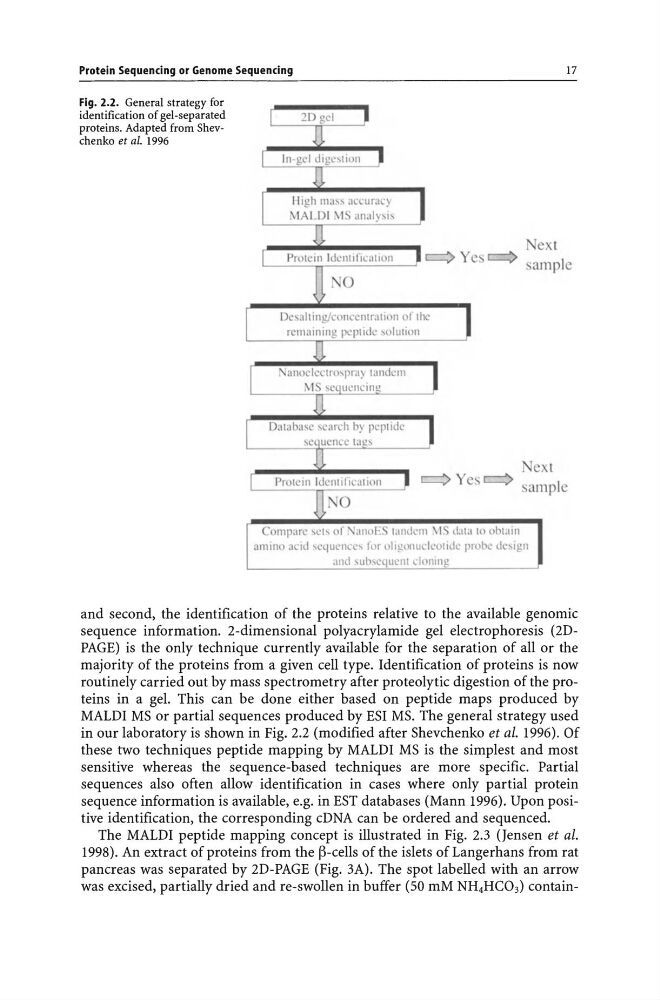
Fig. 2.2. General strategy for
identification of gel-separated
proteins. Adapted from Shevchenko et al. 1996
ext
c:::::> Yc ' c=:> . ample
ex l
c::::::::> Y s c:::::> sample
omparc \~h or 'Jallll!'S I;il1tiCI11 \1. (Lila III ohlain
amino acid \~4l1CIK' C' I'or 1l11~llnul'klllld~ probe dC'lgn
;lIld ,ub,cquCI1I dnning
and second, the identification of the proteins relative to the available genomic
sequence information. 2-dimensional polyacrylamide gel electrophoresis (2DPAGE) is the only technique currently available for the separation of all or the
majority of the proteins from a given cell type. Identification of proteins is now
routinely carried out by mass spectrometry after proteolytic digestion of the proteins in a gel. This can be done either based on peptide maps produced by
MALDI MS or partial sequences produced by ESI MS. The general strategy used
in our laboratory is shown in Fig. 2.2 (modified after Shevchenko et al. 1996). Of
these two techniques peptide mapping by MALDI MS is the simplest and most
sensitive whereas the sequence-based techniques are more specific. Partial
sequences also often allow identification in cases where only partial protein
sequence information is available, e.g. in EST databases (Mann 1996). Upon positive identification, the corresponding cDNA can be ordered and sequenced.
The MALDI peptide mapping concept is illustrated in Fig. 2.3 (Jensen et al.
1998). An extract of proteins from the ~-cells of the islets of Langerhans from rat
pancreas was separated by 2D-PAGE (Fig. 3A). The spot labelled with an arrow
was excised, partially dried and re-swollen in buffer (50 mM NH4HC03) contain-
17
Fig. 2.2. General strategy for
identification of gel-separated
proteins. Adapted from Shevchenko et al. 1996
ext
c:::::> Yc ' c=:> . ample
ex l
c::::::::> Y s c:::::> sample
omparc \~h or 'Jallll!'S I;il1tiCI11 \1. (Lila III ohlain
amino acid \~4l1CIK' C' I'or 1l11~llnul'klllld~ probe dC'lgn
;lIld ,ub,cquCI1I dnning
and second, the identification of the proteins relative to the available genomic
sequence information. 2-dimensional polyacrylamide gel electrophoresis (2DPAGE) is the only technique currently available for the separation of all or the
majority of the proteins from a given cell type. Identification of proteins is now
routinely carried out by mass spectrometry after proteolytic digestion of the proteins in a gel. This can be done either based on peptide maps produced by
MALDI MS or partial sequences produced by ESI MS. The general strategy used
in our laboratory is shown in Fig. 2.2 (modified after Shevchenko et al. 1996). Of
these two techniques peptide mapping by MALDI MS is the simplest and most
sensitive whereas the sequence-based techniques are more specific. Partial
sequences also often allow identification in cases where only partial protein
sequence information is available, e.g. in EST databases (Mann 1996). Upon positive identification, the corresponding cDNA can be ordered and sequenced.
The MALDI peptide mapping concept is illustrated in Fig. 2.3 (Jensen et al.
1998). An extract of proteins from the ~-cells of the islets of Langerhans from rat
pancreas was separated by 2D-PAGE (Fig. 3A). The spot labelled with an arrow
was excised, partially dried and re-swollen in buffer (50 mM NH4HC03) contain-