

16
P. ROEPSTORFF
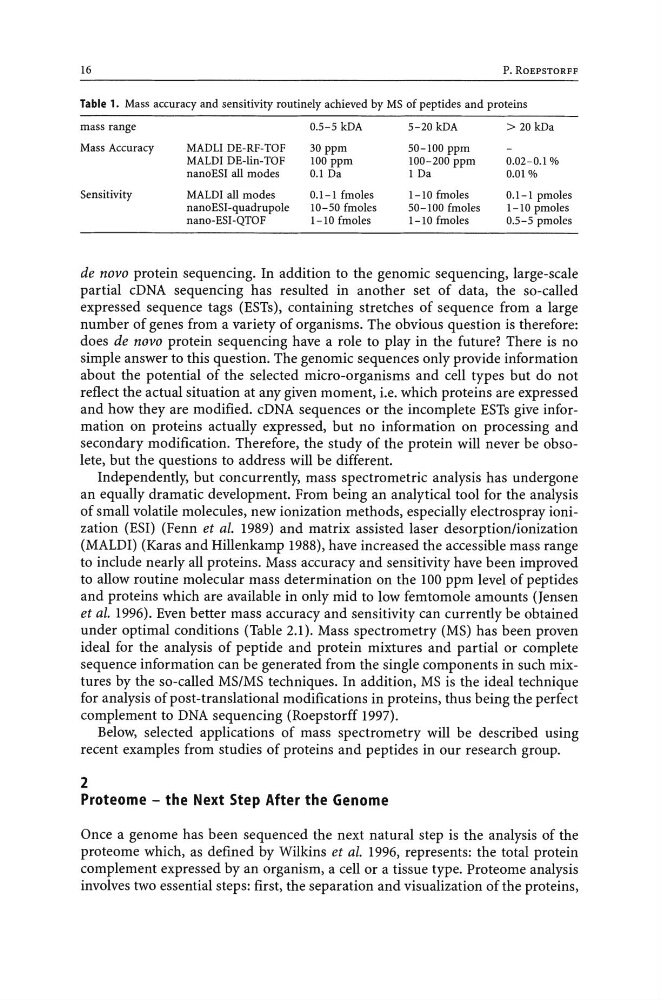
Table 1. Mass accuracy and sensitivity routinely achieved by MS of peptides and proteins
mass range
0.5-5 kDA
5-20 kDA
> 20 kDa
Mass Accuracy
MADLI DE-RF-TOF
30 ppm
50-100 ppm
MALD! DE-lin-TOF
100 ppm
100- 200 ppm
0.02-0.1 %
nanoES! all modes
0.1 Da
1 Da
0.01 %
Sensitivity
MALDI all modes
0.1- 1 fmoles
1-10 fmoles
0.1-1 pmoles
nanoESI-quadrupole
10-50 fmoles
50 -1 00 fmoles
1-10 pmoles
nano-ESI-QTOF
1-10 fmoles
1-10 fmoles
0.5-5 pmoles
de novo protein sequencing. In addition to the genomic sequencing, large-scale
partial cDNA sequencing has resulted in another set of data, the so-called
expressed sequence tags (ESTs), containing stretches of sequence from a large
number of genes from a variety of organisms. The obvious question is therefore:
does de novo protein sequencing have a role to play in the future? There is no
simple answer to this question. The genomic sequences only provide information
about the potential of the selected micro-organisms and cell types but do not
reflect the actual situation at any given moment, i.e. which proteins are expressed
and how they are modified. cDNA sequences or the incomplete ESTs give information on proteins actually expressed, but no information on processing and
secondary modification. Therefore, the study of the protein will never be obsolete, but the questions to address will be different.
Independently, but concurrently, mass spectrometric analysis has undergone
an equally dramatic development. From being an analytical tool for the analysis
of small volatile molecules, new ionization methods, especially electrospray ionization (ESI) (Fenn et al. 1989) and matrix assisted laser desorption/ionization
(MALDI) (Karas and Hillenkamp 1988), have increased the accessible mass range
to include nearly all proteins. Mass accuracy and sensitivity have been improved
to allow routine molecular mass determination on the 100 ppm level of pep tides
and proteins which are available in only mid to low femtomole amounts (Jensen
et ai. 1996). Even better mass accuracy and sensitivity can currently be obtained
under optimal conditions (Table 2.1). Mass spectrometry (MS) has been proven
ideal for the analysis of peptide and protein mixtures and partial or complete
sequence information can be generated from the single components in such mixtures by the so-called MS/MS techniques. In addition, MS is the ideal technique
for analysis of post-translational modifications in proteins, thus being the perfect
complement to DNA sequencing (Roepstorff 1997).
Below, selected applications of mass spectrometry will be described using
recent examples from studies of proteins and peptides in our research group.
2
Proteome - the Next Step After the Genome
Once a genome has been sequenced the next natural step is the analysis of the
proteome which, as defined by Wilkins et al. 1996, represents: the total protein
complement expressed by an organism, a cell or a tissue type. Proteome analysis
involves two essential steps: first, the separation and visualization of the proteins,
P. ROEPSTORFF
Table 1. Mass accuracy and sensitivity routinely achieved by MS of peptides and proteins
mass range
0.5-5 kDA
5-20 kDA
> 20 kDa
Mass Accuracy
MADLI DE-RF-TOF
30 ppm
50-100 ppm
MALD! DE-lin-TOF
100 ppm
100- 200 ppm
0.02-0.1 %
nanoES! all modes
0.1 Da
1 Da
0.01 %
Sensitivity
MALDI all modes
0.1- 1 fmoles
1-10 fmoles
0.1-1 pmoles
nanoESI-quadrupole
10-50 fmoles
50 -1 00 fmoles
1-10 pmoles
nano-ESI-QTOF
1-10 fmoles
1-10 fmoles
0.5-5 pmoles
de novo protein sequencing. In addition to the genomic sequencing, large-scale
partial cDNA sequencing has resulted in another set of data, the so-called
expressed sequence tags (ESTs), containing stretches of sequence from a large
number of genes from a variety of organisms. The obvious question is therefore:
does de novo protein sequencing have a role to play in the future? There is no
simple answer to this question. The genomic sequences only provide information
about the potential of the selected micro-organisms and cell types but do not
reflect the actual situation at any given moment, i.e. which proteins are expressed
and how they are modified. cDNA sequences or the incomplete ESTs give information on proteins actually expressed, but no information on processing and
secondary modification. Therefore, the study of the protein will never be obsolete, but the questions to address will be different.
Independently, but concurrently, mass spectrometric analysis has undergone
an equally dramatic development. From being an analytical tool for the analysis
of small volatile molecules, new ionization methods, especially electrospray ionization (ESI) (Fenn et al. 1989) and matrix assisted laser desorption/ionization
(MALDI) (Karas and Hillenkamp 1988), have increased the accessible mass range
to include nearly all proteins. Mass accuracy and sensitivity have been improved
to allow routine molecular mass determination on the 100 ppm level of pep tides
and proteins which are available in only mid to low femtomole amounts (Jensen
et ai. 1996). Even better mass accuracy and sensitivity can currently be obtained
under optimal conditions (Table 2.1). Mass spectrometry (MS) has been proven
ideal for the analysis of peptide and protein mixtures and partial or complete
sequence information can be generated from the single components in such mixtures by the so-called MS/MS techniques. In addition, MS is the ideal technique
for analysis of post-translational modifications in proteins, thus being the perfect
complement to DNA sequencing (Roepstorff 1997).
Below, selected applications of mass spectrometry will be described using
recent examples from studies of proteins and peptides in our research group.
2
Proteome - the Next Step After the Genome
Once a genome has been sequenced the next natural step is the analysis of the
proteome which, as defined by Wilkins et al. 1996, represents: the total protein
complement expressed by an organism, a cell or a tissue type. Proteome analysis
involves two essential steps: first, the separation and visualization of the proteins,