

222
G. V ANDERHEEREN and 1. HANSSENS
labeled the protein with the interacting dye, which allows observations at relatively low free dye concentrations. As explained in Materials and Methods, by
photo labelling and chromatography, we obtained a sample with 3.3 bis-ANS molecules irreversibly bound per Ca 2 + -GLA molecule. Although the number of
bound probe molecules is larger than for apo-GLA at saturation, the far-UV CD
spectrum of the labeled Ca 2 + -GLA.bis-ANS complex (Fig. 15.6 A) shows the typical shape observed for native GLA with conserved secondary structure elements.
Similarly, the residual ellipticity in the near-UV (Fig. 15.6 B) indicates that the
bound dye molecules only partially disrupt the tertiary structure. The stability of
the tertiary structure of this bis-ANS-Iabeled Ca 2 +-GLA is lowered as shown by
the decrease in the transition temperature from 70°C to 62°C (Fig. 15.4, open circles).
4.5
Fluorescence Energy Transfer
Because of the endothermic character of the hydrophobic interaction, the smaller
effect that bis-ANS has on the conformation in the presence of Ca 2 + than in its
absence, directly results from the higher temperature at which the data are
obtained. The smaller perturbations of Ca 2 + -GLA rather result from a reduction
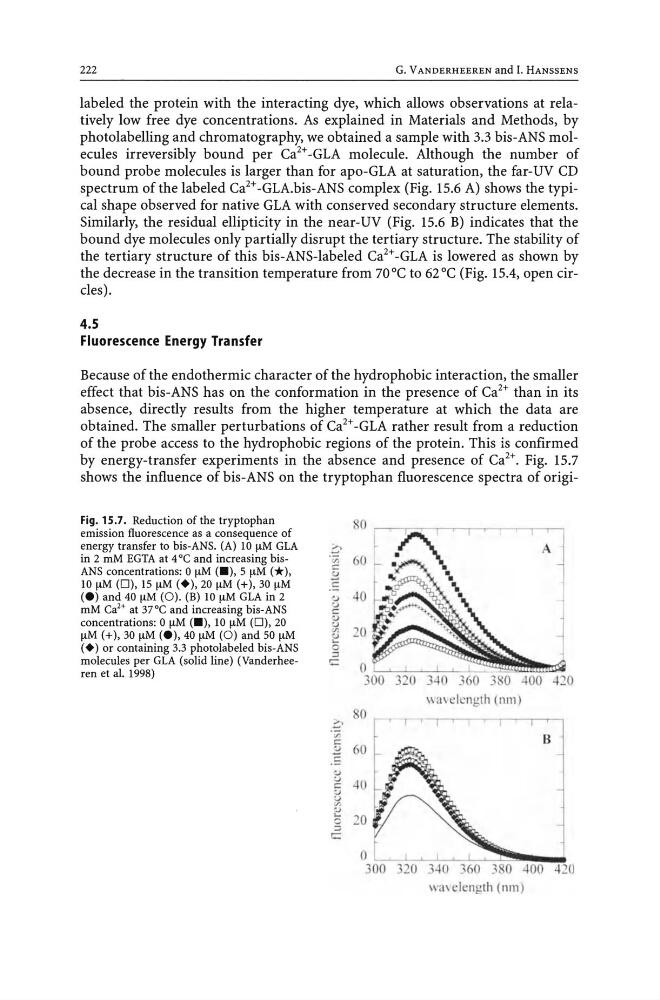
of the probe access to the hydrophobic regions of the protein. This is confirmed
by energy-transfer experiments in the absence and presence of Ca 2 +. Fig. 15.7
shows the influence of bis-ANS on the tryptophan fluorescence spectra of origiFig. 15.7. Reduction of the tryptophan
emission fluorescence as a consequence of
energy transfer to bis-ANS. (A) 10 IlM GLA
in 2 mM EGTA at 4 DC and increasing bisANS concentrations: 0 IlM (_), 5 IlM (*),
10 IlM (0), 15 IlM (.), 20 IlM (+), 30 IlM
(e) and 40 IlM (0). (B) 10 IlM GLA in 2
mM Ca 2 + at 37 D C and increasing bis-ANS
concentrations: 0 IlM (_), 10 IlM (0), 20
IlM (+), 30 IlM (e), 40 IlM (0) and 50 IlM
(.) or containing 3.3 photolabeled bis-ANS
molecules per GLA (solid line) (Vanderheeren et aI. 1998)
.::.;:;;
3 c:
0
;::!
()
u
$J
a ::>
c
::;>
.;:;;
c:
u
C
u
u
c:
u
u
V'>
'-' ....
0
:::::
C
40
20
..f20
wU \ Cknglh (nm)
0
B
60
0
300
~~~~~~~~
320 3·W
420
WU\ eicnglh (nm )
G. V ANDERHEEREN and 1. HANSSENS
labeled the protein with the interacting dye, which allows observations at relatively low free dye concentrations. As explained in Materials and Methods, by
photo labelling and chromatography, we obtained a sample with 3.3 bis-ANS molecules irreversibly bound per Ca 2 + -GLA molecule. Although the number of
bound probe molecules is larger than for apo-GLA at saturation, the far-UV CD
spectrum of the labeled Ca 2 + -GLA.bis-ANS complex (Fig. 15.6 A) shows the typical shape observed for native GLA with conserved secondary structure elements.
Similarly, the residual ellipticity in the near-UV (Fig. 15.6 B) indicates that the
bound dye molecules only partially disrupt the tertiary structure. The stability of
the tertiary structure of this bis-ANS-Iabeled Ca 2 +-GLA is lowered as shown by
the decrease in the transition temperature from 70°C to 62°C (Fig. 15.4, open circles).
4.5
Fluorescence Energy Transfer
Because of the endothermic character of the hydrophobic interaction, the smaller
effect that bis-ANS has on the conformation in the presence of Ca 2 + than in its
absence, directly results from the higher temperature at which the data are
obtained. The smaller perturbations of Ca 2 + -GLA rather result from a reduction
of the probe access to the hydrophobic regions of the protein. This is confirmed
by energy-transfer experiments in the absence and presence of Ca 2 +. Fig. 15.7
shows the influence of bis-ANS on the tryptophan fluorescence spectra of origiFig. 15.7. Reduction of the tryptophan
emission fluorescence as a consequence of
energy transfer to bis-ANS. (A) 10 IlM GLA
in 2 mM EGTA at 4 DC and increasing bisANS concentrations: 0 IlM (_), 5 IlM (*),
10 IlM (0), 15 IlM (.), 20 IlM (+), 30 IlM
(e) and 40 IlM (0). (B) 10 IlM GLA in 2
mM Ca 2 + at 37 D C and increasing bis-ANS
concentrations: 0 IlM (_), 10 IlM (0), 20
IlM (+), 30 IlM (e), 40 IlM (0) and 50 IlM
(.) or containing 3.3 photolabeled bis-ANS
molecules per GLA (solid line) (Vanderheeren et aI. 1998)
.::.;:;;
3 c:
0
;::!
()
u
$J
a ::>
c
::;>
.;:;;
c:
u
C
u
u
c:
u
u
V'>
'-' ....
0
:::::
C
40
20
..f20
wU \ Cknglh (nm)
0
B
60
0
300
~~~~~~~~
320 3·W
420
WU\ eicnglh (nm )