

The Perception of Hydrophobic Clusters in the Native and Partially Unfolded States
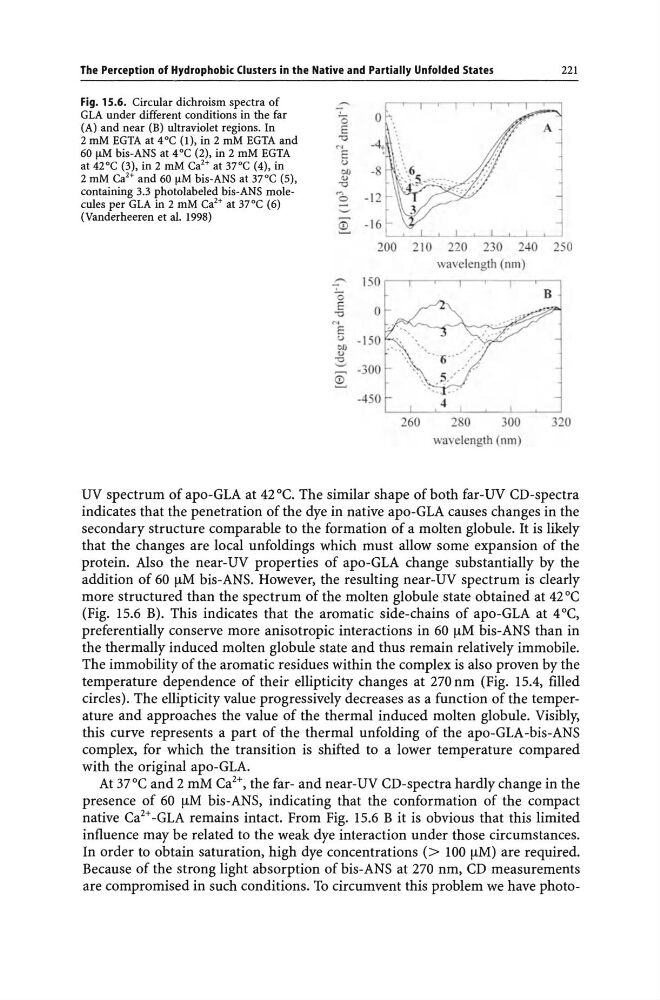
Fig. , 5.6. Circular dichroism spectra of
GLA under different conditions in the far
(A) and near (B) ultraviolet regions. In
2 mM EGTA at 4°C (1), in 2 mM EGTA and
60 flM bis-ANS at 4°C (2), in 2 mM EGTA
at 42°C (3), in 2 mM Ca2+ at 37°C (4), in
2 mM Ca2+ and 60 flM bis-ANS at 37°C (5),
containing 3.3 photolabeled bis-ANS molecules per GLA in 2 mM Ca2+ at 37°C (6)
(Vanderheeren et al. 1998)
---0
E
"0
NE
<.)
OIl
<>
-0
,...
0
0'
1:'
'-0
E
-0
N
E
u
oJ)
.,
~
~
-8
-12
- 16
200 210 220 230 240
wavelength ( nm)
150
0
4
260
2 0
300
wavelength (nm)
221
250
B
320
UV spectrum of apo-GLA at 42°C. The similar shape of both far-UV CD-spectra
indicates that the penetration of the dye in native apo-GLA causes changes in the
secondary structure comparable to the formation of a molten globule. It is likely
that the changes are local unfoldings which must allow some expansion of the
protein. Also the near-UV properties of apo-GLA change substantially by the
addition of 60 !lM bis-ANS. However, the resulting near-UV spectrum is clearly
more structured than the spectrum of the molten globule state obtained at 42°C
(Fig. 15.6 B). This indicates that the aromatic side-chains of apo-GLA at 4°C,
preferentially conserve more anisotropic interactions in 60 !lM bis-ANS than in
the thermally induced molten globule state and thus remain relatively immobile.
The immobility of the aromatic residues within the complex is also proven by the
temperature dependence of their ellipticity changes at 270 nm (Fig. 15.4, filled
circles). The ellipticity value progressively decreases as a function of the temperature and approaches the value of the thermal induced molten globule. Visibly,
this curve represents a part of the thermal unfolding of the apo-GLA-bis-ANS
complex, for which the transition is shifted to a lower temperature compared
with the original apo-GLA.
At 37°C and 2 mM Ca 2 +, the far- and near-UV CD-spectra hardly change in the
presence of 60 !lM bis-ANS, indicating that the conformation of the compact
native Ca 2 +-GLA remains intact. From Fig. 15.6 B it is obvious that this limited
influence may be related to the weak dye interaction under those circumstances.
In order to obtain saturation, high dye concentrations (> 100 !lM) are required.
Because of the strong light absorption of bis-ANS at 270 nm, CD measurements
are compromised in such conditions. To circumvent this problem we have photo-
Fig. , 5.6. Circular dichroism spectra of
GLA under different conditions in the far
(A) and near (B) ultraviolet regions. In
2 mM EGTA at 4°C (1), in 2 mM EGTA and
60 flM bis-ANS at 4°C (2), in 2 mM EGTA
at 42°C (3), in 2 mM Ca2+ at 37°C (4), in
2 mM Ca2+ and 60 flM bis-ANS at 37°C (5),
containing 3.3 photolabeled bis-ANS molecules per GLA in 2 mM Ca2+ at 37°C (6)
(Vanderheeren et al. 1998)
---0
E
"0
NE
<.)
OIl
<>
-0
,...
0
0'
1:'
'-0
E
-0
N
E
u
oJ)
.,
~
~
-8
-12
- 16
200 210 220 230 240
wavelength ( nm)
150
0
4
260
2 0
300
wavelength (nm)
221
250
B
320
UV spectrum of apo-GLA at 42°C. The similar shape of both far-UV CD-spectra
indicates that the penetration of the dye in native apo-GLA causes changes in the
secondary structure comparable to the formation of a molten globule. It is likely
that the changes are local unfoldings which must allow some expansion of the
protein. Also the near-UV properties of apo-GLA change substantially by the
addition of 60 !lM bis-ANS. However, the resulting near-UV spectrum is clearly
more structured than the spectrum of the molten globule state obtained at 42°C
(Fig. 15.6 B). This indicates that the aromatic side-chains of apo-GLA at 4°C,
preferentially conserve more anisotropic interactions in 60 !lM bis-ANS than in
the thermally induced molten globule state and thus remain relatively immobile.
The immobility of the aromatic residues within the complex is also proven by the
temperature dependence of their ellipticity changes at 270 nm (Fig. 15.4, filled
circles). The ellipticity value progressively decreases as a function of the temperature and approaches the value of the thermal induced molten globule. Visibly,
this curve represents a part of the thermal unfolding of the apo-GLA-bis-ANS
complex, for which the transition is shifted to a lower temperature compared
with the original apo-GLA.
At 37°C and 2 mM Ca 2 +, the far- and near-UV CD-spectra hardly change in the
presence of 60 !lM bis-ANS, indicating that the conformation of the compact
native Ca 2 +-GLA remains intact. From Fig. 15.6 B it is obvious that this limited
influence may be related to the weak dye interaction under those circumstances.
In order to obtain saturation, high dye concentrations (> 100 !lM) are required.
Because of the strong light absorption of bis-ANS at 270 nm, CD measurements
are compromised in such conditions. To circumvent this problem we have photo-