

206
S. MENGE et al.
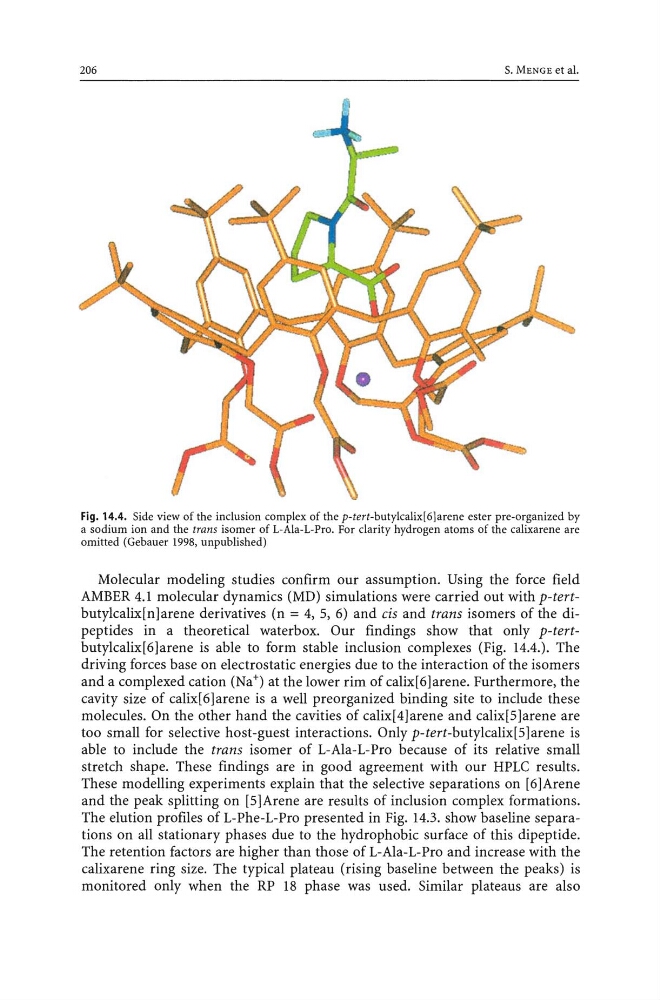
Fig. 14.4. Side view of the inclusion complex of the p-tert-butylcalix[61arene ester pre-organized by
a sodium ion and the trans isomer of L-Ala-L-Pro. For clarity hydrogen atoms of the calixarene are
omitted (Gebauer 1998, unpublished)
Molecular modeling studies confirm our assumption. Using the force field
AMBER 4.1 molecular dynamics (MD) simulations were carried out with p-tertbutylcalix[n]arene derivatives (n = 4, 5, 6) and cis and trans isomers of the dipeptides in a theoretical waterbox. Our findings show that only p-tertbutylcalix[6]arene is able to form stable inclusion complexes (Fig. 14.4.). The
driving forces base on electrostatic energies due to the interaction of the isomers
and a complexed cation (Na+) at the lower rim of calix[6]arene. Furthermore, the
cavity size of calix[ 6]arene is a well preorganized binding site to include these
molecules. On the other hand the cavities of calix[4]arene and calix[5]arene are
too small for selective host-guest interactions. Only p-tert-butylcalix[5]arene is
able to include the trans isomer of L-Ala-L-Pro because of its relative small
stretch shape. These findings are in good agreement with our HPLC results.
These modelling experiments explain that the selective separations on [6]Arene
and the peak splitting on [5]Arene are results of inclusion complex formations.
The elution profiles of L-Phe-L-Pro presented in Fig. 14.3. show baseline separations on all stationary phases due to the hydrophobic surface of this dipeptide.
The retention factors are higher than those of L-Ala-L-Pro and increase with the
calixarene ring size. The typical plateau (rising baseline between the peaks) is
monitored only when the RP 18 phase was used. Similar plateaus are also
S. MENGE et al.
Fig. 14.4. Side view of the inclusion complex of the p-tert-butylcalix[61arene ester pre-organized by
a sodium ion and the trans isomer of L-Ala-L-Pro. For clarity hydrogen atoms of the calixarene are
omitted (Gebauer 1998, unpublished)
Molecular modeling studies confirm our assumption. Using the force field
AMBER 4.1 molecular dynamics (MD) simulations were carried out with p-tertbutylcalix[n]arene derivatives (n = 4, 5, 6) and cis and trans isomers of the dipeptides in a theoretical waterbox. Our findings show that only p-tertbutylcalix[6]arene is able to form stable inclusion complexes (Fig. 14.4.). The
driving forces base on electrostatic energies due to the interaction of the isomers
and a complexed cation (Na+) at the lower rim of calix[6]arene. Furthermore, the
cavity size of calix[ 6]arene is a well preorganized binding site to include these
molecules. On the other hand the cavities of calix[4]arene and calix[5]arene are
too small for selective host-guest interactions. Only p-tert-butylcalix[5]arene is
able to include the trans isomer of L-Ala-L-Pro because of its relative small
stretch shape. These findings are in good agreement with our HPLC results.
These modelling experiments explain that the selective separations on [6]Arene
and the peak splitting on [5]Arene are results of inclusion complex formations.
The elution profiles of L-Phe-L-Pro presented in Fig. 14.3. show baseline separations on all stationary phases due to the hydrophobic surface of this dipeptide.
The retention factors are higher than those of L-Ala-L-Pro and increase with the
calixarene ring size. The typical plateau (rising baseline between the peaks) is
monitored only when the RP 18 phase was used. Similar plateaus are also