

Cavity Supported HPLC of Cis/Trans Isomers of Proline
E
=
:= ...
" "
~
i
~
::{
<:>
N
.)
(, 8
0 2 4
L- la-L-Pro
l
()
2 4 () S
~ 4 I> ~
"
L-Phe-L-Pro
-' l
. .
L...o.....I.... t....,...L......L ~
205
:I)
1
4 () g
4 I> S
.j I> 8
h )
()
1 II "0 10 0
1 II cO
() 4 Sic
(J.)
X 1 e l l ,) 8 12 0 .) 8 12
II,) 8 12
RPI
B-CD
r ljArcne
[4ji\renc
15JArcnc
161i\rcllc
ISI, \ rcnc
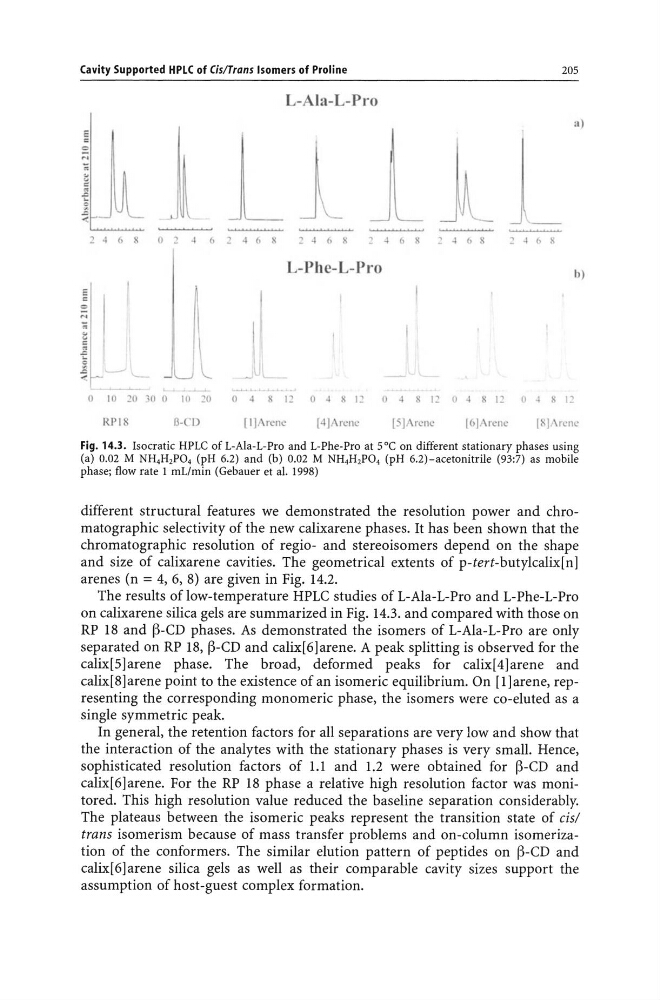
Fig. 14.3. [socratic HPLC of L-Ala-L-Pro and L-Phe-Pro at 5°C on different stationary phases using
(a) 0.02 M NH4H,P04 (pH 6.2) and (b) 0.02 M NH4H,P04 (pH 6.2)-acetonitrile (93:7) as mobile
phase; flow rate 1 mLlmin (Gebauer et aI. 1998)
different structural features we demonstrated the resolution power and chromatographic selectivity of the new calixarene phases. It has been shown that the
chromatographic resolution of regio- and stereoisomers depend on the shape
and size of calixarene cavities. The geometrical extents of p-tert-butylcalix[n]
arenes (n = 4, 6, 8) are given in Fig. 14.2.
The results of low-temperature HPLC studies of L-Ala-L-Pro and L-Phe-L-Pro
on calixarene silica gels are summarized in Fig. 14.3. and compared with those on
RP 18 and ~-CD phases. As demonstrated the isomers of L-Ala-L-Pro are only
separated on RP 18, ~-CD and calix[6]arene. A peak splitting is observed for the
calix[5]arene phase. The broad, deformed peaks for calix[4]arene and
calix[8]arene point to the existence of an isomeric equilibrium. On [l]arene, representing the corresponding monomeric phase, the isomers were co-eluted as a
single symmetric peak.
In general, the retention factors for all separations are very low and show that
the interaction of the analytes with the stationary phases is very small. Hence,
sophisticated resolution factors of 1.1 and 1.2 were obtained for ~-CD and
calix[ 6]arene. For the RP 18 phase a relative high resolution factor was monitored. This high resolution value reduced the baseline separation considerably.
The plateaus between the isomeric peaks represent the transition state of cis/
trans isomerism because of mass transfer problems and on-column isomerization of the conformers. The similar elution pattern of pep tides on ~-CD and
calix [ 6]arene silica gels as well as their comparable cavity sizes support the
assumption of host-guest complex formation.
E
=
:= ...
" "
~
i
~
::{
<:>
N
.)
(, 8
0 2 4
L- la-L-Pro
l
()
2 4 () S
~ 4 I> ~
"
L-Phe-L-Pro
-' l
. .
L...o.....I.... t....,...L......L ~
205
:I)
1
4 () g
4 I> S
.j I> 8
h )
()
1 II "0 10 0
1 II cO
() 4 Sic
(J.)
X 1 e l l ,) 8 12 0 .) 8 12
II,) 8 12
RPI
B-CD
r ljArcne
[4ji\renc
15JArcnc
161i\rcllc
ISI, \ rcnc
Fig. 14.3. [socratic HPLC of L-Ala-L-Pro and L-Phe-Pro at 5°C on different stationary phases using
(a) 0.02 M NH4H,P04 (pH 6.2) and (b) 0.02 M NH4H,P04 (pH 6.2)-acetonitrile (93:7) as mobile
phase; flow rate 1 mLlmin (Gebauer et aI. 1998)
different structural features we demonstrated the resolution power and chromatographic selectivity of the new calixarene phases. It has been shown that the
chromatographic resolution of regio- and stereoisomers depend on the shape
and size of calixarene cavities. The geometrical extents of p-tert-butylcalix[n]
arenes (n = 4, 6, 8) are given in Fig. 14.2.
The results of low-temperature HPLC studies of L-Ala-L-Pro and L-Phe-L-Pro
on calixarene silica gels are summarized in Fig. 14.3. and compared with those on
RP 18 and ~-CD phases. As demonstrated the isomers of L-Ala-L-Pro are only
separated on RP 18, ~-CD and calix[6]arene. A peak splitting is observed for the
calix[5]arene phase. The broad, deformed peaks for calix[4]arene and
calix[8]arene point to the existence of an isomeric equilibrium. On [l]arene, representing the corresponding monomeric phase, the isomers were co-eluted as a
single symmetric peak.
In general, the retention factors for all separations are very low and show that
the interaction of the analytes with the stationary phases is very small. Hence,
sophisticated resolution factors of 1.1 and 1.2 were obtained for ~-CD and
calix[ 6]arene. For the RP 18 phase a relative high resolution factor was monitored. This high resolution value reduced the baseline separation considerably.
The plateaus between the isomeric peaks represent the transition state of cis/
trans isomerism because of mass transfer problems and on-column isomerization of the conformers. The similar elution pattern of pep tides on ~-CD and
calix [ 6]arene silica gels as well as their comparable cavity sizes support the
assumption of host-guest complex formation.