

Cavity Supported HPLC of Cis/Trans Isomers of Proline
E
c
0
N
...
~
\:::l
;it
«!
§
0
r.n
~
«!
I )
i I
10
, !
2)
I
IU
J)
203
-' )
\
' ---I ' , , ' I
'"
I
10
TIMElmiol
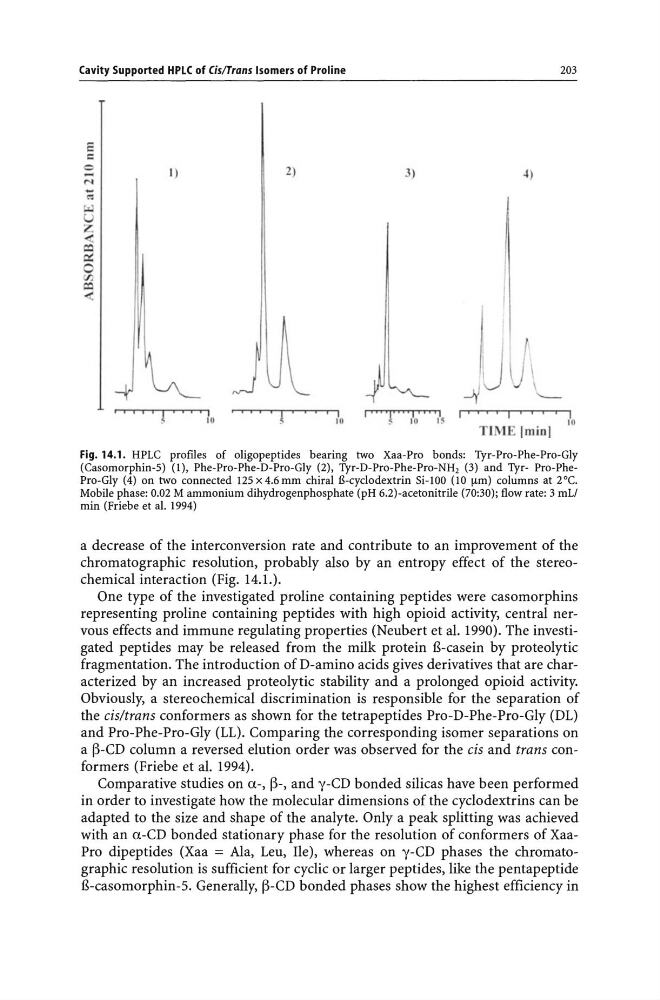
Fig. 14.1. HPLC profiles of oligopeptides bearing two Xaa-Pro bonds: Tyr-Pro-Phe-Pro-Gly
(Casomorphin-S) (1), Phe-Pro-Phe-D-Pro-Gly (2), Tyr-D-Pro-Phe-Pro-NH2 (3) and Tyr- Pro-PhePro-Gly (4) on two connected 12Sx4.6mm chiral B-cyclodextrin Si-IOO (10 ~m) columns at 2°C.
Mobile phase: 0.02 M ammonium dihydrogenphosphate (pH 6.2)-acetonitrile (70:30); flow rate: 3 mLl
min (Friebe et al. 1994)
a decrease of the interconversion rate and contribute to an improvement of the
chromatographic resolution, probably also by an entropy effect of the stereochemical interaction (Fig. 14.1.).
One type of the investigated proline containing peptides were casomorphins
representing proline containing peptides with high opioid activity, central nervous effects and immune regulating properties (Neubert et al. 1990). The investigated peptides may be released from the milk protein B-casein by proteolytic
fragmentation. The introduction of D-amino acids gives derivatives that are characterized by an increased proteolytic stability and a prolonged opioid activity.
Obviously, a stereochemical discrimination is responsible for the separation of
the cis/trans conformers as shown for the tetrapeptides Pro-D-Phe-Pro-Gly (DL)
and Pro-Phe-Pro-Gly (LL). Comparing the corresponding isomer separations on
a ~-CD column a reversed elution order was observed for the cis and trans conformers (Friebe et al. 1994).
Comparative studies on a-, ~-, and y-CD bonded silicas have been performed
in order to investigate how the molecular dimensions of the cyclodextrins can be
adapted to the size and shape of the analyte. Only a peak splitting was achieved
with an a-CD bonded stationary phase for the resolution of conformers of XaaPro dipeptides (Xaa = Ala, Leu, He), whereas on y-CD phases the chromatographic resolution is sufficient for cyclic or larger peptides, like the pentapeptide
B-casomorphin-5. Generally, ~-CD bonded phases show the highest efficiency in
E
c
0
N
...
~
\:::l
;it
«!
§
0
r.n
~
«!
I )
i I
10
, !
2)
I
IU
J)
203
-' )
\
' ---I ' , , ' I
'"
I
10
TIMElmiol
Fig. 14.1. HPLC profiles of oligopeptides bearing two Xaa-Pro bonds: Tyr-Pro-Phe-Pro-Gly
(Casomorphin-S) (1), Phe-Pro-Phe-D-Pro-Gly (2), Tyr-D-Pro-Phe-Pro-NH2 (3) and Tyr- Pro-PhePro-Gly (4) on two connected 12Sx4.6mm chiral B-cyclodextrin Si-IOO (10 ~m) columns at 2°C.
Mobile phase: 0.02 M ammonium dihydrogenphosphate (pH 6.2)-acetonitrile (70:30); flow rate: 3 mLl
min (Friebe et al. 1994)
a decrease of the interconversion rate and contribute to an improvement of the
chromatographic resolution, probably also by an entropy effect of the stereochemical interaction (Fig. 14.1.).
One type of the investigated proline containing peptides were casomorphins
representing proline containing peptides with high opioid activity, central nervous effects and immune regulating properties (Neubert et al. 1990). The investigated peptides may be released from the milk protein B-casein by proteolytic
fragmentation. The introduction of D-amino acids gives derivatives that are characterized by an increased proteolytic stability and a prolonged opioid activity.
Obviously, a stereochemical discrimination is responsible for the separation of
the cis/trans conformers as shown for the tetrapeptides Pro-D-Phe-Pro-Gly (DL)
and Pro-Phe-Pro-Gly (LL). Comparing the corresponding isomer separations on
a ~-CD column a reversed elution order was observed for the cis and trans conformers (Friebe et al. 1994).
Comparative studies on a-, ~-, and y-CD bonded silicas have been performed
in order to investigate how the molecular dimensions of the cyclodextrins can be
adapted to the size and shape of the analyte. Only a peak splitting was achieved
with an a-CD bonded stationary phase for the resolution of conformers of XaaPro dipeptides (Xaa = Ala, Leu, He), whereas on y-CD phases the chromatographic resolution is sufficient for cyclic or larger peptides, like the pentapeptide
B-casomorphin-5. Generally, ~-CD bonded phases show the highest efficiency in